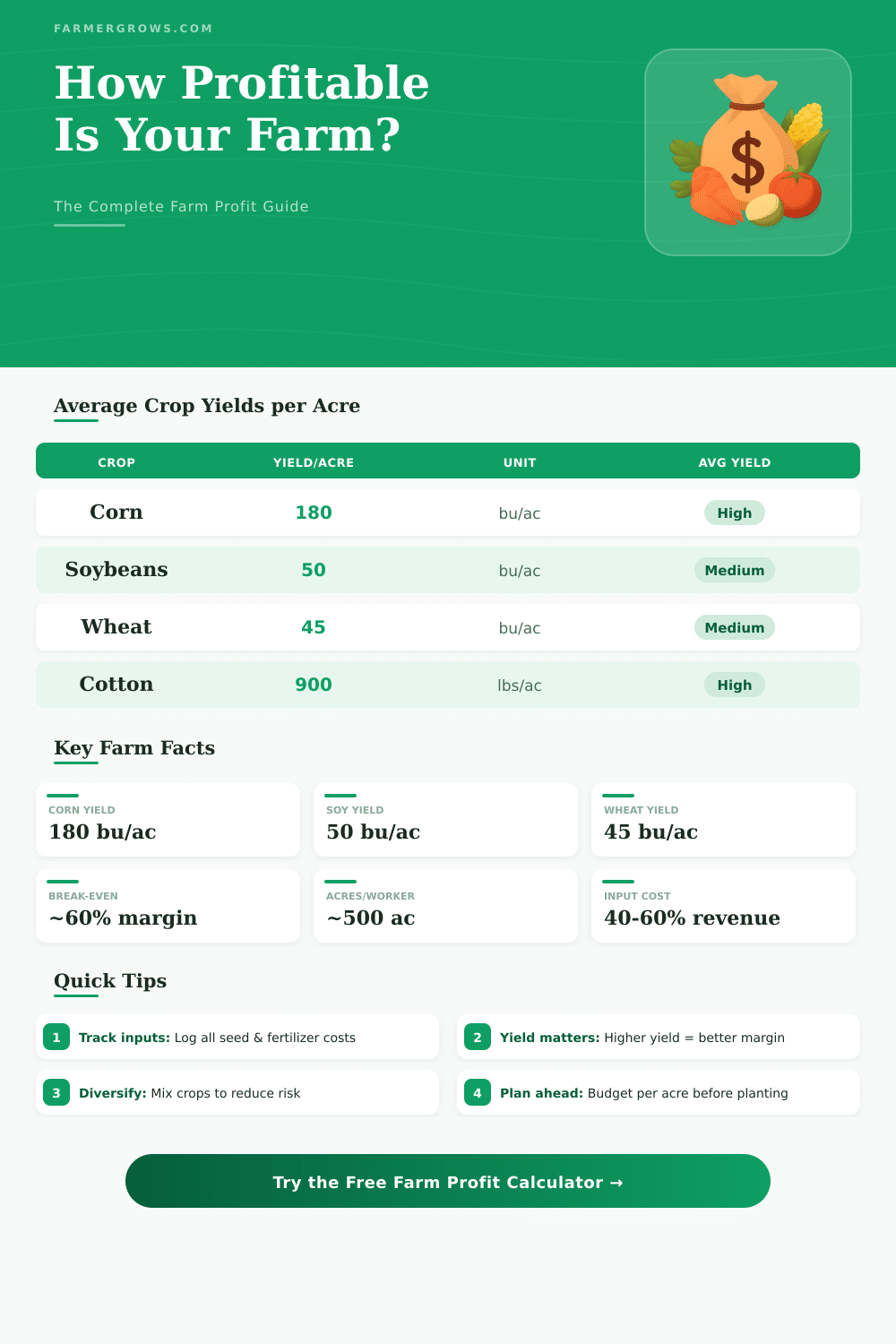
🌾 Farm Profit Calculator
Estimate net farm income by crop type, acreage, yield, and input costs
| Crop | Seed ($/ac) | Fertilizer ($/ac) | Total Inputs ($/ac) |
|---|---|---|---|
| Corn | $55–$85 | $100–$140 | $400–$600 |
| Soybeans | $40–$65 | $40–$70 | $200–$350 |
| Wheat | $18–$35 | $60–$90 | $150–$280 |
| Cotton | $50–$90 | $80–$130 | $450–$700 |
| Rice | $20–$40 | $90–$130 | $500–$800 |
| Canola | $25–$45 | $70–$110 | $200–$400 |
| Sorghum | $18–$35 | $60–$90 | $180–$320 |
| Barley | $15–$30 | $50–$80 | $150–$260 |
| Yield (bu/ac) | Revenue @$3.80/bu | Revenue @$5.00/bu | Revenue @$6.50/bu |
|---|---|---|---|
| 120 bu/ac | $456/ac | $600/ac | $780/ac |
| 150 bu/ac | $570/ac | $750/ac | $975/ac |
| 180 bu/ac | $684/ac | $900/ac | $1,170/ac |
| 200 bu/ac | $760/ac | $1,000/ac | $1,300/ac |
| 220 bu/ac | $836/ac | $1,100/ac | $1,430/ac |
| Imperial | Metric | Conversion Factor | Notes |
|---|---|---|---|
| 1 acre | 0.4047 ha | × 0.4047 | Area |
| 1 bushel corn | 25.40 kg | × 25.40 | 56 lbs/bu |
| 1 bushel soybean | 27.22 kg | × 27.22 | 60 lbs/bu |
| 1 bushel wheat | 27.22 kg | × 27.22 | 60 lbs/bu |
| 1 bushel barley | 21.77 kg | × 21.77 | 48 lbs/bu |
| 1 tonne | 2,204.6 lbs | × 2204.6 | Weight |
| 1 lb/ac | 1.121 kg/ha | × 1.121 | Yield |
| 1 bu/ac corn | 0.0628 t/ha | × 0.0628 | Yield |
Farm profit simply said is what stays after the rancher paid all his expenses. It shows the difference between the price of the products made and the expenses for the materials used for their creation. The income from farm work causes profit or loss during the whole year of farming.
The idea is simple, but applying it in the real world is a whole other thing.
How Farm Profit Works
Pure income from farm gives a general look about the profitable parts. In 2026, one projects it at 153.4 billion dollars, a decrease of 1.2 billion compared to 2025 in dollars without counting inflation. If one adjusts for inflation, the pure income will decline by 4.1 billion.
The gross cash income of farm, that is the annual amount before spending, carries cash incomes, incomes tied to farm and payments of government programs for farming. In 2026 dollars adjusting for inflation, the gross cash income of farm will reach 611.5 billiom, more than the 449.6 billion in 2005.
Business farms are those farms that have annual gross cash income of farm equal to or more than 350 000 dollars, or operations with less than that amount, but where the main work of the owner is farming.
Margins of profit in farming commonly stay very low. Work on farm is a hard task, and no one can escape that. The amount of work put in can be huge, while the prize stays quite small.
Small farms can give profit, but that will not be simpler then regular work in typical jobs. Everything depends on the time put in and on what one sells the products for. Growing usual vegetables and selling them to folks that want cheap food commonly ends in failure.
Crops that give only some hundreds of dollars per acre grow beside those that bring twenty to thirty thousand dollars per acre. The main factor for benefit is the market. If one grows corn, soy or wheat for a full market of commercial grain, one will probably lose money.
Special crops with direct sales can be profitable even on small land. Organic vegetables that restaurants want, flowers or even chickens can work well. Microgreens are ready for harvest in two to three weeks and can give more than fifteen dollars per pound.
Some owners of farms do not grow anything themselves. They have the ground and rent it to ranchers, getting money whether the season works or not. Costs for insurance, market, ads, transport and fees all shrink the income.
If one removes all expenses of 220 000 dollars in gross income, the pure profit reaches around 54 640 dollars, so 24.8 percent of the gross income. Strategy is very important. Old methods in farming maybe no longer give profit depending on the place.
Making money andbeing a good manager are key to staying ahead.