🌾 FS22 Crop Yield Calculator
Estimate your Farming Simulator 22 harvest output by field size, crop type, and growth bonuses
| Bonus Type | Multiplier | Notes | Stacks? |
|---|---|---|---|
| No Fertilizer | 0.5x (50%) | Half yield output | — |
| Fertilized 1x | 0.75x (75%) | Single application | — |
| Fertilized 2x | 1.0x (100%) | Full base yield | — |
| Lime Applied | +15% | Every 3 harvests | Yes |
| Plowed | +15% | Before planting | Yes |
| Weeded | Required | Reduces yield if skipped | — |
| Trailer Type | Capacity (L) | Capacity (gal) | Good For |
|---|---|---|---|
| Small Tipper | 10,000 | 2,642 | Under 1 ha grain |
| Medium Tipper | 20,000 | 5,283 | 1–2 ha grain |
| Large Tipper | 40,000 | 10,567 | 2–4 ha grain |
| Auger Wagon | 30,000 | 7,925 | Field transfer |
| Semi Trailer | 52,000 | 13,737 | Large hauls |
| Combine Hopper (avg) | 12,000 | 3,170 | Harvesting |
| Field Size | Wheat (L, 2x fert) | Corn (L, 2x fert) | Potatoes (L, 2x fert) |
|---|---|---|---|
| 0.5 ha (1.24 ac) | 4,400 | 5,600 | 21,000 |
| 1 ha (2.47 ac) | 8,800 | 11,200 | 42,000 |
| 2 ha (4.94 ac) | 17,600 | 22,400 | 84,000 |
| 3 ha (7.41 ac) | 26,400 | 33,600 | 126,000 |
| 5 ha (12.36 ac) | 44,000 | 56,000 | 210,000 |
| 10 ha (24.71 ac) | 88,000 | 112,000 | 420,000 |
| Hectares | Acres | Sq Meters | Sq Feet |
|---|---|---|---|
| 0.25 | 0.62 | 2,500 | 26,910 |
| 0.5 | 1.24 | 5,000 | 53,820 |
| 1.0 | 2.47 | 10,000 | 107,639 |
| 2.0 | 4.94 | 20,000 | 215,278 |
| 5.0 | 12.36 | 50,000 | 538,196 |
| 10.0 | 24.71 | 100,000 | 1,076,391 |
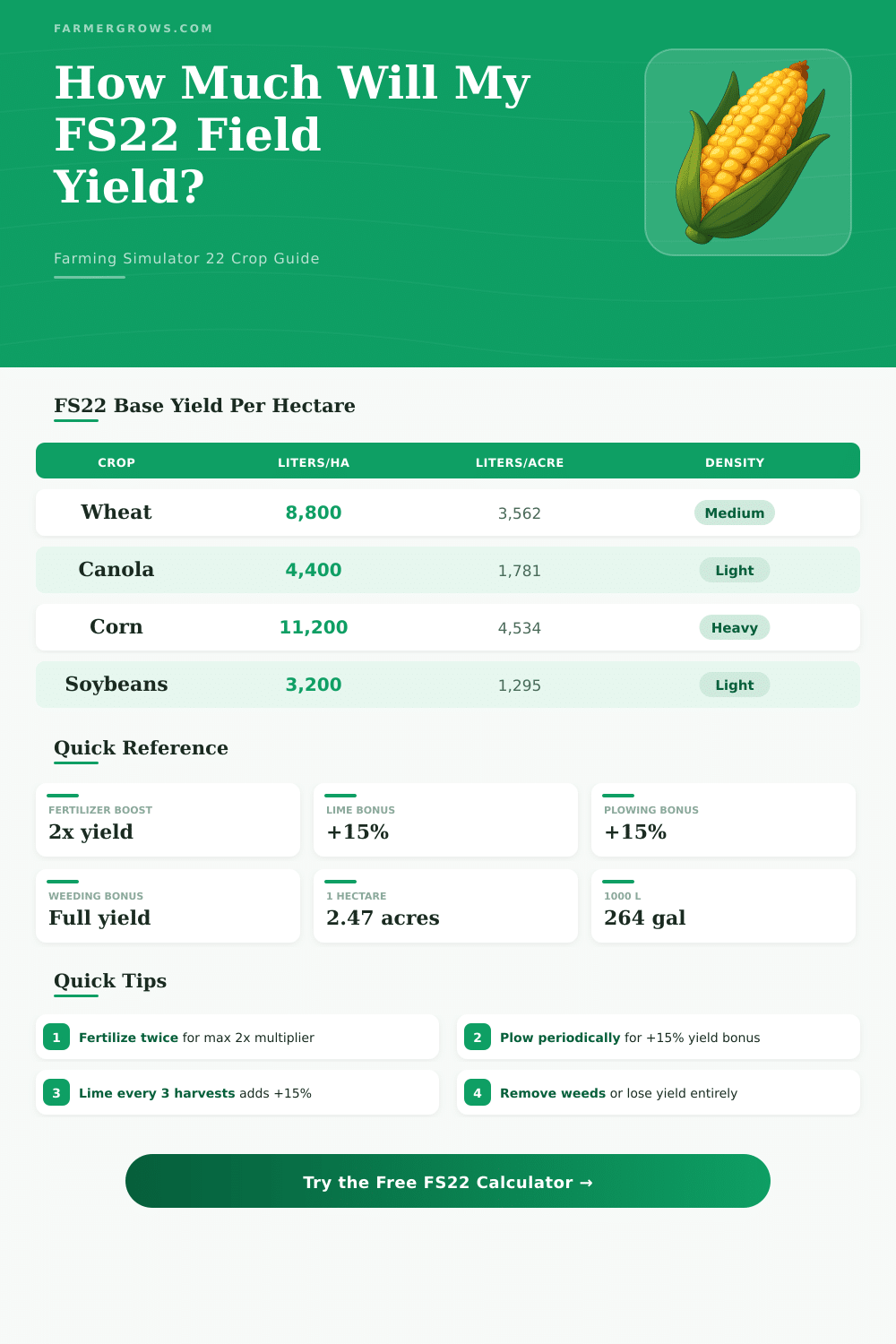
Wheat in FS22 gives quite a stable output, around 8 800 liters per hectare, when you well applied the dressing. In old units that matches to around 3 500 liters per acre. Even so corn truly beats everything, reaching more than 11 000 L/ha.
The root vegetables are simply wonderful: potatoes reach 42 000 and sugar beets even 52 000 liters per hectare. I had to check those figures the first time, when I saw them, they are truly impressive.
How to Get Better Crop Yields
Full potential output depends mainly on the input. If you fertilize twice, you reach 100% of the base. If you skip that, you end with only half.
Add a bit of lime and plowing, and you can push it to around 32% above the base, that gives a nice multiplier of 1.32 times. Canola has lower output at 4 400 L/ha, and beans are even worse at 3 200. But imagine a 5-hectare corn field well fertilized: it will produce aruond 74 000 liters, easily enough to fill two 40 000 L trailers.
The info below does not come from a calculator, but it is based on real experience of farmers and discussions in forums. Yield of crops is measured by how much one receives per unit of ground. So if a field gives X tons per hectare, that is the Yield.
One can look at that the same weigh. Those data about Yield are especially important for managing food security and ensuring that we grow enough to feed all.
Sometimes, even so, you find Yield gaps, the Crop simply does not reach the expected levels. There are many reasons, like sudden cold, dryness, pests, diseases, you name it. Because of that 24% to 39% of world main crops like corn, rice, wheat and beans either stall or directly decline occasionally.
One commonly misses one big factor: pollinators. Across various crops and regions, one third to two thirds of farms has fields that suffer because of lack of enough pollinators nearby. That is called “pollinating limit”.
We also saw big increases over years thanks to new things like better dressings, machines and farming methods. Testing of soil is a key first stage for naturally increasing Yield, it shows exactly your soil needs. Adding more organic material by means of something like manure, compost or worm compost can truly change things.
You need to reach the right mix of chemical dressings also.
Even so this whole climate change casts real surprise. Big heats do not damage as much as old models predicted. There is around 50% chance that rice Yield indeed will grow as the planet warms, because rice benefits from warmer nights.
But for other main crops, the risks of decline until 2100 range from around 70% to 90%. Oh no!
On the other hand, climate-controlled indoor farms are truly wonderful. Those high-tech greenhouses can produce so much Crop per acre as 10 traditional outdoor fields, and use 95% less water. More Yield, less ground, lesswater (what is not to love?
But you know), maximum Yield is not always the main target. Farmers must balance it against costs of input, if extra dressing or work for those last few percentages cost more than the extra Crop is worth, it simply does not pay. Rich clay-loam that keeps moisture but drains well, that is the ideal.
Rotation of crops is another tool that switches plants and crops to enrich the soil over time.