🌾 FS19 Crop Yield Calculator
Estimate your Farming Simulator 19 harvest output by field size, crop type, and growth bonuses
| Bonus Type | Multiplier | How to Activate | Frequency |
|---|---|---|---|
| Fertilizer Stage 1 | 2x base yield | Apply fertilizer, slurry, or manure once | Every harvest |
| Fertilizer Stage 2 | 3x base yield | Apply fertilizer a second time (different growth stage) | Every harvest |
| Weeding | +20% bonus | Use weeder or herbicide after sowing | Every harvest |
| Plowing | +15% bonus | Plow before planting | Every 3 harvests |
| Liming | +15% bonus | Apply lime to field | Every 3 harvests |
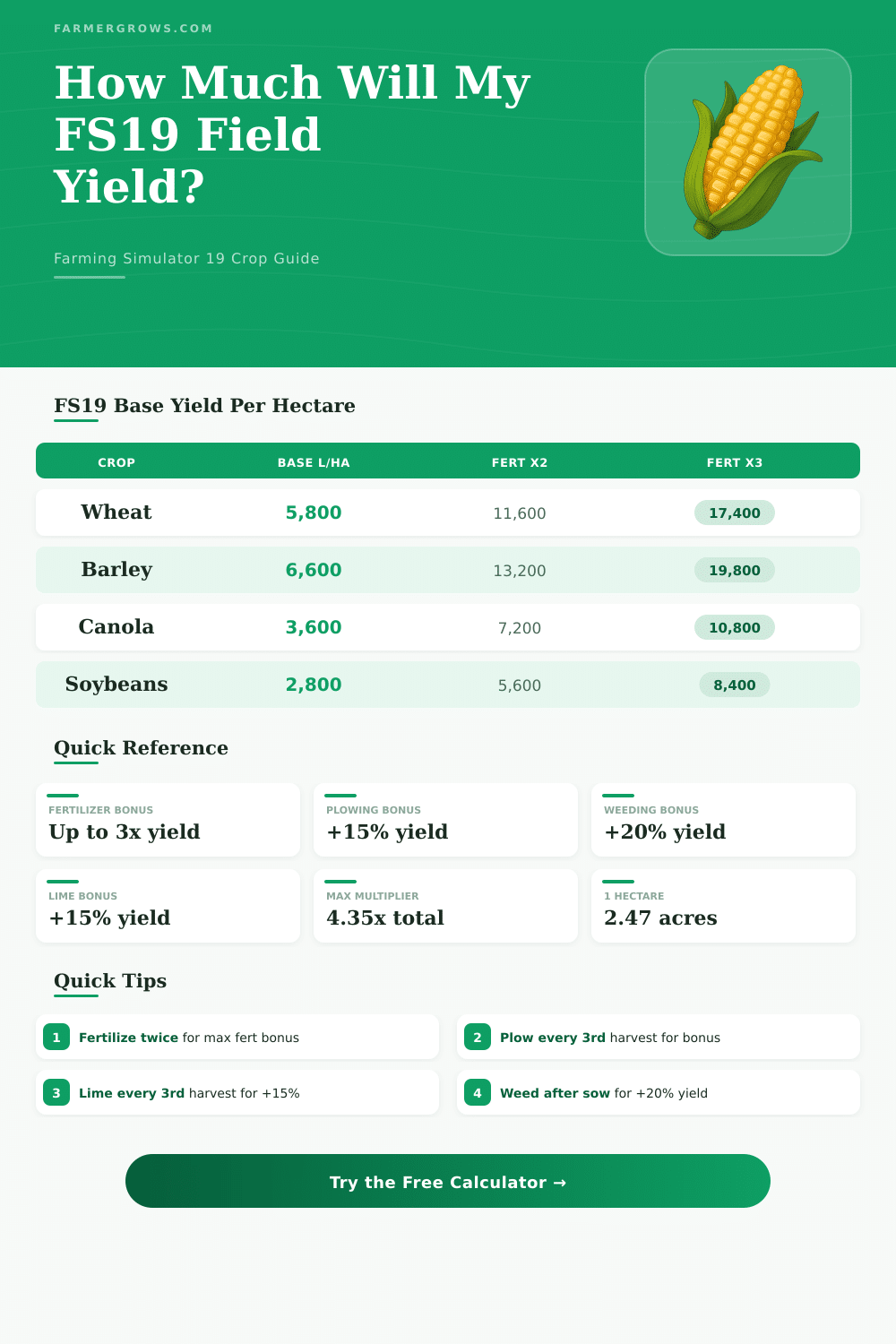
| Crop | Base L/ha | Fert 2x | Fert 3x | Max (all bonuses) |
|---|---|---|---|---|
| Wheat | 5,800 | 11,600 | 17,400 | 25,230 |
| Barley | 6,600 | 13,200 | 19,800 | 28,710 |
| Canola | 3,600 | 7,200 | 10,800 | 15,660 |
| Corn | 9,500 | 19,000 | 28,500 | 41,325 |
| Soybeans | 2,800 | 5,600 | 8,400 | 12,180 |
| Sunflowers | 3,800 | 7,600 | 11,400 | 16,530 |
| Potatoes | 22,000 | 44,000 | 66,000 | 95,700 |
| Sugar Beet | 34,000 | 68,000 | 102,000 | 147,900 |
| Oat | 5,500 | 11,000 | 16,500 | 23,925 |
| Cotton | 5,000 | 10,000 | 15,000 | 21,750 |
| Field Size | Hectares | Acres | Wheat Max Yield (L) |
|---|---|---|---|
| Small | 0.5 ha | 1.24 ac | 12,615 |
| Medium | 2 ha | 4.94 ac | 50,460 |
| Large | 5 ha | 12.36 ac | 126,150 |
| Very Large | 10 ha | 24.71 ac | 252,300 |
| Huge | 20 ha | 49.42 ac | 504,600 |
| Massive | 50 ha | 123.55 ac | 1,261,500 |
| Trailer Type | Capacity (L) | Loads for 5ha Wheat Max | Loads for 10ha Wheat Max |
|---|---|---|---|
| Small Tipper | 10,000 | ~13 loads | ~26 loads |
| Medium Tipper | 20,000 | ~7 loads | ~13 loads |
| Large Tipper | 36,000 | ~4 loads | ~7 loads |
| HKD 302 Auger Wagon | 50,000 | ~3 loads | ~6 loads |
| Large Semi | 60,000 | ~3 loads | ~5 loads |
In FS19, the basic amount of wheat per hectare is 5 800 liters, while order reach 6 600 outside. I did not expect that order surpass wheat like this clearly. Corn jumps to 9 500 basic, what is strong, but root plants do everything mad, potatoes reach 22 000 and sugar beets massively 34 000 L/ha.
Here almost triple compared to wheat runs from same soil.
Big Differences in Crop Yields and How to Improve Them
The highest multiplier, that I saw, are 4,35 times. One reaches that by means of full dressing in 3x, therefore weeding adds 20 percent, ploughing 15 percent and liming extra 15 percent. Like this 5-hectare wheat countryside in maximum runs give around 126 150 liters.
Apply same to sugar beet and you have around 1,48 million liters from 10 hectares. Not even talking about front loader transportation.
One hectare matches in 2,47 acres, 10 000 square metres. 36 000-litre front loader take maybe 4 loads for maxed 5-ha wheat countryside. For potatoes in that size?
You will need almost 27 loads with same tool. That is a hueg difference.
The info below do not come from calculator or translation tool. They base on real usage, looking back, forum chats and experiences of farming communities on the net.
Crop Yield measures, how many Crop grows on one area of ground. Simply said, it shows the harvested amount per unit of harvested space. So if countryside gives a certain amount of tons per hectare, that is the Yield.
Talk about seeds is other way to estimate that. Data about Crop Yield really matters to seize national food security and whether land produces enough food.
Yield loss happens, when countryside gives fewer harvest than one hoped. That can come because of many reasons, as late cold, bad weather, dryness, disease or pests. Above big areas of corn, rice, wheat and soy, the production either no improves, or decline or crash entirely.
It is serious cause, when world food needs will have too grow by a third in the coming three decades because of population growth, higher incomes and changing food habits.
Steps as usage of dressings, better farming tools and fresh ways helped to push Yield through the time. Testing of soil is the first key stage to naturally improve Crop Yield. It describes the state of the ground structure and reveals, what nutrients lack in the soil.
Add more carbon to the ground by means of animal manure, worm compost or city compost can help also. Matter to reduce or improve use of chemical dressings. Understand the microbiome of Crop and apply microbial products can reduce need of dressing and bug sprays without hurting the Yield.
Climate change is big element. Fresh research stripped, that gross heats can be less harmful for Crop Yield than old models assumed. There are around fifty percent chance, that world rice Yield actually will grow in warmer world, because rice benefits from warmer nights.
But for other basic Crop, the risks of falling Yield at the headline range of around seventy until ninety percent.
Surprisingly, pollinators play role. Across various Crop and regions, one third until two third of farms have countrysides, that does not produce at the needed levels because of pollinator absence. One calls that pollinating limit.
Climate-controlled farms as greenhouses grow plants all year, regardless of weather. Each greenhouse acre gives likewise a lot of product as ten open acres and use 95 percent less water than usual farming. Expanding Crop Yield can also reduce the whole area of ground for farming.
Some farmers twist Crop and following countrysides between animal grazing and Crop. The animals feed the soil, and following year the countryside can give higher Yield. Lasting Crop as fruits and nut-trees tend to be little lasting with high Yield.
Widely, Crop Yield per acre no always mean profit. Maximum amount no usually matchesmaximum prize. Farmers aim for the most profitable option, no only the biggest Yield.