🌾 Crop Yield Calculator
Estimate your harvest output by crop type, field size, and expected yield rate
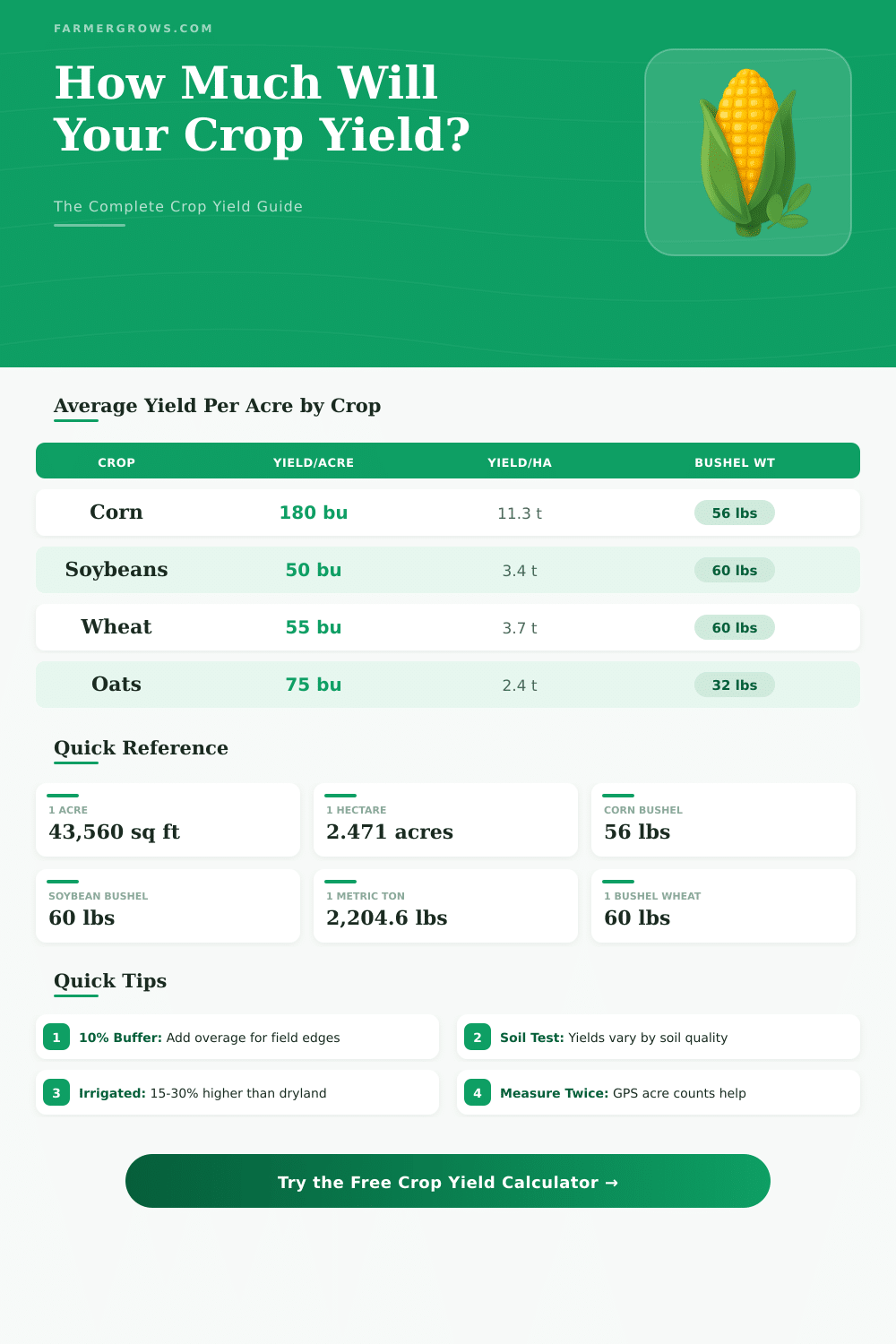
| Crop | Low Yield | Average Yield | High Yield | Unit |
|---|---|---|---|---|
| Corn (Grain) | 120 | 180 | 250 | bu/acre |
| Soybeans | 30 | 50 | 70 | bu/acre |
| Wheat (Winter) | 35 | 55 | 80 | bu/acre |
| Oats | 50 | 75 | 110 | bu/acre |
| Barley | 40 | 60 | 85 | bu/acre |
| Rice | 5,500 | 7,500 | 9,500 | lbs/acre |
| Potatoes | 250 | 400 | 550 | cwt/acre |
| Sunflower | 1,000 | 1,600 | 2,200 | lbs/acre |
| Crop | Bushel Weight (lbs) | Bushel Weight (kg) | Tonnes/Acre (avg) |
|---|---|---|---|
| Corn | 56 | 25.4 | 4.57 |
| Soybeans | 60 | 27.2 | 1.36 |
| Wheat | 60 | 27.2 | 1.50 |
| Oats | 32 | 14.5 | 1.09 |
| Barley | 48 | 21.8 | 1.31 |
| Rice | 45 | 20.4 | 3.40 |
| Potatoes | 60 (cwt=100 lbs) | 45.4/cwt | 18.14 |
| Sunflower | — | — | 0.73 |
| Container | Volume / Weight | Units per Acre (Corn avg) | Coverage Notes |
|---|---|---|---|
| Standard Bushel Bag | 56 lbs (corn) | 180 bags | 1 bu = 1.244 cu ft |
| 50 lb Bag | 50 lbs | ~202 bags | Slightly less than 1 bushel |
| 1 Ton Tote | 2,000 lbs | ~5 totes | 35.7 bushels corn per tote |
| Semi Load (corn) | ~56,000 lbs | ~1,000 bu | Covers about 5.6 acres |
| Grain Bin (1,000 bu) | 56,000 lbs | 1,000 bu | 5.6 acres at 180 bu/acre |
| Field Description | Area (sq ft) | Area (acres) | Corn Yield (bu at 180/ac) |
|---|---|---|---|
| Garden Plot | 10,000 | 0.23 | 41 |
| Small Field | 43,560 | 1.0 | 180 |
| Quarter Section Corner | 108,900 | 2.5 | 450 |
| 5-Acre Parcel | 217,800 | 5.0 | 900 |
| Quarter Quarter Section | 1,742,400 | 40 | 7,200 |
| Quarter Section | 6,969,600 | 160 | 28,800 |
| Section (Full) | 27,878,400 | 640 | 115,200 |
One acre with well-managed corn gives around 180 bushels even so I observed swings of 120 bushels on dry sandy areas until almost 250 under central pivot irrigation. That is huge difference. Because each bushel weighs 56 pounds, 180 bushels per acre mean about 10,000 pounds, around 4.5 tons in metric system.
Beans have more lightweight bushels at 60 pounds, but the amount is much smaller… Around 50 bushels in good year. For a 40-acre quarter of section, that results in 2,000 bushles or 120,000 pounds total.
Crop Yields: How Much They Produce and Why They Change
Wheat averages similarly at 55 bushels per acre, what gives around 3,300 pounds. About potatoes we talk about a totally other level, with 400 hundred-pound units, so 40,000 pounds per acre.
Irrigated fields beat everything by 15 until 30 percent higher amounts. Slopes and clay areas commonly drop yields by 20 percent without effort. I always estimate mistakes at 10 percent.
The information in this article does not come from a computer calculator or automatic translator. They are based on real knowledge, forum talks and experiences from farming communities, that won finds everywhere on the net.
yield of crops is simply a rating of how much one grows on one bit of ground. Think of it as the amount of harvest from one field during one season. Usually one says it per unit of surface, for instance tons per hectare.
Another view gives the seed rating, that counts the amounts somewhat differently. Simply said, the crop is what grows, and the yield shows, how much it gives, whether thousands of kilos per hectare or grains per factory.
Data about crop yields matter a lot. They help in the rating of health of the food supply of a land. Like this one can estimate national food security and see if farming gives quite a lot.
Future needs of food expect to grow by a third during the coming three decades, because of growing population, bigger incomes and changes in eating habits.
Indeed stronger yields of crops can shrink the needed ground for farming. Controlled environments like greenhouses grow plant species all year, without relation to weather. One acre in a greenhouse can give as much as ten acres under the sky and use only five percent of water compared to traditional farming.
Many obstacles risk the yields. Too much or too little water, diseases, insects, funguses and bacteria all affect. Wrong fertilizing, amount of rain, is another challenge.
Delays in sowing because of bad weather or machine failure also can drop the results of fields. When fields produce less than expected, that happens because of late cold, dryness, pests or unforeseen climate. Across big areas of corn, rice, wheat and soy, the amounts neither adjust to better, nor stay stable, or even disappear.
Limits of pollination are a real problem. A third until half of crops have areas, that do not reach the wanted levels because of absence of enough visits of pollinating insects.
Testing of soil is the first stage for improving yields. It gives a picture of the ground structure and shows what nutrients lack. Adding carbon by means of manure or compost helps, together with less chemical dressings.
Understanding the microbes of crops and applying microbial resources can reduce expenses for dressing and insecticides without hurting the amounts. Progress in farm machines, usage of dressings and fresh methods all pushed the yields upward over years. Rotating fields between animals and plant types can turn bad amounts into good, when the ground is healthy.
The best areas are there, where the soil is clay loam with good drainage, on gentle slopes. Surprisingly, the highest yield does not always give the biggest profit, because extra expenses can pass the value ofextra harvest.
Fresh research shows, that extreme heats do not destroy crop amounts, as old models predicted. Especially rice could benefit from warmer nights, with a fifty percent chance, that world rice yields will grow on a warmer globe.