🌽 Corn Sunlight Requirements Calculator
Calculate daily sun hours, seasonal light exposure & planting area sunlight needs for your corn crop
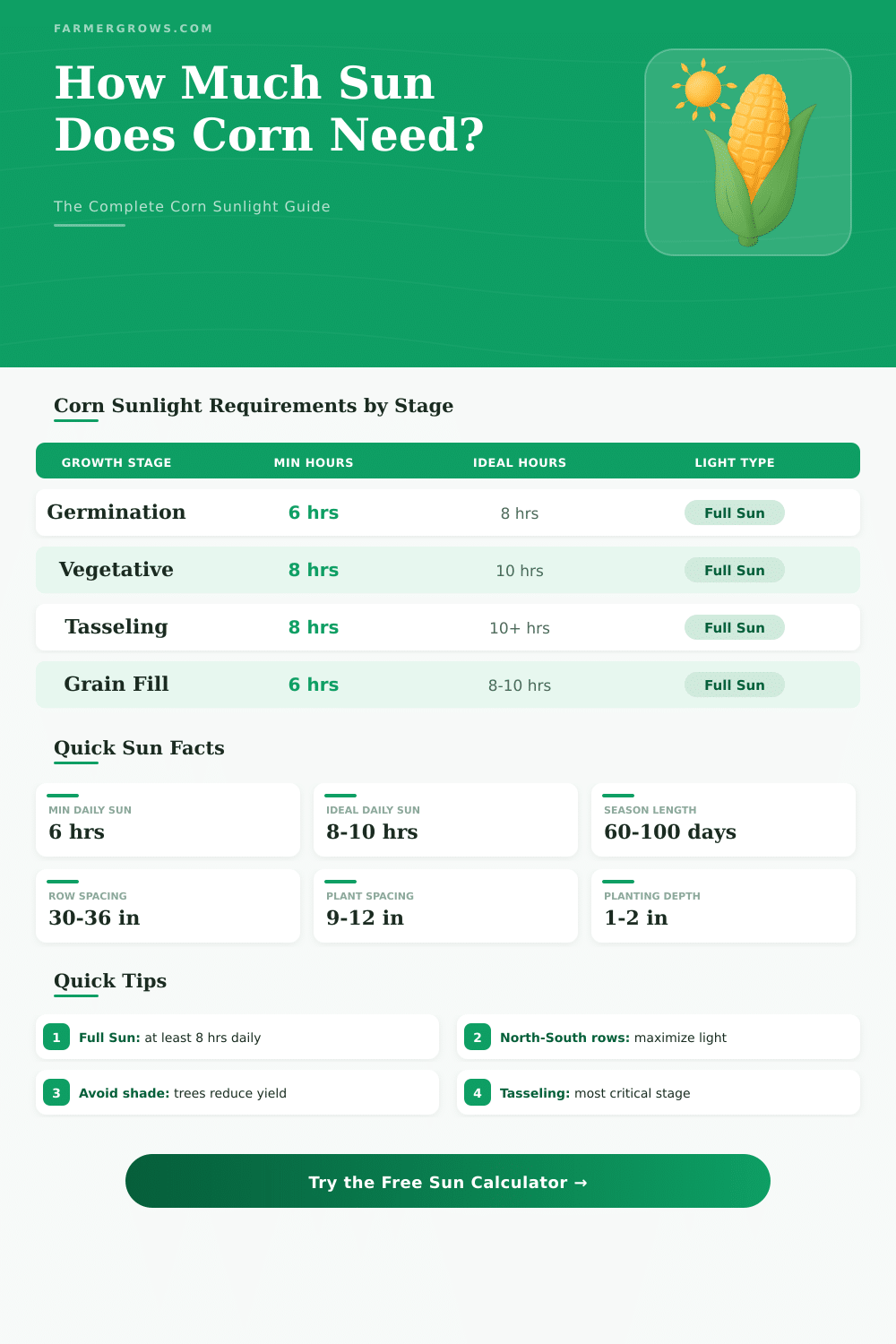
| Growth Stage | Min Sun (hrs/day) | Ideal Sun (hrs/day) | Season Duration | Light Priority |
|---|---|---|---|---|
| Germination | 6 | 8 | Days 1–10 | Moderate |
| Seedling / V1–V3 | 6 | 8–10 | Days 10–25 | High |
| Vegetative (V4–V10) | 8 | 10 | Days 25–50 | Very High |
| Pre-Tasseling (V11+) | 8 | 10+ | Days 50–65 | Critical |
| Tasseling / Silking | 8 | 10+ | Days 65–75 | Critical |
| Grain / Ear Fill | 6 | 8–10 | Days 75–95 | High |
| Maturity / Drying | 6 | 8 | Days 95–110 | Moderate |
| Corn Type | Row Spacing (in) | Plant Spacing (in) | Plants per 100 sq ft | Row Spacing (cm) |
|---|---|---|---|---|
| Sweet Corn | 30–36 | 9–12 | ~33–48 | 76–91 |
| Field Corn | 30 | 8–10 | ~40–50 | 76 |
| Popcorn | 24–30 | 8–10 | ~48–62 | 61–76 |
| Baby Corn | 18–24 | 4–6 | ~100–166 | 46–61 |
| Ornamental | 30–36 | 12–18 | ~22–33 | 76–91 |
| Flint Corn | 30 | 9–12 | ~33–44 | 76 |
| Daily Sun (hrs) | 60-Day Season | 80-Day Season | 100-Day Season | Rating |
|---|---|---|---|---|
| 4 hrs/day | 240 hrs | 320 hrs | 400 hrs | Insufficient |
| 6 hrs/day | 360 hrs | 480 hrs | 600 hrs | Minimum |
| 8 hrs/day | 480 hrs | 640 hrs | 800 hrs | Good |
| 10 hrs/day | 600 hrs | 800 hrs | 1,000 hrs | Ideal |
| 12 hrs/day | 720 hrs | 960 hrs | 1,200 hrs | Excellent |
| Plot Size | Area (sq ft) | Plants @ 9 in spacing | Plants @ 12 in spacing | Rows @ 30 in |
|---|---|---|---|---|
| 4 x 8 ft | 32 | ~15 | ~11 | 1–2 |
| 10 x 20 ft | 200 | ~96 | ~72 | 4 |
| 25 x 50 ft | 1,250 | ~600 | ~450 | 10 |
| 50 x 100 ft | 5,000 | ~2,400 | ~1,800 | 20 |
| 100 x 200 ft | 20,000 | ~9,600 | ~7,200 | 40 |
Corn is a crop that is hungry for Sun and wants the whole amount of daylight to reach its best growth. For those plants full sunshine is absolutely needed. They require at least 6 to 8 hours of direct light daily.
Various sources stress that at least eight hours of full Sun are required, and even 10 hours prove more helpful. A place with full sunshine receives direct rays during no less than 10 hours a day. Although Corn fits to grow also in partial shade then it results lower, short and less strong.
How Much Sunlight Does Corn Need?
If Sun lacks under eight hours, the plants hardly flower and form ears.
Sunshine delivers the energy that the plants require to turn carbon dioxide and water into carbs and oxygen. Those carbs help the growth and spread of the crop. Corn owns a slightly diffrent way of making energy than some other plants.
It manages to boost the process with bigger light strength and gains from extra Sun, while temperatures and water do not limit the growth. The upper leaves of Corn rise almost straight and stay fairly small, while more bottom ones spread and reach bigger size.
Temperature plays a big role also. The ideal daytime values for Corn range between 77°F and 91°F. Overnight one suggests 62°F to 74°F. For the whole growing season the best average sits around 68°F to 73°F. For sprouting ground temperature must reach at least 50°F, but 60°F to 85°F works best. Already sprouting sweet Corn handles gentle colds, because the seed is protected buy means of the outer leaves.
Corn plants require direct solar rays and warm conditions. They usually require more than 1000 warm days to give good result. Any cover against heat or Sun is not needed for them.
With water and nutrients sunshine forms the key base for plant growth and grain product.
When one grows Corn indoors, the plant receives indirect, filtered or weak light. It should have at least 6 hours of sunshine a day, from that 3 to 6 can be direct. Too much direct light inside can hurt the leaves by means of burns.
Little light leads to low, weak growth. Movement of the plant with seasons helps it stay healthy. Very bright Sun can create silver or gray tone on leaves or cause brown strips between the grains.
One commonly sees slow growth in Corn because of weak light, too little moisture or lack of nutrients. The soil stays always moist, but well drained. Light need is the main thing during planning of partner plants for Corn.
Pollination forms another important spot. Corn benefits most in blocks of rows, not in single or double lines. Birds risk the crop during growth.
Scarecrows formed from light colored fabric, that flies in wind, help to remove them. Strips from aluminum sheet bound to thescarecrows reflect sunshine and boost the scary effect.