🌽 Corn Seed Per Acre Calculator
Calculate exact seed quantities, bag counts & plant populations for any field size
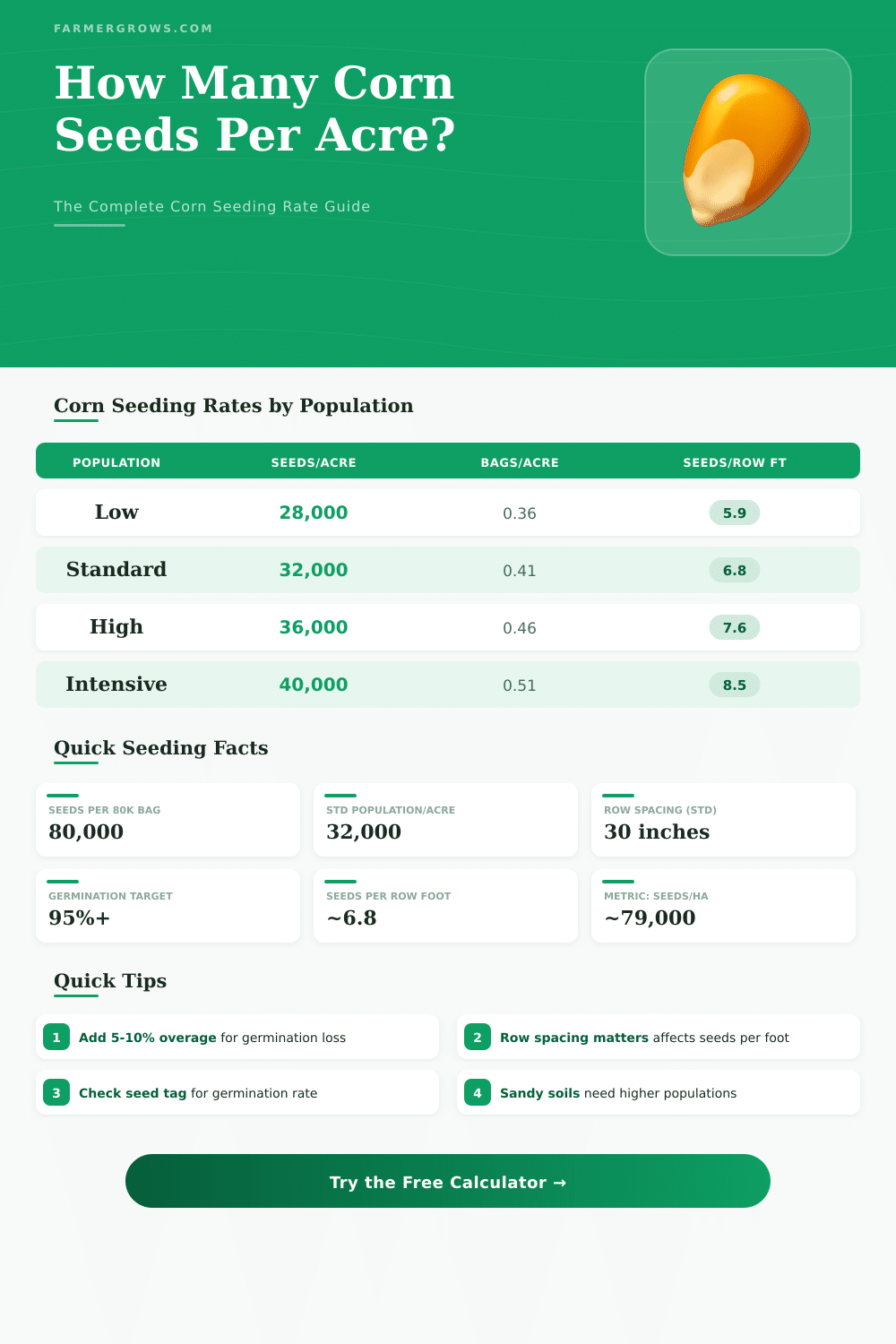
| Row Spacing | Population/Acre | Seeds per Row-ft | Seeds per Row-ft (metric) |
|---|---|---|---|
| 20 in (51 cm) | 32,000 | 4.9 | 1 per 16 cm |
| 22 in (56 cm) | 32,000 | 5.4 | 1 per 17 cm |
| 30 in (76 cm) | 32,000 | 7.3 | 1 per 23 cm |
| 36 in (91 cm) | 32,000 | 8.7 | 1 per 28 cm |
| 38 in (97 cm) | 32,000 | 9.2 | 1 per 30 cm |
| 30 in (76 cm) | 36,000 | 8.2 | 1 per 26 cm |
| 30 in (76 cm) | 40,000 | 9.1 | 1 per 29 cm |
| Field Size | 28,000 seeds/ac | 32,000 seeds/ac | 36,000 seeds/ac |
|---|---|---|---|
| 10 acres | 3.5 bags | 4.0 bags | 4.5 bags |
| 40 acres | 14 bags | 16 bags | 18 bags |
| 80 acres | 28 bags | 32 bags | 36 bags |
| 160 acres | 56 bags | 64 bags | 72 bags |
| 320 acres | 112 bags | 128 bags | 144 bags |
| 640 acres | 224 bags | 256 bags | 288 bags |
| Population (seeds/ha) | Seeds/acre equiv. | Bags/ha (80K bag) | Row spacing (cm) |
|---|---|---|---|
| 60,000 | ~24,300 | 0.75 | 76 |
| 70,000 | ~28,300 | 0.875 | 76 |
| 79,000 | ~32,000 | 0.99 | 76 |
| 89,000 | ~36,000 | 1.11 | 76 |
| 99,000 | ~40,000 | 1.24 | 76 |
Corn is between the most popular crops for home gardens. Sweet seed types and hybrids offer a scope of flavors and details. It forms a feature in summer meals, known because of its soft, juicy kernels and tenderness.
There are old and mixed species, and many of them are not GMO and openly pollinated.
How to Grow Corn and Save Seeds
In the popular tradition of native Americans, corn was part of the “three sisters”. Together with beans and squash one planted it and grew it. They helped each other during its life cycle.
Like this they ensured nutrition with carbohydrates, proteins and plant fat.
Indeed, the kernel of corn is the seed. If one harvests it early for eating, the kernels stay soft, sweet and easy to chew. Such young seeds do not grow, if one plants them.
Dried and used as whole grain, corn ranks between the grains. Barley, wheat, rye, rice and corn all belong to that group.
Corn comes from careful selective breeding of species of grass. It looks surprisingly different from its ancestors. One plants corn seed per acre during spring, and children can transfer later according to the kind.
In planting depth, clay soil works best at two and half inches, while sandy soil favours around three inches.
Start seeds inside have advantages. That ensures better sprouting, because one can create warm space. The perfect temperature of ground is between 75 and 77 degrees.
Outside in new soil, many corn species hardly sprout and risk to rot. Inside starts protect also against animals like crows, branes, mice, voles and raccoons, that eat seeds and young plants.
To preserve corn seed per acre, one requires many plants. Minimum 100 to 200 plants escape problems of internal breeding. Without enough amount, corn does not stay healthy or gives big harvest after some years.
Openly pollinated seeds one grows from lines of reliable origin with good traits. Hybrid corn seeds come from chosen lines and one pollinates them controlled.
In harvesting of seeds, one chooses ears, when the husks dry outside and become brown. The kernels are dark. One dries them slowly by means of air in a cool, dry space.
They are fully dry before frost. Usage of silica gel for monthly checks helps that. One preserves seeds in airtight tin, to escape moisture because they attract humidity from the air.
Corn sprouting usually fails after one or too years of storage. Rain can injure seeds by means of sprouting or disease, and animals cansteal them too.