🌽 Corn Fertilizer Calculator
Calculate exact N-P-K fertilizer needs for your corn field based on yield goal, field size, and fertilizer type
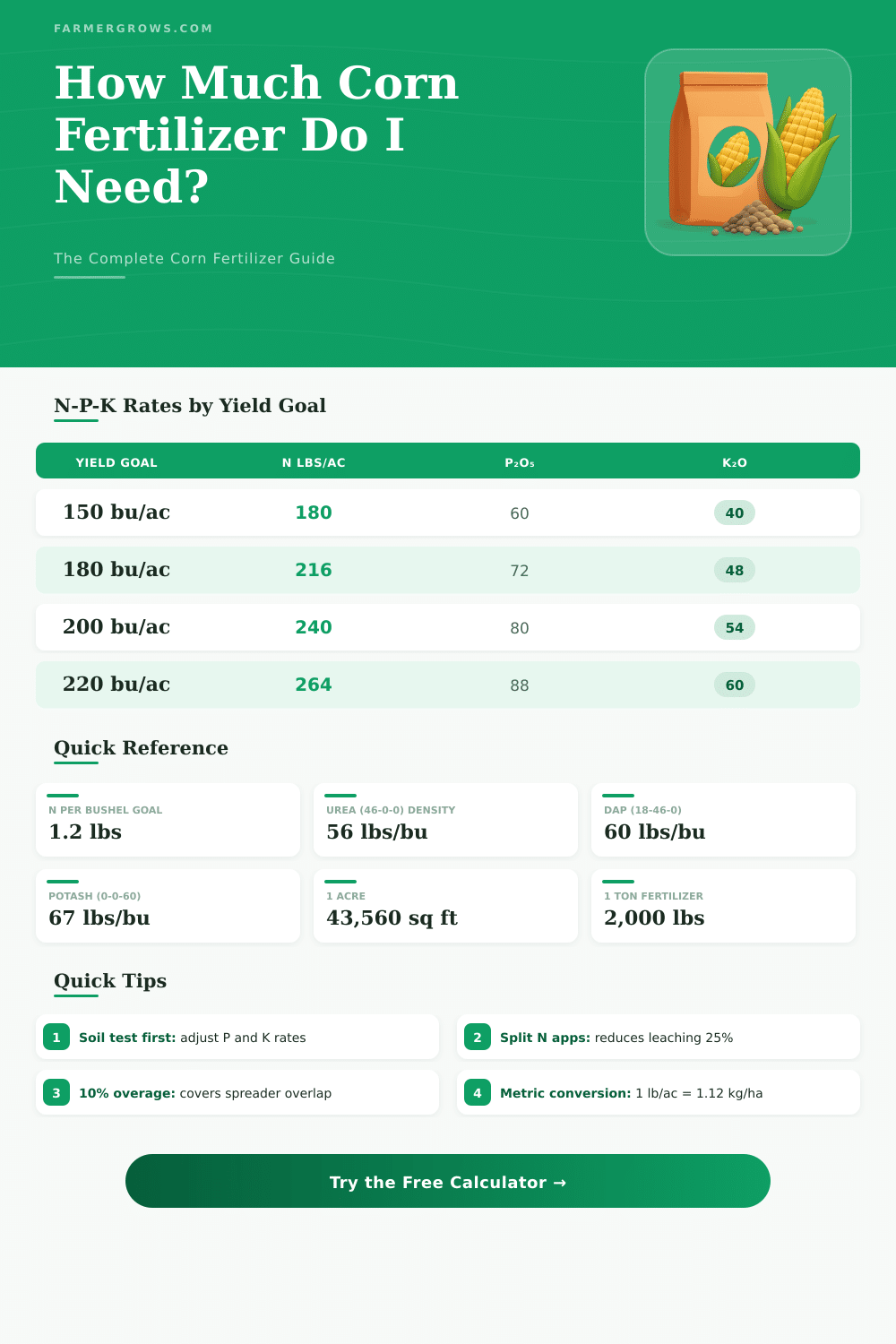
| Yield Goal (bu/ac) | N Required (lbs/ac) | N Required (kg/ha) | Urea Needed (lbs/ac) |
|---|---|---|---|
| 120 | 144 | 161 | 313 |
| 150 | 180 | 202 | 391 |
| 180 | 216 | 242 | 470 |
| 200 | 240 | 269 | 522 |
| 220 | 264 | 296 | 574 |
| 250 | 300 | 336 | 652 |
| Fertilizer | N-P-K | Lbs per Acre (180 bu goal) | Kg per Hectare |
|---|---|---|---|
| Urea | 46-0-0 | 470 | 527 |
| UAN-32 | 32-0-0 | 675 (61 gal) | 757 |
| Ammonium Sulfate | 21-0-0-24S | 1,029 | 1,153 |
| DAP | 18-46-0 | 130 (P₂O₅ at 60 lbs) | 146 |
| MAP | 11-52-0 | 115 (P₂O₅ at 60 lbs) | 129 |
| Potash (MOP) | 0-0-60 | 67 (K₂O at 40 lbs) | 75 |
| Complete | 10-10-10 | 2,160 | 2,421 |
| Anhydrous Ammonia | 82-0-0 | 263 (51 gal) | 295 |
| Field Size | Area (sq ft) | N Needed at 180 bu/ac (lbs) | Urea 46-0-0 (lbs) |
|---|---|---|---|
| 1 Acre | 43,560 | 216 | 470 |
| 5 Acres | 217,800 | 1,080 | 2,348 |
| 10 Acres | 435,600 | 2,160 | 4,696 |
| 20 Acres | 871,200 | 4,320 | 9,391 |
| 40 Acres | 1,742,400 | 8,640 | 18,783 |
| 80 Acres | 3,484,800 | 17,280 | 37,565 |
| 100 Acres | 4,356,000 | 21,600 | 46,957 |
| 160 Acres (Quarter Section) | 6,969,600 | 34,560 | 75,130 |
| Bag Size | Fertilizer Type | Coverage at 180 bu/ac Rate | Bags per Acre |
|---|---|---|---|
| 50 lb bag | Urea (46-0-0) | 4,635 sq ft (0.106 ac) | 9.4 |
| 50 lb bag | AMS (21-0-0) | 2,117 sq ft (0.049 ac) | 20.6 |
| 50 lb bag | DAP (18-46-0) | 16,738 sq ft (0.384 ac) | 2.6 |
| 50 lb bag | Potash (0-0-60) | 32,507 sq ft (0.746 ac) | 1.3 |
| 50 lb bag | Complete (10-10-10) | 1,008 sq ft (0.023 ac) | 43.2 |
| 2000 lb tote | Urea (46-0-0) | 4.26 acres | 0.23 totes |
Corn pulls roughly 1.2 lbs of nitrogen for every bushel of yield, so a 200 bushel goal means 240 lbs of actual N per acre. Thats a lot of fertilizer no matter how you slice it.
The information below does not come from any computer program or automatic translator. It is based on actual experiences of users, discussions in forums and gathered knowledge of the internet community.
How Much Nitrogen Corn Needs and When to Add Fertilizer
corn is a strong nutrient consumer. It requires nitrogen more than almost anything else. During the choice of fertilizer for sweet corn, one wants a product with N-P-K ratio that stresses high nitrogen proportion.
A good option gives also enough potassium together with a bit of phosphorus at least. For instance, the professional liquid corn fertilizer Sheets and Bone with 5-1-5 make-up answers well for wanted results.
To grow, corn requires nutrients and minerals, the main ones are nitrogen, phosphorus and potassium. Some of those elements already exist in the ground, even so extra fertilizer sometimes is needed to help the plants grow more quickly or to fix absences of nutrients in the soil. For good corn production, good ground fertility is key.
Commonly the amount of corn ears is limited because of low pH of the ground and absence of nutrients, so balanced management of the fertility matters a lot.
Nitrogen receives the biggest attention. Formulas like 21-0-0 or 36-0-0 are popular, because corn genuinely benefits from nitrogen. Some fertilizer for sweet corn holds both fast and slow release nitrogen.
Such mix gives early push to the growth and ensures nutrition of the plant through the whole season. Corn also uses a lot of sulphur. Add basic sulphur during tilling to help, especially in poor clay areas with little sulphur.
Sulphur breaks clay clumps, what makes the soil softer and more easily worked.
Studies strongly support shared applications of nitrogen for corn. It can be made up of dry burst or in-line giving during crop, later followed by second dose. Side dressing is a usual method.
It answers when the corn reaches around twelve inches of height, and again during the tasseling. Spreading blood meal around the plants, when they reach knee height, works very well. Three weeks after such application corn can grow until six feet high and become the deepest green colour.
Granular fertilizer with high nitrogen, like 20-10-10, answers for side dressing instead of blood meal, and it usually costs much less. Other favourite liquid choice is the Alaska Fish fertilizer with 5-1-1 ratio. Apply it heavily weekly, when the plants reach two inches of height, gives good results.
Some gardeners use top dressing with slow release fertilizer, for instance Espoma Garden Tone, later switch to fish mix when the corns start to shoot upward, sometimes mixing with compost and alfalfa meal.
Ammonium thiosulfate is popular for corn thanks to its ability to mingle and apply with urea-ammonium nitrate. Ammonium sulfate also gives good results in corn, although it commonly requires extra transport threw the countryside.
Starter fertilizer does not always expand the amount of corn grains. The effects are unclear, when one uses traditional tilling on well draining areas, that already have enough phosphorus and potassium. In big corn fields, liquid ammonia commonly serves as liquid, injected directly in the soil.
Gardeners in such scales need to handle millions of tons quickly and simply.
The cost of fertilizer is now a real problem. The price of urea compared to corn prices reached levels not seen since at least 2018. Since the first half of December, when urea prices reached their minimum, they climbed above hundred dollars per ton.
Lot of that increase comes from world events. During the planting season ahead, nitrogen prices and corn field areas will be main factors, thatform the spring input costs in the farms.
When corn leaves dry until either above the ear leaf, or the whole plant becomes very light green with yellow leaves beside the ear, that shows, that nitrogen fertilizer was given twenty until forty pounds each acre under the best amount. Compost is a much better choice than direct manure. Worm compost is even more useful than normal compost.
Crop rotation also affects the fertility. In farms with full selling, nitrogen from prior permanent feed crops slowly releases in the ground, what allows to use less manure or nitrogen fertilizer for second and third year corn.