🌱 Compost & Manure Calculator
Calculate exactly how much compost or manure you need by area, depth & material type
lbs / cu yd (avg)
lbs / cu yd (avg)
lbs / cu yd (avg)
lbs / cu yd (avg)
lbs / cu yd (avg)
lbs / cu yd (avg)
lbs / cu yd (avg)
lbs / cu yd (avg)
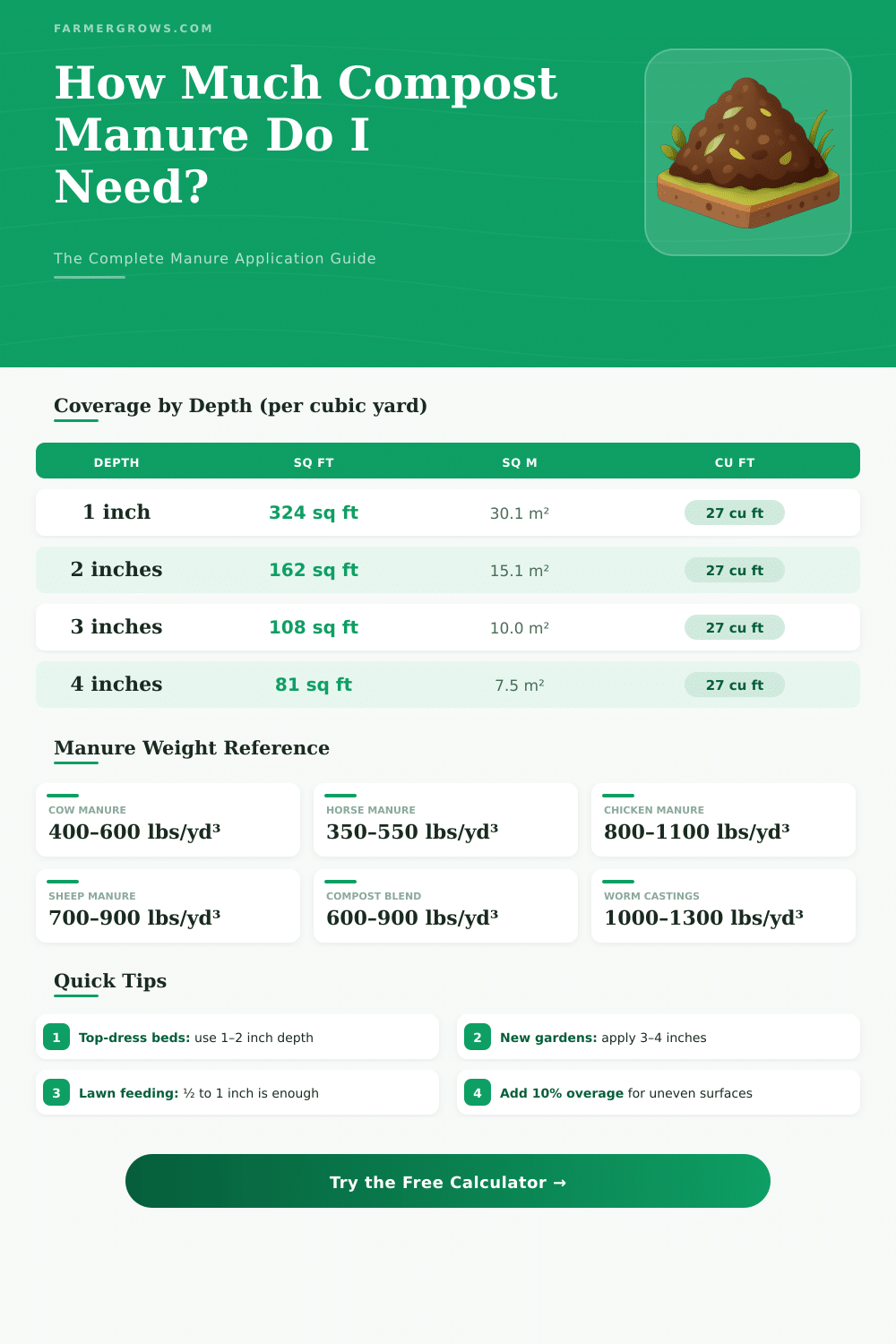
| Depth | Sq Ft Covered | Sq Meters | Cubic Feet |
|---|---|---|---|
| ½ inch (1.3 cm) | 648 sq ft | 60.2 m² | 27 cu ft |
| 1 inch (2.5 cm) | 324 sq ft | 30.1 m² | 27 cu ft |
| 2 inches (5 cm) | 162 sq ft | 15.1 m² | 27 cu ft |
| 3 inches (7.5 cm) | 108 sq ft | 10.0 m² | 27 cu ft |
| 4 inches (10 cm) | 81 sq ft | 7.5 m² | 27 cu ft |
| 6 inches (15 cm) | 54 sq ft | 5.0 m² | 27 cu ft |
| Bag Size | Cu Ft / Bag | Bags per Cu Yd | Covers at 3 in |
|---|---|---|---|
| 1 cu ft bag | 1.0 cu ft | 27 bags | 4 sq ft |
| 2 cu ft bag | 2.0 cu ft | 13.5 bags | 8 sq ft |
| 3 cu ft bag | 3.0 cu ft | 9 bags | 12 sq ft |
| 40L bag | 1.41 cu ft | 19.2 bags | 5.6 sq ft |
| Bulk cubic yard | 27 cu ft | 1 | 108 sq ft |
| Project | Area (sq ft) | Cu Yds at 3 in | 2 cu ft Bags |
|---|---|---|---|
| Raised bed 4x8 | 32 sq ft | 0.4 cu yd | 5 bags |
| Small garden 10x10 | 100 sq ft | 0.9 cu yd | 14 bags |
| Garden bed 10x20 | 200 sq ft | 1.9 cu yd | 26 bags |
| Medium plot 20x30 | 600 sq ft | 5.6 cu yd | 75 bags |
| Large bed 30x40 | 1,200 sq ft | 11.1 cu yd | 150 bags |
| Half-acre field | 21,780 sq ft | 201.7 cu yd | 2,723 bags |
Compost manure forms when tiny living things, and sometimes worms, break down the manure together with other organic stuff. This process normally lasts some months up to a year. One gets then fiber-rich and carbon-loaded soil rich in nutrients like potassium, phosphorus and nitrogen.
It works for home use as a homemade project.
Compost Manure: What It Is, How to Make It, and How to Use It
Compost manure is rich in nutrients for the garden. It works well for fresh plantings, raised bed gardens or as surface cover, bedding and ground change for already existing garden. It delivers the main trio of nutrients, nitrogen, phosphorus and potassium, together with many tiny elements.
Like this it helps in many ways for ground improvement, even though it comes from mess in the manure.
Between compost and manure exists a clear difference. Compost is a processed product, that broke down and divided by means of insects and bacteria. Manure is the waste of animals.
Old manure even so is not compost. It simply stays manure, that sat in a pile a bit of time released ammonia and partially started to break down.
Manure can be too strong for many plantings and easily overdose. Average compost better works as gentle nutrient and structural improver. Manure is like a fast energy boost, good for great results, but dangerous if overused.
Old manure has less nitrogen than fresh manure. Also, too much comopst can upset the ground balance. For good compost one does not need manure, and manure sometimes carries antibiotics or hormones.
While composting one uses green materials with high nitrogen and brown with more carbon. Balanced compost has a ratio of 30 parts carbon to 1 part nitrogen. Manure of horses and cows usually has a ratio around 15:1.
A possible recipe is one part manure too four parts compost-based materials. To start the composting, one makes a pile at least three feet wide, high and long, so that it warms quite a lot. Mix the manure with carbon-loaded materials like pine bedding, shredded cardboard or newspaper.
Manure of horses can carry seeds of unwanted grasses, more than cow manure. If it passed warm composting, those seeds die and there is no problem. Old horse manure, that forms 20 percent of the pile, can be very useful.
Composting also shrinks the volume and density of manure by around 50 to 65 percent, which lowers transport costs.
Some commercial mixes from old cow manure with peat soil and various extras are approved for organic growers. Other products combine natural garden top with old animalmanure, which makes them ideal for tomato plants, peppers and other vegetables. They usually are odorless and sifted for equal texture.