🌱 Compost Depth Calculator
Calculate exactly how much compost you need by area, depth, and material type
✅ Your Compost Calculation Results
lbs / yd³
lbs / yd³
lbs / yd³
lbs / yd³
lbs / yd³
lbs / yd³
lbs / yd³
lbs / yd³
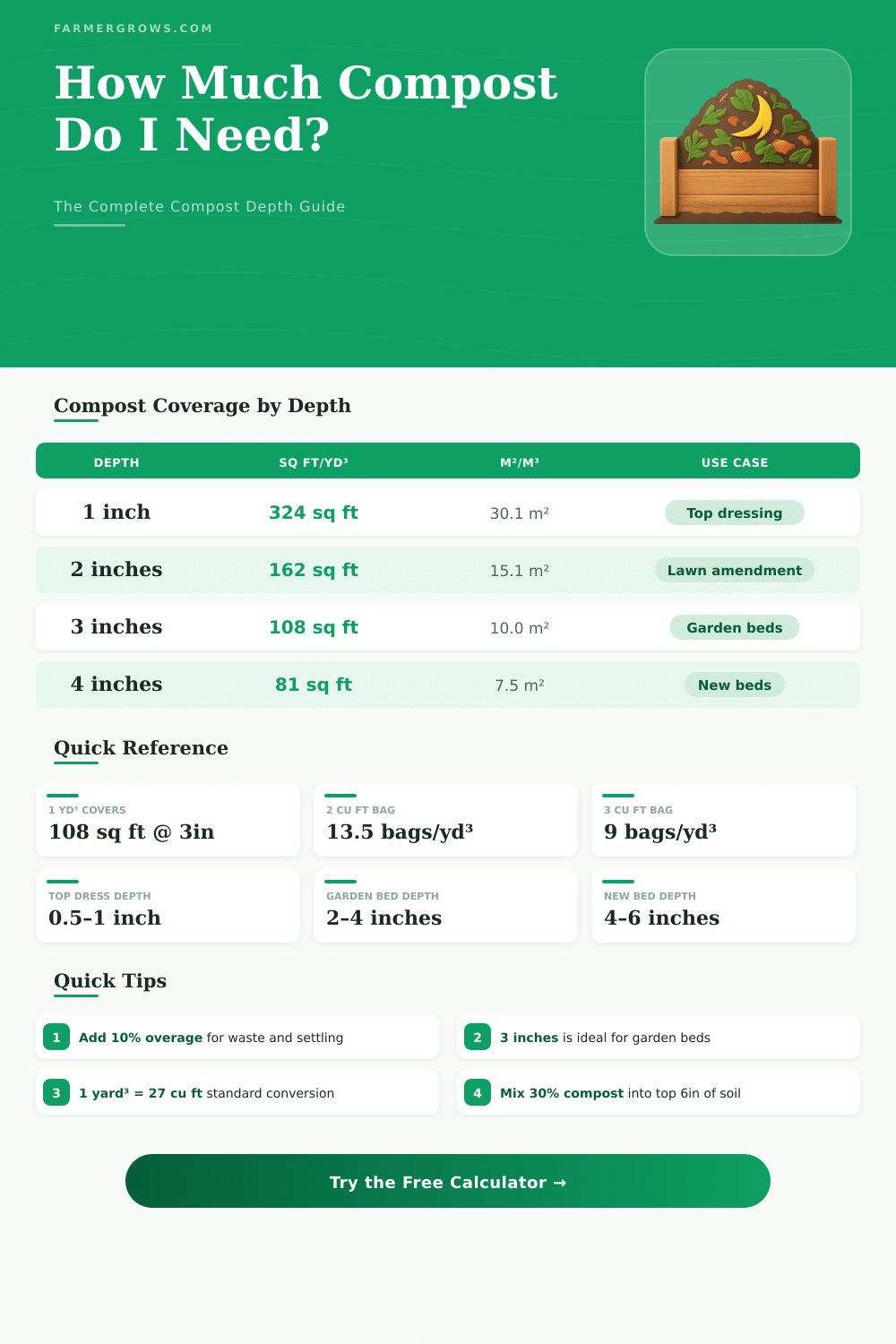
| Depth | Sq Ft per Yd³ | M² per M³ | Typical Use |
|---|---|---|---|
| 0.5 in / 1.3 cm | 648 sq ft | 60.2 m² | Light lawn top dressing |
| 1 in / 2.5 cm | 324 sq ft | 30.1 m² | Lawn renovation |
| 2 in / 5 cm | 162 sq ft | 15.1 m² | Annual bed refresh |
| 3 in / 7.6 cm | 108 sq ft | 10.0 m² | Standard garden beds |
| 4 in / 10 cm | 81 sq ft | 7.5 m² | Heavy amendment |
| 6 in / 15 cm | 54 sq ft | 5.0 m² | New bed creation |
| Bag Size | Volume per Bag | Bags per Yd³ | Coverage @ 3 in |
|---|---|---|---|
| 1 cu ft bag | 1 cu ft / 0.028 m³ | 27 bags | 4 sq ft |
| 2 cu ft bag | 2 cu ft / 0.057 m³ | 13.5 bags | 8 sq ft |
| 3 cu ft bag | 3 cu ft / 0.085 m³ | 9 bags | 12 sq ft |
| 40 L bag | 1.41 cu ft / 0.040 m³ | 19.1 bags | 5.6 sq ft |
| 50 L bag | 1.77 cu ft / 0.050 m³ | 15.3 bags | 7.1 sq ft |
| Project | Area | Yd³ @ 3 in | 2 cu ft Bags |
|---|---|---|---|
| Small raised bed (4x8) | 32 sq ft | 0.4 yd³ | 6 bags |
| Medium garden bed (10x12) | 120 sq ft | 1.1 yd³ | 20 bags |
| Large bed (20x20) | 400 sq ft | 3.7 yd³ | 67 bags |
| Tree ring (8ft dia) | 50 sq ft | 0.46 yd³ | 9 bags |
| Vegetable patch (15x20) | 300 sq ft | 2.8 yd³ | 50 bags |
| Lawn 50x100 | 5,000 sq ft | 46.3 yd³ | 833 bags |
Get the right depth of compost is key for success in gardening. Usually one must spread around quarter to half of inch above the ground. While mixing of compost in the soil, aim one to two inches worked in the upper six to eight inches of soil.
Right mix for the blend is made up of around 25% compost and 75% soil.
How Deep to Put Compost in Your Garden
When dealing with already existing lawns, thin layers around it most answers. It is enough to spread only quarter to half of inch above the grass. Compost that passes through screen of three eighths of inch, spreads best during top dressing of lawns.
After the application, brush it equally in the grassy cover and later reseed as usually.
For veggie and flowery beds one requires a bit more. Good starting point is one to two inches on top, or two to three inches mixed in the upper six to eight inches of soil. While starting a new garden space, spread three to four inches of compost and mix it to a Compost depth of six to eight inches by means of fork, shovel or tiller.
The goal is reach around five percent of organic material in the soil. Add two to three inches of pure compost and work it to that Compost depth of six to eight inches help to reach that.
Some plants truly like compost. Tomatoes, melons and squash even can benefit in pure compost. Even so trees and perennials should not grow in soil with too much organic material.
The organic matter breaks down slowly over time, which does, that it shrinks and sinks. Therefore that damages the root structure and the planting depth.
For layers of compost bed, two to three inches answer as depth. Not every kind of compost works equally, so choose the right one for your task. During counting of amount for purchase, one cubic foot bag of compost covers twelve square feet in one inch depth.
At same depth, every square foot requires 0.08 cubic feet of compost. A handy way to count the volume is multiply the area in square feet by the depth in inches, then divide by 324 to get cubic yards.
Where the soil already is loose and well drained, one can spread compost on top and work it to a depth of six to twelve inches in one stage. Apply five inches of compost on top and leave, that ground biology and roots mix it naturally over time, putting the garden in great shape for years. Working compost in one shovel depth can boost the process in the first year.
After that, deep mixing is no more needed. For veggie gardens, add soil and compost to at least one and half feet of depth before planting helps roots reach water easily. Over time, garden covered with mulch can expand the typical rootdepth by around a fifth to quarter inch yearly.