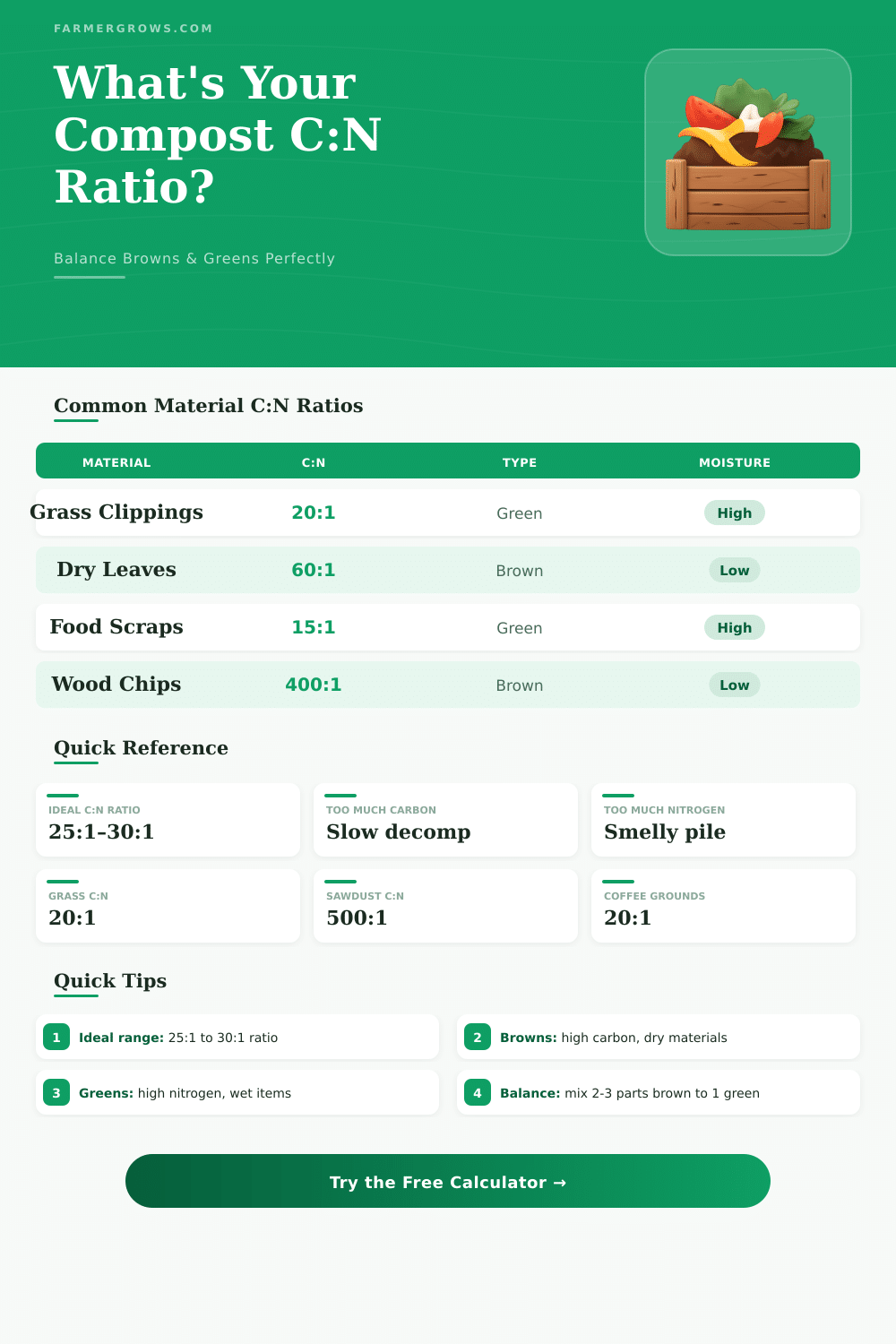
🌿 Compost C:N Ratio Calculator
Add your compost materials to calculate the carbon-to-nitrogen ratio and get mix recommendations
| Material | C:N Ratio | Type | % Carbon | % Nitrogen | Moisture % | Density (lbs/yd³) |
|---|---|---|---|---|---|---|
| Grass Clippings | 20:1 | Green | 45 | 2.4 | 80 | 400 |
| Food Scraps (Mixed) | 15:1 | Green | 48 | 3.2 | 80 | 1,100 |
| Coffee Grounds | 20:1 | Green | 45 | 2.1 | 65 | 700 |
| Fresh Manure (Horse) | 25:1 | Green | 42 | 1.7 | 60 | 1,000 |
| Chicken Manure | 7:1 | Green | 38 | 5.5 | 65 | 950 |
| Vegetable Scraps | 12:1 | Green | 40 | 3.5 | 87 | 1,050 |
| Alfalfa Hay | 16:1 | Green | 44 | 2.8 | 12 | 250 |
| Dry Leaves | 60:1 | Brown | 50 | 0.9 | 35 | 200 |
| Straw | 75:1 | Brown | 46 | 0.6 | 15 | 150 |
| Cardboard (Shredded) | 350:1 | Brown | 44 | 0.1 | 8 | 100 |
| Newspaper (Shredded) | 175:1 | Brown | 45 | 0.3 | 6 | 120 |
| Wood Chips | 400:1 | Brown | 50 | 0.1 | 40 | 500 |
| Sawdust | 500:1 | Brown | 50 | 0.1 | 40 | 350 |
| Pine Needles | 80:1 | Brown | 48 | 0.6 | 30 | 180 |
| Corn Stalks | 60:1 | Brown | 43 | 0.7 | 12 | 200 |
| Finished Compost | 15:1 | Neutral | 30 | 2.0 | 50 | 1,000 |
| Pile Size (L x W x H) | Volume (ft³) | Volume (yd³) | Volume (m³) |
|---|---|---|---|
| 3 x 3 x 3 ft | 27 | 1.0 | 0.76 |
| 4 x 4 x 3 ft | 48 | 1.8 | 1.36 |
| 4 x 4 x 4 ft | 64 | 2.4 | 1.81 |
| 5 x 5 x 3 ft | 75 | 2.8 | 2.12 |
| 5 x 5 x 4 ft | 100 | 3.7 | 2.83 |
| 6 x 6 x 4 ft | 144 | 5.3 | 4.08 |
| 8 x 4 x 4 ft | 128 | 4.7 | 3.62 |
| 10 x 5 x 4 ft | 200 | 7.4 | 5.66 |
| Bag Size | Volume per Bag | Bags per Yard | Bags per m³ |
|---|---|---|---|
| 1 cu ft bag | 1.0 ft³ | 27 bags | 35 bags |
| 2 cu ft bag | 2.0 ft³ | 13.5 bags | 18 bags |
| 3 cu ft bag | 3.0 ft³ | 9 bags | 12 bags |
| 40 lb bag (compost) | ~0.75 ft³ | 36 bags | 47 bags |
| 50 lb bag (manure) | ~1.0 ft³ | 27 bags | 35 bags |
| Project | Pile Area | At 3 ft Deep (yd³) | At 4 ft Deep (yd³) |
|---|---|---|---|
| Small Bin (3x3 ft) | 9 sq ft | 1.0 | 1.3 |
| Medium Bin (4x4 ft) | 16 sq ft | 1.8 | 2.4 |
| Large Bin (4x8 ft) | 32 sq ft | 3.6 | 4.7 |
| Open Pile (5x5 ft) | 25 sq ft | 2.8 | 3.7 |
| Windrow (3x10 ft) | 30 sq ft | 3.3 | 4.4 |
| Large Windrow (4x20 ft) | 80 sq ft | 8.9 | 11.9 |
The ideal C:N ratio for active composting is between 25:1 and 30:1. Below 20:1, excess nitrogen creates ammonia and odors. Above 40:1, decomposition slows dramatically because microbes lack enough nitrogen to break down all the carbon. A ratio around 30:1 produces finished compost in 2–4 months with regular turning.
Mixing by volume is common but mixing by weight is more accurate. A 5-gallon bucket of grass clippings weighs roughly 15 lbs, while the same bucket of dry leaves weighs about 2–3 lbs. When the calculator says add equal parts by weight, it means significantly more volume of the lighter brown material. Always factor in moisture content — wet materials weigh 2–4 times more than dry equivalents.
A 30:1 carbon to nitrogen ratio is what microbes want, but Ive found most backyard piles land somewhere around 50:1 or higher because people toss in way too many leaves. Dry leaves run about 60:1 on their own. Grass clippings sit at 20:1, and mixing them roughly 2 parts leaves to 1 part grass by weight gets you close to that 30:1 target.
What you are learning here does not come from some automatic tool or calculator. Everything directly comes from real folks, gardeners, forum talks, and community experience scattered through the net.
How to Make Good Compost at Home
In its essence, Compost is very simple stuff. Organic materials naturally break down with help of tiny organisms, and because the process requires oxygen to operate, it is technically aerobic. You can toss in grassy clippings, leaves, garden trimmings, tree branches and kitchen scraps.
Straw and animal dung also works well. And the reward? Black, crumbly, rich mix from partially rotting organic matter that does wonders for your garden beds.
Think about Compost as plant food, that simultaneously rebuilds the soil. It is not only dung, it actually changes the physical, chemical and biological make-up of what is under your feet. Mix it in heavy clay soils, and suddenly they more easily break and drain more well.
And sandy soils? They grasp water and nutrients instead of letting everything wash away. Moreover, Compost releases useful nutrients and brings crowds of helpful tiny organisms, that slowly builds the health of your soil.
Here is what separates a lively, nice garden from one that is only… Here.
There is also another side of Compost that deserves attention: cutting down mess. Instead of tossing kitchen scraps, old newspapers and used paper towels in the bucket, they receive second life. That is much more friendly to the earth than depending on chemical fertilizers.
And funny enough, some packaging, both store-bought and homemade, actually can be composted too.
Compost bins became really popular, and for good reason. Open piles do work, but bins commonly boost the process quite a bit. Better airflow and easier moisture-control means that you sea ended Compost much more early.
Moreover, bins keep everything held and sorted, instead of it spreading through your garden. You have lots of choices. Plastic bins, designed to let air go through while they keep everything neat, or you can quickly build four pallets, if you want to do that yourself.
Cedar bins are another option, quite large enough to handle all those veggie scraps, lawn clippings and leaves without getting too full.
More matters than folks usually think, that you get the right balance. “Brown” materials, card, paper, leaves, wood chips… Bring Carbon to the mix.
Nitrogen comes from kitchen scraps and fresh green mess. If you keep enough browns inside, you will escape that terrible rotten smell, that appears when things fully go out of the right ratio. Unbalanced piles smell just like forgotten scraps sitting in the back of your fridge, believe me.
Compost opens some real chances: better water-control in the soil, revived ground health, even improved plant quality with time. When you work in Compost, the germs already living in your soil multiply and get active. Most gardeners do not inherit perfect soil, so Compost offers a natural, lasting way to feed what already is here.
Naturally there is also store-bought Compost, although always there is a trade between cost, effort and time compared with doing your own. But here is the thing… Never use unfinished Compost as a ground booster.
Materials that still break down will indeed steal nutrientsaway from your plants while they decompose.