🐓 Chicken Feed Per Day Calculator
Calculate exactly how much feed your flock needs daily, weekly, and monthly
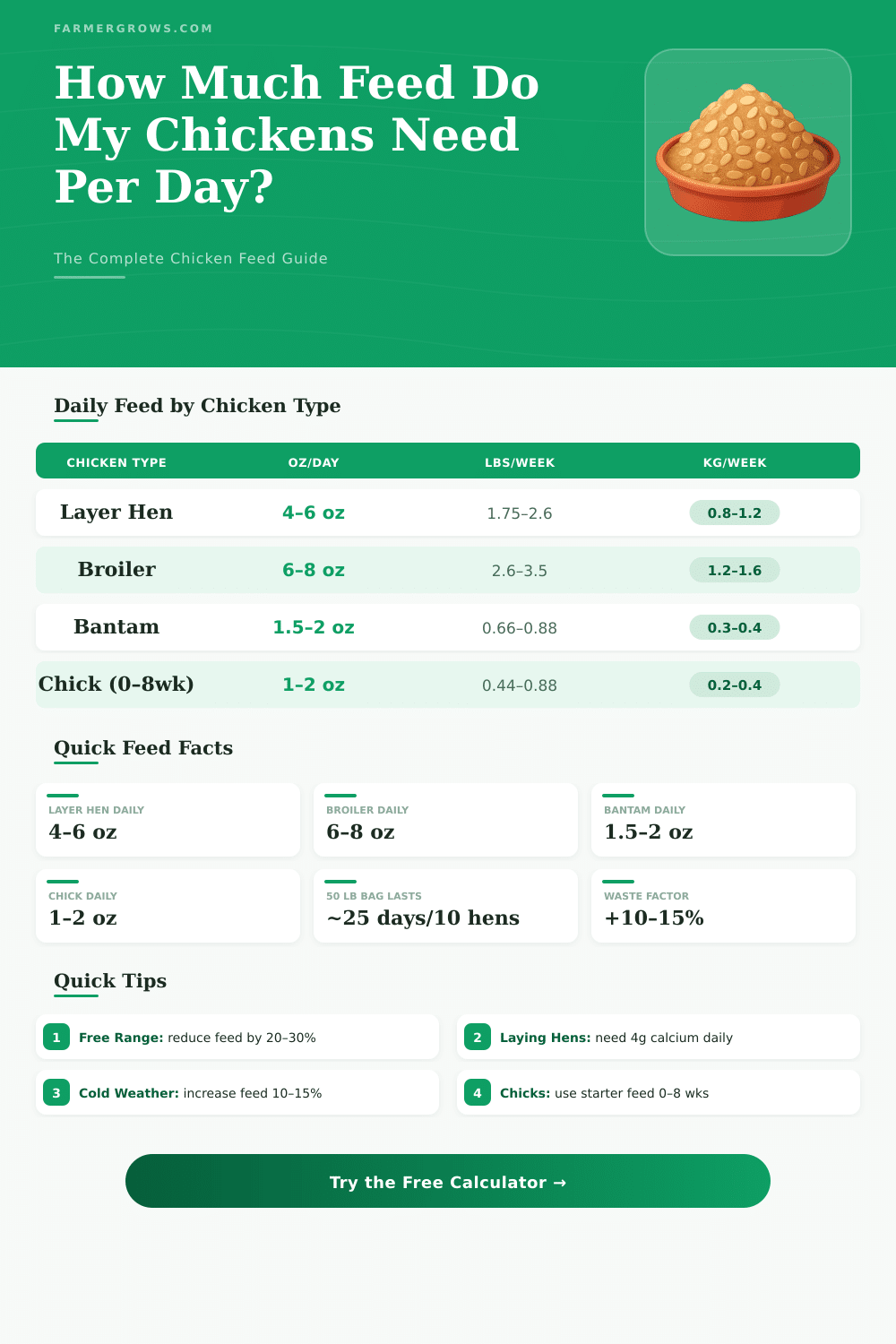
| Chicken Type | Feed Per Day (oz) | Feed Per Day (g) | Feed Per Week (lbs) | Feed Per Week (kg) |
|---|---|---|---|---|
| Layer Hen (Standard) | 4–6 oz | 113–170 g | 1.75–2.6 lbs | 0.79–1.18 kg |
| Broiler / Meat Bird | 6–8 oz | 170–227 g | 2.6–3.5 lbs | 1.18–1.59 kg |
| Bantam | 1.5–2 oz | 43–57 g | 0.66–0.88 lbs | 0.30–0.40 kg |
| Chick (0–8 weeks) | 1–2 oz | 28–57 g | 0.44–0.88 lbs | 0.20–0.40 kg |
| Pullet / Grower (8–20 wk) | 2.5–4 oz | 71–113 g | 1.09–1.75 lbs | 0.50–0.79 kg |
| Dual-Purpose Breed | 4.5–6.5 oz | 128–184 g | 1.97–2.84 lbs | 0.89–1.29 kg |
| Turkey Poult | 5–9 oz | 142–255 g | 2.19–3.94 lbs | 0.99–1.79 kg |
| Duck | 4–7 oz | 113–198 g | 1.75–3.06 lbs | 0.79–1.39 kg |
| Bag Size | 5 Hens Last | 10 Hens Last | 25 Hens Last | 50 Hens Last |
|---|---|---|---|---|
| 25 lb bag | ~20 days | ~10 days | ~4 days | ~2 days |
| 40 lb bag | ~32 days | ~16 days | ~6.4 days | ~3.2 days |
| 50 lb bag | ~40 days | ~20 days | ~8 days | ~4 days |
| 50 kg bag | ~88 days | ~44 days | ~18 days | ~8.8 days |
| Flock Size | Oz / Day | Lbs / Month | Kg / Month | 50 lb Bags / Month |
|---|---|---|---|---|
| 4 Hens | 20 oz | ~38 lbs | ~17 kg | ~0.75 bags |
| 6 Hens | 30 oz | ~56 lbs | ~25 kg | ~1.1 bags |
| 10 Hens | 50 oz | ~94 lbs | ~43 kg | ~1.9 bags |
| 20 Hens | 100 oz | ~188 lbs | ~85 kg | ~3.7 bags |
| 50 Hens | 250 oz | ~469 lbs | ~213 kg | ~9.4 bags |
| 100 Hens | 500 oz | ~938 lbs | ~425 kg | ~18.8 bags |
Chicken Feed simply works as fuel for your set of chickens, it backs their healthy growth and rich production of eggs. The calcium in it matters a lot because it forms those solid, strong shells. The content of the mix adjusts a bit according to whether you have chicks or adult birds, and whether you choose vegetarian variant or add animal proteins.
Young chicks require food different than adult chickens. From birth until around eight weeks, one gives them starter Chicken Feed, that holds 18 to 20 percent of protein for fast growth. Later, between eight and sixteen weeks, one moves to growth food, that lowers the protein to 16 to 18 percent.
What to Feed Chickens and When
When chickens reach sixteen weeks, the standard Chicken Feed with about 16 percent of protein works. Here it gets interesting: hens truly require that extra calcium to produce eggs, but roosters? They do fine with the standard Chicken Feed.
So mix for whole set with around 18 to 20 percnet of protein works well, if you have mixed birds. For extra calcium help to your hens, one can leave crushed shells or cracked egg shells outside all day, so that they freely peck them.
Birds show more picky, than one would think, when deal about the shape of their Chicken Feed. Some chickens like pellets, while others like it scattered. Pellets usually cause less surrounding mess beside the coop.
Whole grains form another option. But mind, if you mix corn, oats and sunflower seeds, chickens first will remove the seeds and corn, leaving oats too spread everywhere.
Good fats inside add more calories in the Chicken Feed and help chickens absorb vitamin A, D, E and K. Added fat becomes especially useful during harsh winters, because that extra energy keeps them warm.
For a set of ten birds, around two and half pounds daily usually works. I found, that splitting it in two meals, in the morning and again right before they fall asleep, helps keep everything in balance and give them time to eat and drink before they settle for the knight. Have Chicken Feed always outside is good, if you do not care about possible attraction of wild birds or rodents.
Chickens surprisingly quickly waste Chicken Feed, so closed feeders truly pay for themselves.
Chickens are omnivores and honestly, they will eat almost everything, what seems somehow edible. Fully vegetarian diet does not give enough nutrition for them. Fish meal gives strong protein boost, and extras like vitamins, minerals and amino acids help to balance homemade mixes, only do not overdo it.
Larvae provide protein, fiber, calcium and phosphorus all in one mouthful. You have organic options also, including soy-free and corn-free kinds. Free range birds can find quite a lot on their own, which can lower the food that you give, and kitchen scraps work well as extras, only keep that tounder ten percent of their whole diet.
Avoid anything rich in sugar, salt or fat, chocolate, avocado and spoiled food have no role in the coop.