💧 Center Pivot Irrigation Calculator
Calculate coverage area, water application rates, flow requirements, and system capacity for your center pivot
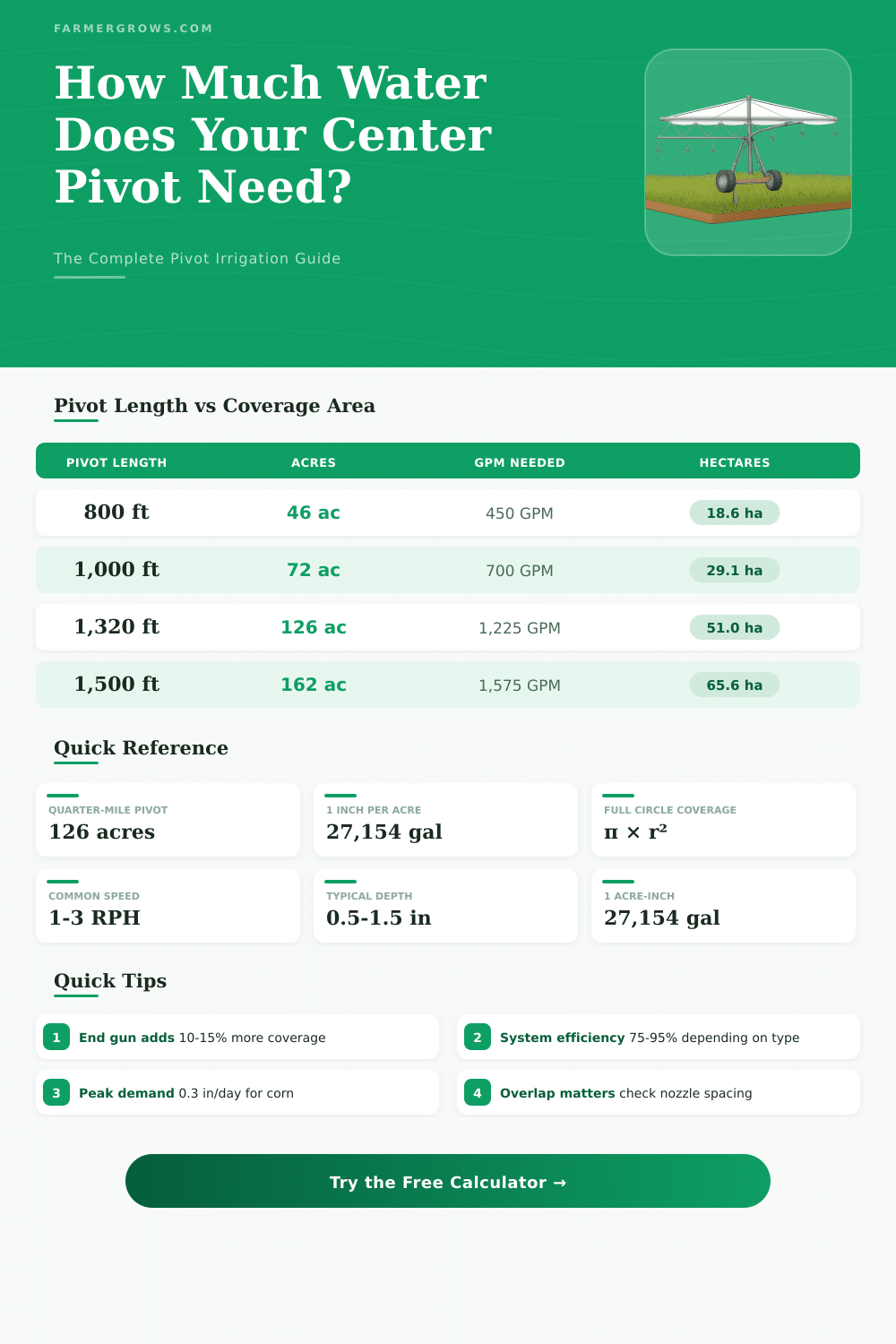
| Pivot Length | Full Circle (acres) | Full Circle (hectares) | GPM for 1 in/4 days |
|---|---|---|---|
| 400 ft (122 m) | 11.5 | 4.7 | 112 |
| 600 ft (183 m) | 26.0 | 10.5 | 252 |
| 800 ft (244 m) | 46.2 | 18.7 | 449 |
| 1,000 ft (305 m) | 72.2 | 29.2 | 701 |
| 1,200 ft (366 m) | 104.0 | 42.1 | 1,010 |
| 1,320 ft (402 m) | 125.7 | 50.9 | 1,221 |
| 1,500 ft (457 m) | 162.3 | 65.7 | 1,576 |
| 1,700 ft (518 m) | 208.7 | 84.5 | 2,027 |
| Crop | Peak ET (in/day) | Peak ET (mm/day) | Season Total (in) |
|---|---|---|---|
| Corn | 0.30 | 7.6 | 20–25 |
| Soybeans | 0.25 | 6.4 | 18–22 |
| Wheat | 0.22 | 5.6 | 12–18 |
| Alfalfa | 0.28 | 7.1 | 30–40 |
| Cotton | 0.27 | 6.9 | 22–28 |
| Potatoes | 0.25 | 6.4 | 18–24 |
| Vegetables | 0.20 | 5.1 | 12–18 |
| Turf / Grass | 0.18 | 4.6 | 24–36 |
| Application Depth | Gallons / Acre | Liters / Hectare | Acre-Inches |
|---|---|---|---|
| 0.25 in (6.4 mm) | 6,789 | 63,487 | 0.25 |
| 0.50 in (12.7 mm) | 13,577 | 126,974 | 0.50 |
| 0.75 in (19.1 mm) | 20,366 | 190,461 | 0.75 |
| 1.00 in (25.4 mm) | 27,154 | 253,948 | 1.00 |
| 1.50 in (38.1 mm) | 40,731 | 380,922 | 1.50 |
| 2.00 in (50.8 mm) | 54,309 | 507,896 | 2.00 |
| System Description | Pivot Length | Acres | GPM @ 1 in / 4 days |
|---|---|---|---|
| Small Field / Specialty Crop | 400 ft | 11.5 | 112 |
| Small Farm Pivot | 600 ft | 26.0 | 252 |
| Medium Farm Pivot | 800 ft | 46.2 | 449 |
| Standard Half-Section | 1,000 ft | 72.2 | 701 |
| Quarter-Mile Standard | 1,320 ft | 125.7 | 1,221 |
| Extended Quarter-Mile | 1,500 ft | 162.3 | 1,576 |
| Large Field / Section | 1,700 ft | 208.7 | 2,027 |
| 2x Quarter-Mile (dual pivot) | 1,320 ft x2 | 251.4 | 2,442 |
Central pivot irrigation helps to water crops by means of gear that twists around one central spot. One also calls it radial or rotating irrigation. The setup uses sprinklers to spread the seed in a surrounding pattern.
The big rotating device sits on wheels and it twists around that central place. From here comes the name of the method.
How Central Pivot Irrigation Works and Its Good and Bad Points
The way it works is fairly easy. One pumps water from a well in the centre of the round, usually from underground aquifers. Later it runs through a long pipe, that extends even hundreds of metres.
The whole device twists around that central spot. The pivot is made up of a long water pipe, that hangs high on moving towers on wheels.
Between the main benefits of central pivot irrigation is the little need of hand work. After setup, one can control and watch it from afar with almost no physical action. Compared to other ways, like furrow irrigation, that requires much direct effort and channels dug, that is a big difference.
Pivot systems can be used during the whole day, rather than some others, that must pause to move them.
Doubly more efficient is central pivot irrigation than simply flooding the fields. The benefits of different irrigations are huge. In regions, where the yearly rain average only eight to ten inches reach, irrigation can decide between sixty bushels of corn each acre and more then two hundred.
Some grounds are very sandy and drain too quickly, so that even in rainy places the soil does not keep the water well. That shows how useful irrigation can be.
Such systems work for various types of soil. Central pivot works on fields with up to thirty percent slope, but they recommend only fifteen percent. One even uses them on hilly lands, what makes them practical in many farm regions.
The corners of the field, that the round does not cover, one still farms, so no ground truly misses. At the finish of the line is a big sprinkler called final cannon. It has an electronic valve to turn.
The final cannon shuts off, when the pipe end reaches the outer edges of the field, and turns on, when it points to the corners.
Even so there are some downsides. The high cost to run and care for the system is an important problem. In some areas the level of the aquifer drops.
Central pivot does not cover square fields fully because of its round path. They best serve on flat or a bit hilly soil and are limited to medium or lightweight ground. To use and care for them, one needs technical knowledge.
Around one to two percent of crops are lost because of the tire paths, where the towers roll, but that cost is thought to be small. The paths create their own ruts and one canfill them with gravel.
Also safety matters. Central pivot systems bring several risks. Between problems are missing covers of the gearbox and danger of falls from stairs and towers.
If one does not care for the system correctly, it can cause uneven water spread, loss of crops, bigger energy use, diseases in the plants and nitrogen loss because of drainage or runoff.
The current costs depend on several things. If the water source is two hundred feet deep and the pivot covers around a hundred twenty acres, with sixty percent of the crop water from irrigation, the yearly cost could reach around twelve thousand dollars. Installing the electrical tie to the pivot centre can cost between seven and ten thousand dollars only for digging and pulling cables.
Modern technology allows farmers to control their pivot setups by means of smartphone, tablet or computer. GPS mapping of the fields eases the use of water and nutrients based on output and soil maps. Central pivot systems grow various types of crops everywhere in the world, between them corn, wheat, cotton, sorghum, bulbs, coffee, fruits and flowers.