🧱 Brick Edging Calculator
Calculate exactly how many bricks you need for garden beds, paths & landscape edging
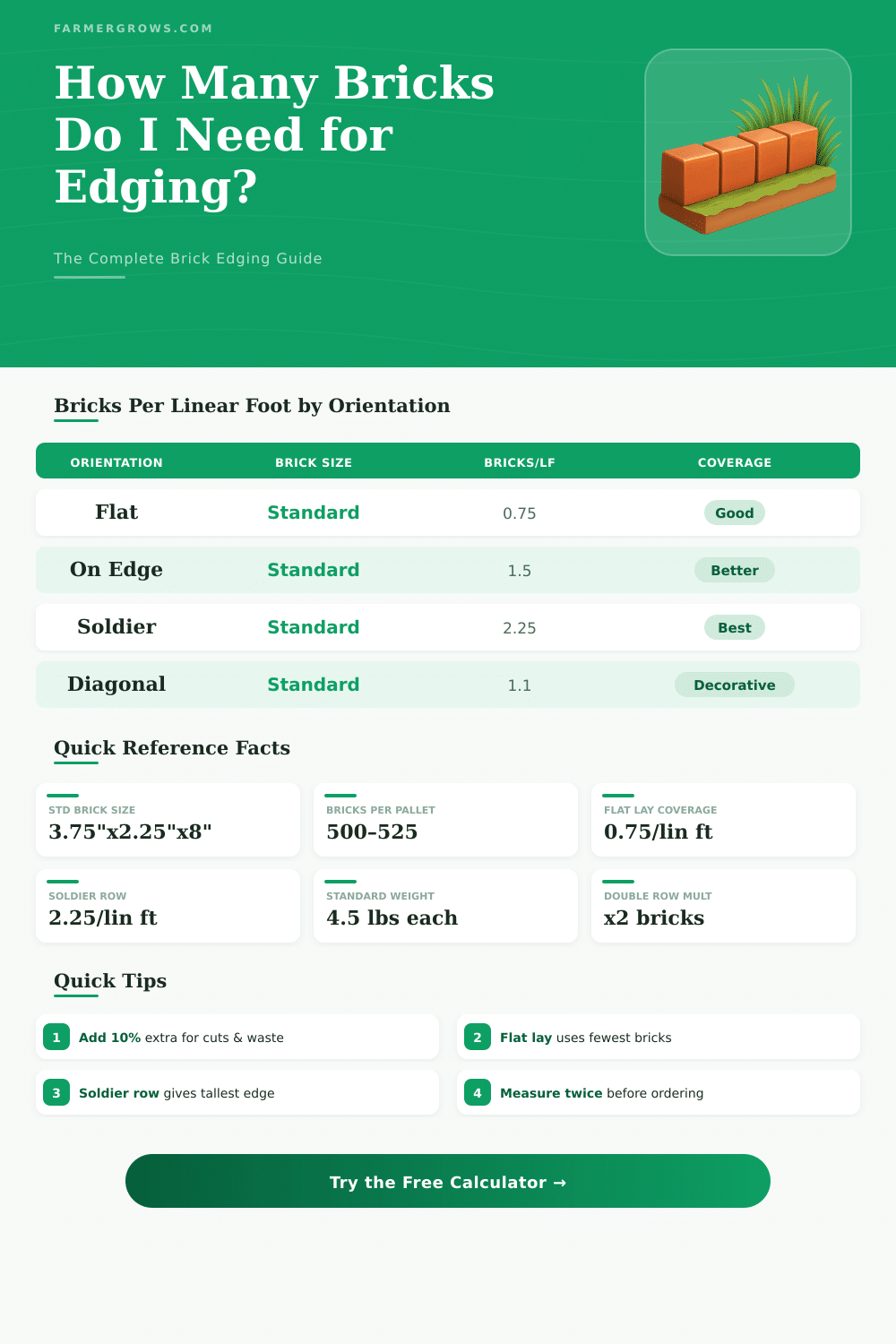
| Orientation | Bricks/Linear Ft | Bricks/Linear M | Visible Height | Best Use |
|---|---|---|---|---|
| Flat (Stretcher) | 0.75 | 2.46 | 2.25 in (5.7 cm) | Low border, paths |
| On Edge | 1.50 | 4.92 | 3.75 in (9.5 cm) | Garden beds, general |
| Soldier (Upright) | 2.25 | 7.38 | 7.625 in (19.4 cm) | Tall formal edges |
| Diagonal / Angled | 1.10 | 3.61 | Varies | Decorative edging |
| Double Flat | 1.50 | 4.92 | 2.25 in (5.7 cm) | Wide edging strip |
| Double Soldier | 4.50 | 14.76 | 7.625 in (19.4 cm) | Thick retaining edge |
| Brick Type | Length | Width | Height | Avg Weight |
|---|---|---|---|---|
| Standard Clay | 7.625 in / 19.4 cm | 3.75 in / 9.5 cm | 2.25 in / 5.7 cm | 4.5 lbs / 2.0 kg |
| Jumbo Brick | 11.5 in / 29.2 cm | 3.75 in / 9.5 cm | 2.75 in / 7.0 cm | 6.5 lbs / 2.9 kg |
| Concrete Paver | 7.75 in / 19.7 cm | 3.875 in / 9.8 cm | 2.375 in / 6.0 cm | 5.0 lbs / 2.3 kg |
| Reclaimed Brick | 8.0 in / 20.3 cm | 3.75 in / 9.5 cm | 2.25 in / 5.7 cm | 4.8 lbs / 2.2 kg |
| Thin Brick Veneer | 7.625 in / 19.4 cm | 3.625 in / 9.2 cm | 0.75 in / 1.9 cm | 1.8 lbs / 0.8 kg |
| Fire Brick | 9.0 in / 22.9 cm | 4.5 in / 11.4 cm | 2.5 in / 6.4 cm | 7.5 lbs / 3.4 kg |
| Roman Brick | 11.625 in / 29.5 cm | 3.5 in / 8.9 cm | 1.625 in / 4.1 cm | 5.0 lbs / 2.3 kg |
| Utility Brick | 11.625 in / 29.5 cm | 3.625 in / 9.2 cm | 3.625 in / 9.2 cm | 7.0 lbs / 3.2 kg |
| Project | Est. Length | Flat Bricks | On-Edge Bricks | Soldier Bricks |
|---|---|---|---|---|
| Small garden bed | 20 ft (6.1 m) | 15 | 30 | 45 |
| Medium flower border | 40 ft (12.2 m) | 30 | 60 | 90 |
| Large bed perimeter | 60 ft (18.3 m) | 45 | 90 | 135 |
| Circular tree ring | 19 ft (5.8 m) | 14 | 29 | 43 |
| Driveway edge (one side) | 50 ft (15.2 m) | 38 | 75 | 113 |
| Full yard border | 120 ft (36.6 m) | 90 | 180 | 270 |
| Walkway (both sides) | 80 ft (24.4 m) | 60 | 120 | 180 |
Brick edging in a garden means use of bricks to form limits between various parts of the space, around flowers beds or trees. That helps keep lawns, paths and flower beds in good order during the whole year. Brick edging keeps them firmly placed and creates a clear line, that shows differences of colours and textures, so the whole design of the garden areas looks better.
In tough garden work, simple style works best. A clean look appears, if you limit yourself to two or three kinds of materials in the yard, for instance brick edging together with usual paving stones. Two-level brick edging gives a base that flatly keeps ground, flower beds or other garden pieces.
How to Lay Brick Edging
Placing two layers of bricks helps to raech the wanted height.
For laying brick edging, start by digging a slice a bit deeper than the bricks when they lay flat, around three until four inches. Loosen the soil, and make precise slices by means of a digging fork or by means of a special tool for bed edges with a curved blade. The slice should be one inch broader than the brick on any side and two inches deeper.
Fill it with base material in a two-inch layer below. Later, pour a layer of good paving sand on that base.
Lines from string help to ensure, that the edges stay flat, without upward or downward parts. A simple wooden board serves also as an easy replacement for the string method, to get smooth edges. Using a knife for beds with a shovel or clippers for brick, you well define the slice, if the terrain is flat.
A PVC tube as template at the outer side of the garden edge provides a reliable guide four the work.
Bricks you can arrange at the edge by means of the long side facing the bed. They are quite narrow, so turning in gentle corners does not matter, if you do not need perfection. Arrange the edge of the bed with bricks pressed against the grass line, equal between themselves but not too near, to leave space for sand.
Best to buy clay paving stones, that sometimes are called bricks that resist severe weather.
There are also plastic edging bricks, that simply click together. They bend or go straight. No need to draw, dig or mix mortar.
Simply click them and press into the soil. One packet covers twenty-five feet of edge and surrounds a tree in some minutes.
When you build a retaining wall with bricks, the next layers must lean a bit backwards, so that the front side slightly slopes toward the filled part. The space in the slice behind the bricks fill with stones for good drainage. For the two most upper layers, use support aids to stop the bricks in position, because there islack of weight on top to set them.