🌿 Boston Fern Sunlight Calculator
Calculate ideal light for your Boston fern indoors or outdoors
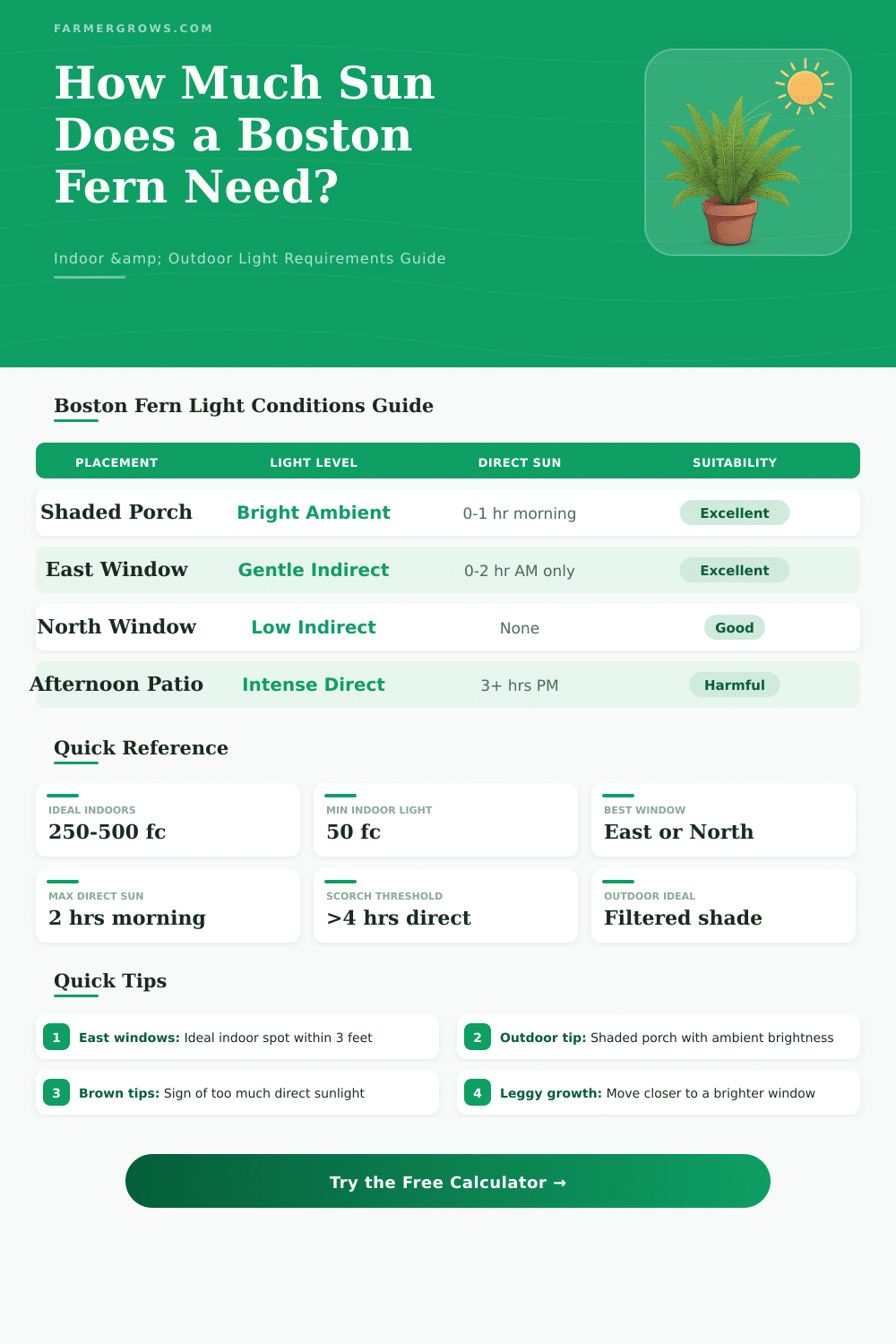
| Condition | Direct Hours | Sun Timing | Suitability | Notes |
|---|---|---|---|---|
| Shaded porch | 0–0.5 hrs | Filtered all day | Excellent | Ideal spot; bright ambient |
| North-facing patio | 0–1 hr | Morning only | Excellent | Consistent cool indirect light |
| Dappled tree shade | 1–2 hrs | Filtered / mixed | Good | Variable but generally fine |
| Partial AM sun | 2–3 hrs | Morning only | Adequate — monitor | Watch for tip browning in heat |
| Mixed sun & shade | 3–4 hrs | Mixed throughout | Too Bright — risk | Move to shadier spot |
| Full afternoon sun | 4+ hrs | Afternoon only | Harmful — will scorch | Fronds will burn rapidly |
| Window | Base Light | Distance Options | Suitability | With Sheer Curtains |
|---|---|---|---|---|
| East | ~200 fc base | Best <2 ft or 2–5 ft | Excellent | Not needed; still adequate |
| North | ~80 fc base | Best <2 ft | Good (close only) | Not recommended (too dim) |
| West | ~300 fc base | 2–5 ft recommended | Good with filter | Recommended — softens PM rays |
| South | ~500 fc base | 5+ ft or use curtains | Adequate with care | Required to prevent scorch |
| Light Level | Foot-Candles | Window Equivalent | Boston Fern Response |
|---|---|---|---|
| Very Low | <50 fc | Dark corner / >10 ft N | Decline; fronds yellow & drop |
| Marginal | 50–100 fc | North window 5–10 ft | Survives; slow leggy growth |
| Adequate | 100–250 fc | East window 5–10 ft | Steady growth; some vigor |
| Good | 250–500 fc | East <2 ft / West 2–5 ft | Lush, healthy fronds |
| Excellent | 500–800 fc | East at window / S with curtain | Thriving; deep green growth |
| Too Bright | >800 fc | South/West at window | Tip scorch; rapid browning |
Boston Fern benefit best under light that is bright but indirect sunshine. Here is the main rule for their care so that they stay happy. Place beside window with filtered or gentle light works great for that tropical plant, whether one grows it inside or outside.
Direct sunshine risks to burn their tender leaves. If too much of it reaches the plant, it can dry out and the leaves become burned. For indoor growing, north or east window is the best option.
Boston Fern Needs Bright, Indirect Light
Also sitting behind curtain at south or west window works well. The main idea is give medium to bright light, without strong direct rays that hit the leaves.
Morning fresh sunshine really pleases Boston Fern. They require at least two hours of bright, filtered or indirect light each day. Places with morning or evening sunshine commonly is the best.
Even so, the heat in afternoon can become too strong. For instance, balcony positioned west can flood the palnt with warm evening Sun.
The amount of direct sunshine that Boston Fern lasts depend also on the place of growth. In cool climate as in England, the fern can receive more direct light. In warm region as Arizona, one should fully escape direct rays.
The climate plays big role.
In autumn and winter, the plant needs deal of bright indirect light. It is well to receive at least two hours of such sunshine day in those seasons, best in the mourning or late afternoon. The growth slows in winter, and the plant can seem less healthy in that period, especially if it only receives surrounding light of west window.
Boston Fern last low light levels. They are good plants for rooms that lack direct sunshine. Even so, absence of light causes problems.
The leaves can fade, the growth slows and the plant can become leggy or its leaves turn yellow. Moving poorly looking fern to more bright place beside south window with indirect light can help it revive.
Outside, Boston Fern like shady places. One choose filtered shade. Inside, one place the fern as close to window as possible, without risk of sunburn.
The spot should copy the filtered sunshine that those ferns find in their natural surroundings.
Boston Fern laid in full Sun soon can start browning. Remove the brown leaves and move the plant to shady place help it gain force. Boston Fern last between three and six hours of sunshine daily, but that light should mostly be indirect or filtered sothat the leaves stay in good state.