🌳 Bonsai Pot Size Calculator
Calculate the ideal pot dimensions and soil volume for your bonsai tree based on trunk diameter, tree height, and style
lbs/cu ft
lbs/cu ft
lbs/cu ft
lbs/cu ft
lbs/cu ft
lbs/cu ft
lbs/cu ft
lbs/cu ft
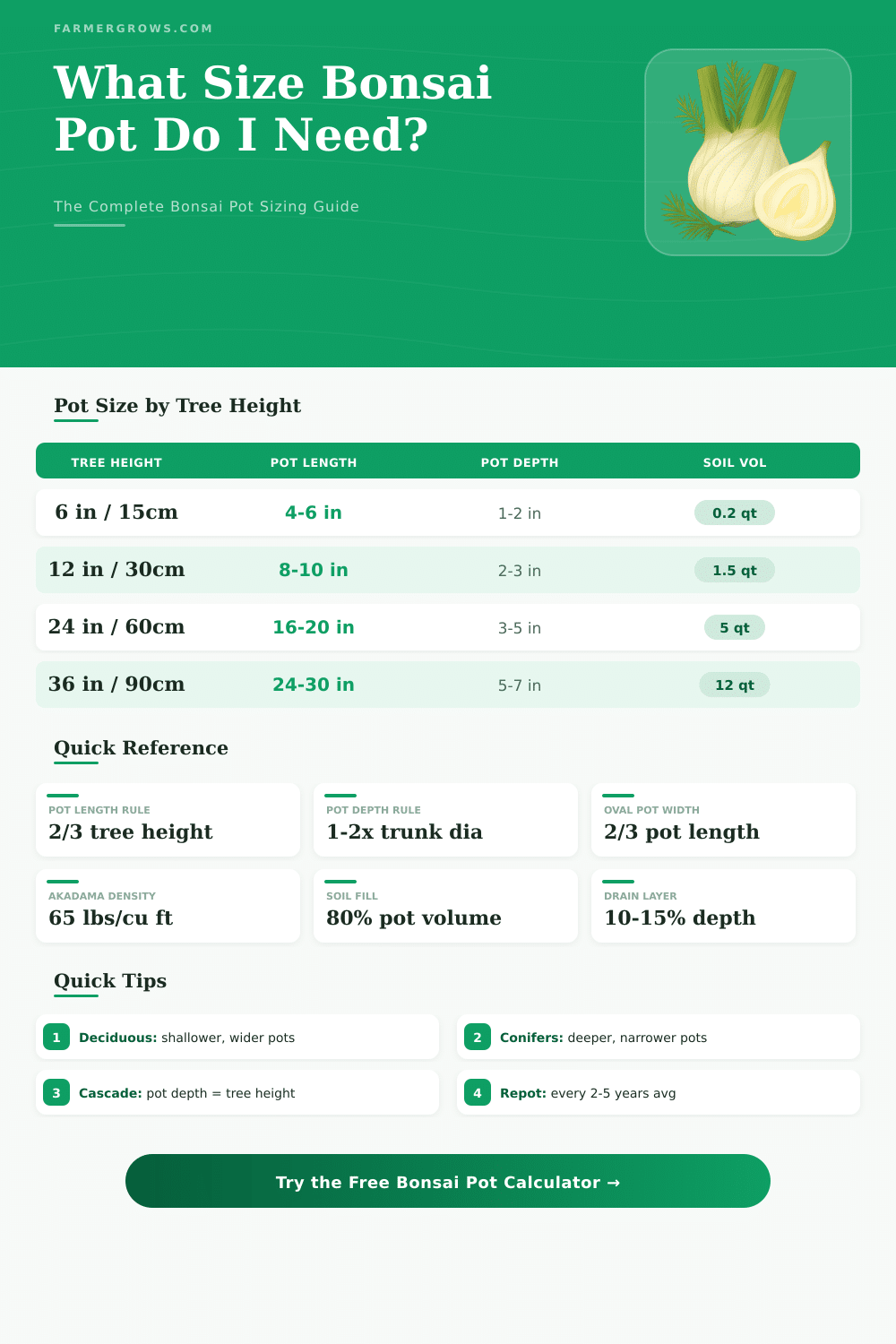
| Tree Height | Pot Length | Pot Depth | Pot Width (Oval) |
|---|---|---|---|
| 3–6 in (8–15 cm) | 2–4 in (5–10 cm) | 0.75–1.5 in (2–4 cm) | 1.5–3 in (4–8 cm) |
| 6–10 in (15–25 cm) | 4–7 in (10–18 cm) | 1.5–2.5 in (4–6 cm) | 3–5 in (8–13 cm) |
| 10–18 in (25–45 cm) | 7–12 in (18–30 cm) | 2–3.5 in (5–9 cm) | 5–8 in (13–20 cm) |
| 18–30 in (45–75 cm) | 12–20 in (30–50 cm) | 3–5 in (8–13 cm) | 8–14 in (20–35 cm) |
| 30–48 in (75–120 cm) | 20–32 in (50–80 cm) | 5–8 in (13–20 cm) | 14–22 in (35–55 cm) |
| Pot Size (L×W×D) | Volume (cu in) | Volume (liters) | Dry Soil Weight (akadama) |
|---|---|---|---|
| 4×3×1.5 in | 14.4 | 0.24 L | 0.5 lbs (0.24 kg) |
| 6×4×2 in | 38.4 | 0.63 L | 1.4 lbs (0.66 kg) |
| 8×6×2.5 in | 96 | 1.57 L | 3.6 lbs (1.63 kg) |
| 10×7×3 in | 168 | 2.75 L | 6.3 lbs (2.86 kg) |
| 14×10×3.5 in | 392 | 6.42 L | 14.8 lbs (6.7 kg) |
| 18×13×4 in | 748.8 | 12.27 L | 28.2 lbs (12.8 kg) |
| 24×16×5 in | 1536 | 25.17 L | 57.8 lbs (26.2 kg) |
| 30×20×6 in | 2880 | 47.2 L | 108.3 lbs (49.1 kg) |
| Bonsai Style | Pot Shape | Pot Depth Rule | Length Rule |
|---|---|---|---|
| Formal Upright (Chokkan) | Rectangle, Oval | 1–1.5× trunk diameter | 2/3 tree height |
| Informal Upright (Moyogi) | Rectangle, Round, Oval | 1–1.5× trunk diameter | 2/3 tree height |
| Slanting (Shakan) | Rectangle, Oval | 1–2× trunk diameter | 2/3 total spread |
| Cascade (Kengai) | Tall Round, Square | Equal to tree drop | 1/3–1/2 canopy width |
| Semi-Cascade (Han-kengai) | Medium Round, Oval | 1.5–2× trunk diameter | 2/3 canopy width |
| Literati (Bunjin) | Small Round, Oval | 1× trunk diameter | 1/3 tree height |
| Forest (Yose-ue) | Shallow Oval, Slab | 0.5–1× tallest trunk | 2/3 group spread |
| Windswept (Fukinagashi) | Rectangle, Oval | 1–2× trunk diameter | 2/3 total spread |
| Bag Size | Volume | Fills Pots (Medium 10×7×3) | Approx Weight (Akadama) |
|---|---|---|---|
| 1 quart | 57.75 cu in / 0.95 L | 0.34 pots | 2.2 lbs (1 kg) |
| 2 quarts | 115.5 cu in / 1.89 L | 0.69 pots | 4.3 lbs (2 kg) |
| 1 gallon | 231 cu in / 3.79 L | 1.38 pots | 8.7 lbs (3.9 kg) |
| 2 gallons | 462 cu in / 7.57 L | 2.75 pots | 17.4 lbs (7.9 kg) |
| 14 liters (standard bag) | 854 cu in / 14 L | 5.08 pots | 32 lbs (14.5 kg) |
| 5 gallons | 1155 cu in / 18.93 L | 6.88 pots | 43.4 lbs (19.7 kg) |
The information that you will read is based on real experiences of growers, discussions in forums and all shared experiences in the online bonsai community.
bonsai pots come in many different forms. One finds squares, rectangles, round shapes, ovals, long ovals, octagons, hexagons, free ranges, low trays and higher vases. There is not only one right way to choose a bonsai pot, but some basic rules work better than others.
How to Choose the Right Bonsai Pot
The most important thing is to choose a display pot that truly matches your tree instead of stealing the attention. Think of a bonsai pot as a helping role in theater. It should not be too visible and attention-stealing, so that it pulls the look from the tree, but it does need enough character, so that the whole look does not seem dull and empty.
Drain holes? That is totally needed. Without them roots become too wet and that truly risks the life of the plant.
Those little holes around the bottom have another benefit, here one can set wire for safely fixing the tree in the pot. Many pots come with built-in drain mesh, that has little openings to stop the soil from spilling. There are both glazed and unglazed pieces.
For ceramic vases the forms lotus, oval and rectangle are the most commonly found.
The materials that the pot is made from truly affect its use. Ceramic is commonly chosen because of its strength and nice look. Old Chinese pots sometimes used china.
The Yixing clay from China became known for bonsai vases. Also thier is the Tokoname ceramic, imported from Japan, that has its own fame. Some stores have one of the biggest collections of Tokoname pots in the land, got through Japanese auctions or from private collectors.
Handmade pieces from skilled potters are truly unique, because no two of them are exactly the same.
Prices change a lot based on what one buys. A small three-color Chinese pot can cost around twenty-five dollars. Custom handmade pieces from known artists?
They can easily pass a thousand dollars. For unglazed pots in twelve-inch size one expects a price around hundred thirty-five dollars. Finding good shohin-, mame- and semi-cascading types, that do not wreck the budget, becomes harder.
There seems to bee a lack of budget-friendly pots in many regions, while prime pieces from good artists stay fairly easy to find.
Plastic training pots work surprisingly well, especially when the trees still grow. Many bonsai fans live well only in plastic training pots during their whole life. What truly matters is only how people care about the tree itself, not whether it lives in a nice ceramic vase.
Plastic pots have real benefits (they are cheap), one can recycle them and they work for both indoor and outdoor growing of trees in early phase.
The main role of a bonsai pot is to hold and limit the growth of the tree. They work best after the tree reaches the stage where good branching starts to form. Low vases affect the shape and look of roots, though they also help to dry them more quickly.
When a tree needs more space, moving it into a bigger growing pot gives more room for roots, which means bigger growth ability. If one wants a thick trunk, then planting directly in the soil gives the fastest progress.
Old patina on old pots has real artistic value. Real aging always looks more convincing than forced attempts to copy it. It reflects the unchanged aged look of wildly gathered trees, which are almost impossibleto copy.
Online stores, bonsai groups in social media and special bonsai dealers are good places to find great pots. Adding a collection of custom handmade pieces, as your trees mature, gives the best visual impact and allows you to exactly match every pot with its tree. Many potters accept orders directly through their pages.
Handmade bonsai ceramic is produced in places like Ohio and Sweden by eager artists. Pots from some makers come with fixing wire and drain mesh already installed, which is smart thinking. Creative people also manage to reuse everyday vases for bonsai pots, using a diamond drill to make the drain holes that are missing.
Red ceramic Yixing pots have set sizes… Eight and a half inches long, six and a half inches wide and only under three inches high. They weigh around two pounds and have a needed drain hole.
They work for moving trees that outgrew their homes or for reaching a custom style.