🎋 Bamboo Plant Water Calculator
Calculate exactly how much water your bamboo needs based on species, size & growing conditions
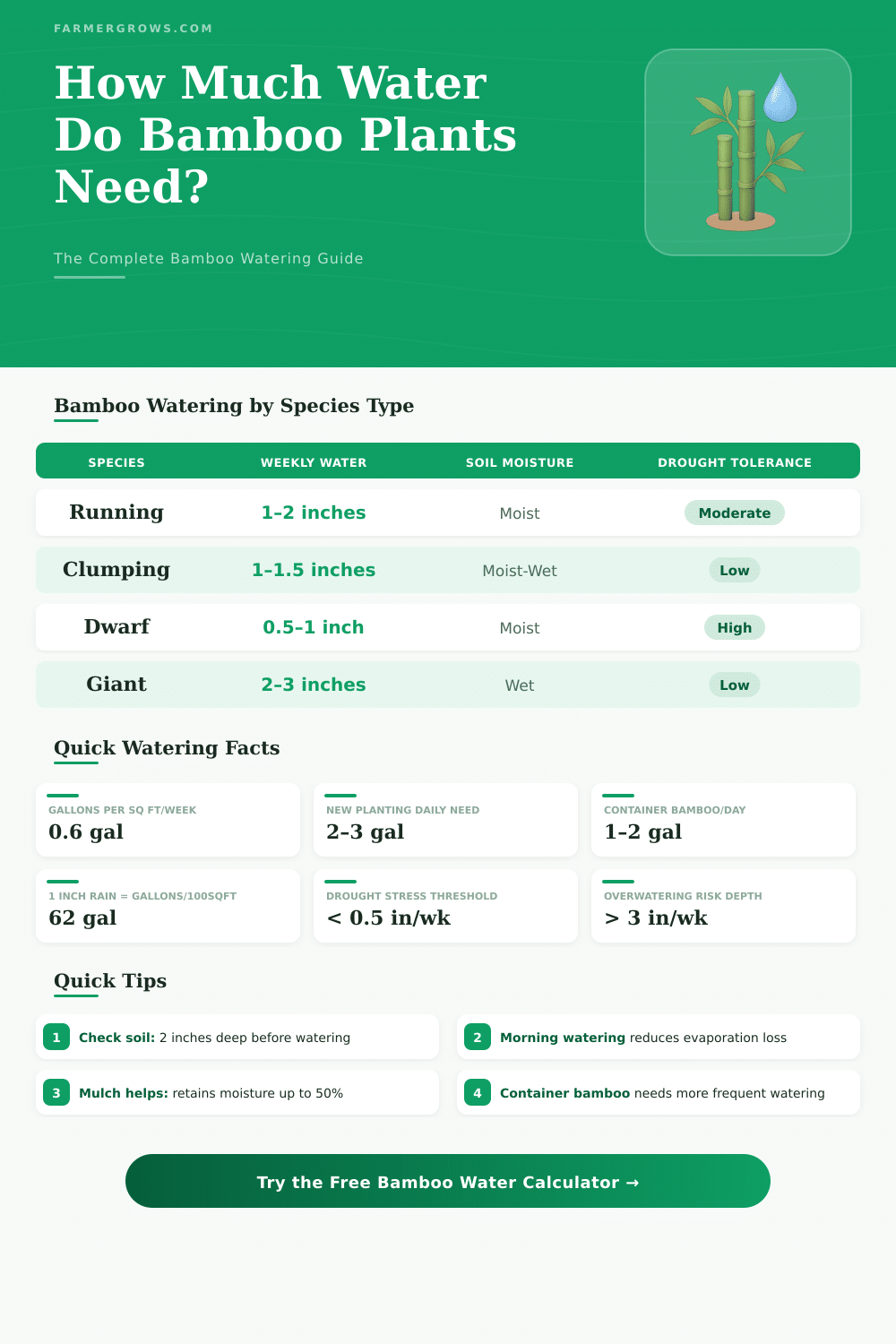
| Water Depth | Gallons per 100 sq ft | Liters per 10 m² | Gallons per 500 sq ft |
|---|---|---|---|
| 0.25 inch (6 mm) | 15.6 gal | 59 L | 78 gal |
| 0.5 inch (13 mm) | 31.2 gal | 118 L | 156 gal |
| 1 inch (25 mm) | 62.4 gal | 236 L | 312 gal |
| 1.5 inches (38 mm) | 93.5 gal | 354 L | 467 gal |
| 2 inches (51 mm) | 124.7 gal | 472 L | 624 gal |
| 3 inches (76 mm) | 187.1 gal | 708 L | 935 gal |
| Growing Method | Daily Frequency | Weekly Total | Key Consideration |
|---|---|---|---|
| In-Ground (New) | Daily for 2–4 weeks | 1.5–3 in / 94–187 gal per 100 sqft | Deep root establishment |
| In-Ground (Established) | 2–3x per week | 1–2 in / 62–125 gal per 100 sqft | Drought-tolerant once rooted |
| Container (Small <5 gal) | Daily | 1–2 gal total | Dries out faster than ground |
| Container (Large 15+ gal) | Every 2–3 days | 5–10 gal total | Check top 2 inches of soil |
| Raised Bed | Every 2–4 days | 1–1.5 in equivalent | Better drainage than ground |
| Season | Water Multiplier | Frequency | Notes |
|---|---|---|---|
| Spring | 1.2x base | 2–3x per week | Active shoot growth begins |
| Summer | 1.5x base | 3–4x per week | Peak demand; heat stress risk |
| Fall | 0.8x base | 1–2x per week | Growth slows; reduce watering |
| Winter | 0.4x base | Every 2–3 weeks | Near dormant; minimal need |
Bamboo plants rank between the most quickly growing plants on Earth. Some species reach around thirty centimetres each day, while others grow almost one of the four feet in only one day. There exist more than thousand different species of bamboo plants They differ in height from only half a metre until more than twenty-three metres, and also show big colour range.
Bamboo plants form a group of tall, thick grasses similar to trees. Most of them come from forests and stay green all year. They belong to the grass family Poaceae and form the subfamily Bambusoideae.
Bamboo Basics: Growth, Types, Care and Uses
The large bamboo plants are the biggest members of that grassy family.
In North America there are around two hundred fifty strong mild bamboo plants. Bamboo plants for the 7th zone can grow in a wide range of states, from Alaska and Arizona until Virginia and West Virginia. The basic rule for all plants is: right species, right place.
For instance, moso bamboo works more for tropical settings and it is liked because of its faded look. In Florida moso bamboo falied, because it is a mild species, while Florida is mostly under-tropical. Dendrocalamus asper works as a better choice here, especially in the south part of Florida.
Compact bamboo plants do not invade the area. Their roots stay dense and the crowns do not spread. Most compact types reach eight until sixteen feet in mild regions, which works for small areas.
Those rare tropical compact types are easy to grow and stay wear one planted them. Running bamboo is a whole other thing. It spreads itself underground by means of roots, and if any root is left in the ground, it will grow back.
Bamboo plants can adapt to most soil, but some species like more sour ground. The key is to avoid dirty, soggy or too dry soil. Most bamboo plants like sun, but species like sasa bamboo plants handle shade.
The biggest bamboo plants need at least five hours of direct sunshine for best growth. They need plenty of water, food and safety from competing grasses. When freshly planted, bamboo plants need daily water during at least one month.
Bamboo plants were used already before history was recorded. Their uses are many: food, shields, tools, weapons, water pipes, vases, fuel, privacy fences and landscaping. Fresh shoots are good for eating.
Bamboo forests release 35 percent more oxygen than the same area of trees, which helps to lower the carbon trace. Indoor bamboo plants also clean the surrounding air. In Asia and Latin America bamboo plants are well known, where communities use them for many needs.
During thelast ten years they became very liked landscape plants in the United States.