🐟 Aquarium Gravel Calculator
Find out exactly how much substrate your tank needs — by depth, shape, and material type
| Depth | Sq In Covered (1 lb Natural Gravel) | Sq Cm (metric) | Good For |
|---|---|---|---|
| 1 inch (2.5 cm) | ~18 sq in | ~116 sq cm | Bare bottom / fry tanks |
| 2 inches (5 cm) | ~9 sq in | ~58 sq cm | Community fish tanks |
| 3 inches (7.6 cm) | ~6 sq in | ~39 sq cm | Planted / cichlid tanks |
| 4 inches (10 cm) | ~4.5 sq in | ~29 sq cm | Deep planted tanks |
| 6 inches (15 cm) | ~3 sq in | ~19 sq cm | Heavy planted biotope |
| Bag Size | Approx. Cu In | Approx. Cu Cm | Covers at 2 in depth |
|---|---|---|---|
| 5 lb bag | ~14 cu in | ~230 cu cm | ~7 sq in |
| 10 lb bag | ~27 cu in | ~443 cu cm | ~13 sq in |
| 20 lb bag | ~54 cu in | ~885 cu cm | ~27 sq in |
| 25 lb bag | ~68 cu in | ~1113 cu cm | ~34 sq in |
| 50 lb bag | ~135 cu in | ~2213 cu cm | ~68 sq in |
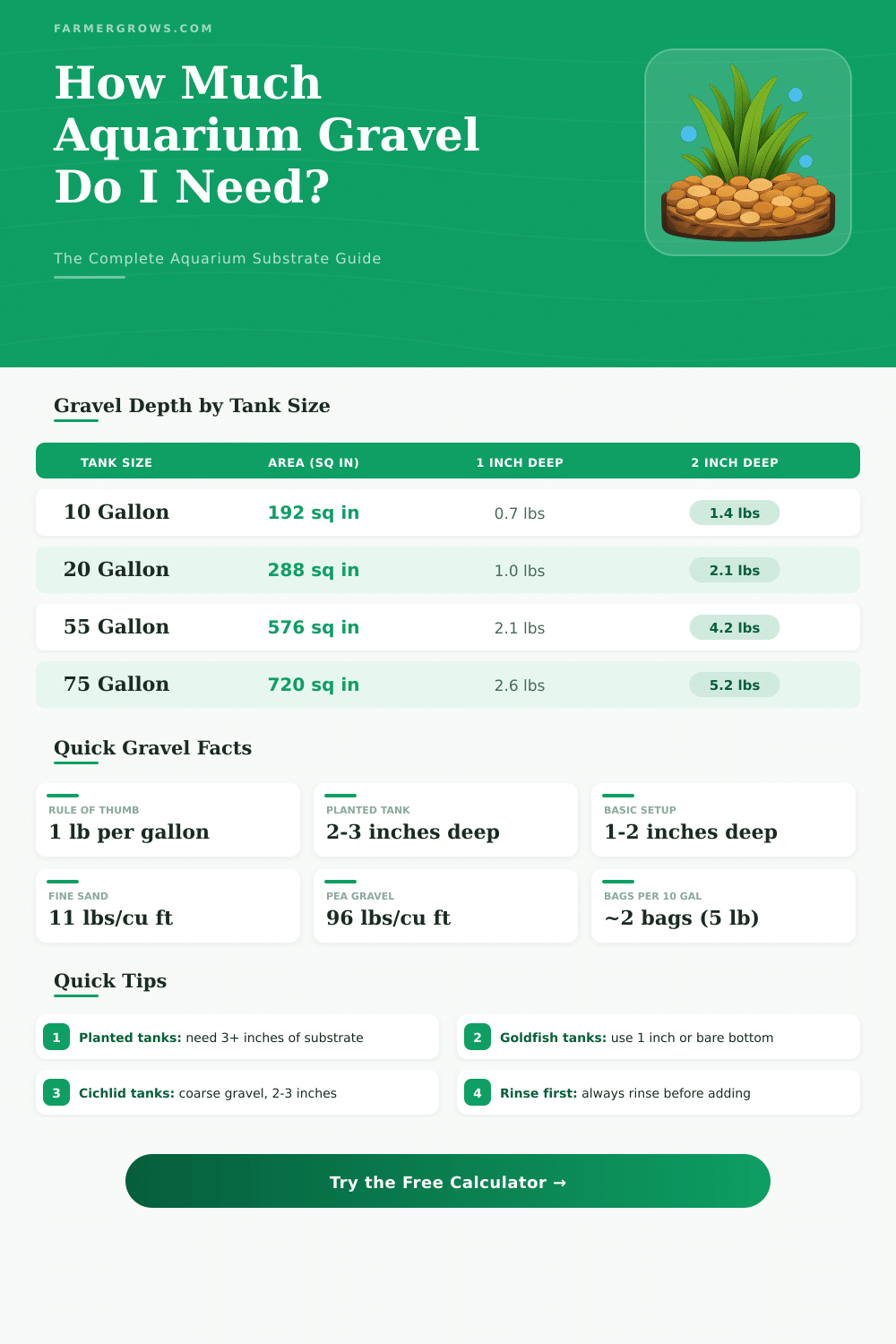
| Tank Size | Floor Area (sq in) | Gravel at 2 in (lbs) | Gravel at 3 in (lbs) |
|---|---|---|---|
| 5 Gallon (16x8) | 128 sq in | ~9 lbs | ~13 lbs |
| 10 Gallon (20x10) | 200 sq in | ~13 lbs | ~20 lbs |
| 20 Gallon (24x12) | 288 sq in | ~19 lbs | ~29 lbs |
| 29 Gallon (30x12) | 360 sq in | ~24 lbs | ~36 lbs |
| 40 Gallon (36x18) | 648 sq in | ~43 lbs | ~65 lbs |
| 55 Gallon (48x12) | 576 sq in | ~38 lbs | ~58 lbs |
| 75 Gallon (48x18) | 864 sq in | ~58 lbs | ~86 lbs |
| 125 Gallon (72x18) | 1296 sq in | ~86 lbs | ~129 lbs |
Aquarium Gravel ranks between the most liked bottoms for fish tanks, and not without reason. It comes in many kinds, various forms, sizes and shades that goes from natural ground colors to bright variants, that truly attracts the attention. From simple natural bottoms to special Aquarium Gravel made for particular species in mind.
For instance African cichlids do well with Aquarium Gravel that carries coral pieces; that truly helps to keep the water chemistry healthy in the tank.
All About Aquarium Gravel
Here Aquarium Gravel truly shines: it gathers bits of waste and scraps of food that falls to the bottom. Under that seen layer lies area, where helpful bacteria work and grow. Those good bacteria are truly important for keeping your tank in good state.
They break down fish waste and control levels of nitrate and nitrite. Aquarium Gravel also stops particles of food, waste and rot from wandeirng always in the water. That results in less need for water changes, although you still must care about regular cleaning.
The debate between sand and Aquarium Gravel depends mostly on what lives in your tank. Fishes that dig in the bottom searching food can injure their mouths or whiskers on sharp bits of Aquarium Gravel. Species that live below, like corydoras and plecos, actively dig and sift through the bottom as part of their natural habit.
Sand feels softer and gentler four the skin of such fishes. Rather, fishes that stay in the middle or top of the tank, like betta, tetras and livebearers, simply do not mind about what lies on the bottom.
For care, Aquarium Gravel is easily cleaned by means of special vacuum tube. It protects the bacteria colony and works well in everyday tank care. Sand, on the other hand, does not need vacuuming, but needs sometimes stirring to stay nice.
Loose sand can easily block the vacuum tube, what becomes truly stressful.
Plants grow well only in few cases with standard Aquarium Gravel. Tiger plants live in plain Aquarium Gravel for decades without problem (the bottom simply needs enough depth), so that roots stay set. Plants like anubias, java fern and moss not even want bottom; they attach directly to wood or lava rock.
Most tanks work well with around one to two pounds of Aquarium Gravel each gallon, what forms almost two-inch layer on the bottom. Too big grains of Aquarium Gravel do not work for aquariums, because food simply sits clearly up. Aquarium Gravel from hardware store costs much less than that from pet store, although the grains usually are bigger.
Always well wash new Aquarium Gravel before you use it. Many times, to be sure. The right Aquarium Gravel depends on what fishes you keep andwhether it is freshwater or saltwater system.