🌿 Perlite Soil Calculator
Calculate exactly how much perlite you need for soil amendments, raised beds, and potting mixes
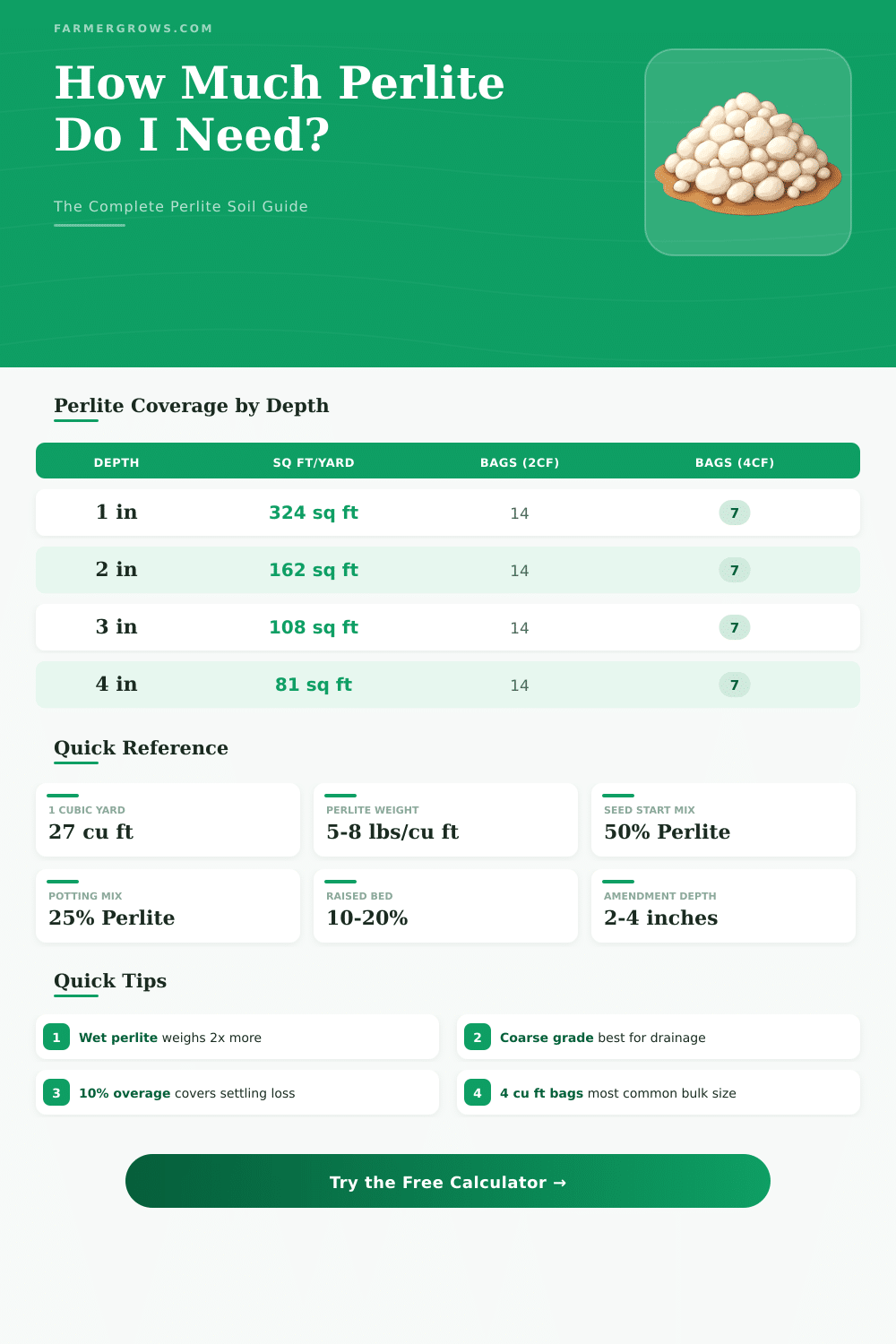
| Depth | Sq Ft per Cu Yd | Sq M per Cu M | Cu Ft per 100 Sq Ft |
|---|---|---|---|
| 1 in (2.5 cm) | 324 | 40 | 8.3 |
| 2 in (5 cm) | 162 | 20 | 16.7 |
| 3 in (7.6 cm) | 108 | 13.3 | 25.0 |
| 4 in (10 cm) | 81 | 10 | 33.3 |
| 6 in (15 cm) | 54 | 6.7 | 50.0 |
| Bag Size | Volume | Bags per Cu Yd | Coverage at 3 in |
|---|---|---|---|
| Small Bag | 2 cu ft (56.6 L) | 13.5 | 8 sq ft |
| Medium Bag | 4 cu ft (113.3 L) | 6.75 | 16 sq ft |
| Large Bag | 8 cu ft (226.5 L) | 3.38 | 32 sq ft |
| Quarter Yard | 6.75 cu ft (191.1 L) | 4 | 27 sq ft |
| Half Yard | 13.5 cu ft (382.3 L) | 2 | 54 sq ft |
| Full Yard | 27 cu ft (764.6 L) | 1 | 108 sq ft |
| Project | Area | Cu Yd at 3 in | 4 Cu Ft Bags |
|---|---|---|---|
| Window Box (1×4 ft) | 4 sq ft | 0.04 | 1 |
| Small Raised Bed (4×4 ft) | 16 sq ft | 0.15 | 1 |
| Standard Raised Bed (4×8 ft) | 32 sq ft | 0.30 | 2 |
| Garden Row (20×5 ft) | 100 sq ft | 0.93 | 7 |
| Large Bed (12×12 ft) | 144 sq ft | 1.33 | 9 |
| Greenhouse Bench (50×3 ft) | 150 sq ft | 1.39 | 10 |
| Full Garden Plot (25×25 ft) | 625 sq ft | 5.79 | 40 |
| Large Landscape (50×50 ft) | 2,500 sq ft | 23.15 | 157 |
| Application | Perlite % | Perlite per Cu Ft of Mix | Grade Recommended |
|---|---|---|---|
| Seed Starting | 50% | 0.50 cu ft | Fine |
| Succulent / Cactus | 40% | 0.40 cu ft | Coarse |
| Container / Potting | 25–30% | 0.25–0.30 cu ft | Medium |
| Garden Soil Amendment | 15–20% | 0.15–0.20 cu ft | Coarse |
| Raised Bed Fill | 10–15% | 0.10–0.15 cu ft | Medium/Coarse |
| Lawn Top Dressing | 10% | 0.10 cu ft | Fine/Medium |
| Propagation / Cuttings | 100% | 1.00 cu ft | Coarse |
| Drainage Layer | 100% | 1.00 cu ft | Coarse |
Perlite, this natural volcanic mineral, appears as little white pieces almost like tiny balls. Likely you noticed those white spots floating in potting soil. That is perlite working.
When volcanic rock spills and bubbles burst, it forms this light, airy material. It looks like popcorn, only made from glass. It looks like bits of foam and really, it almost does not weigh anything.
What Perlite Is and How It Helps Plants
Gardeners add perlite to soil mix mainly because of two reasons: better drainage and better airflow. The open structure of it creates little air spaces in the soil, allowing roots to reach the oxygen that they need to live. Without enough oxygen, roots can choke.
Too wet soil causes slow growth or even root rot. Perlite keeps that important air available even after watering.
If you look at garden perlite under a microscope, you will see that it is full of tiny holes. In one way, those holes hold a bit of moisture and food for the plants. In the other way, they allow excessive water to quickly go.
Depending on the kind, garden perlite can absorb up to eight times its own wait of water, and even so it helps oxygen reach the roots.
In pots, garden beds or raised beds, you can use perlite just as well. It helps the soil stay loose and stops it from getting too wet. It also works well for starting cuttings.
Many gardeners plant directly in pure perlite. Cuttings in it grow leaves and roots over time.
Here is a weird trouble: perlite floats. Because it is this lightweight, it climbs to the surface during watering. Wind can blow it around.
Laying something heavier on top helps to keep it below. Interestingly, perlite on the soil surface often takes a reddish shade over time, while the buried part stays whitebright.
The right ratio for a mix depends on what you grow, what pot you use and what other things go in your soil mix. A good starting spot is around a quarter to a third of perlite with standard garden soil. For succulents, a mix of 40 percent cactus soil and 60 percent perlite usually works well.
If plants have problems with moisture, going up to half perlite can really help. Another good method is two parts compost soil to one part perlite.
Store-bought potting mixes usually rely on organic material that breaks down and causes problems like fungus over time. Perlite, as a mineral addition, helps the soil stay useful longer, without adding weight or blocking water flow. It does not break down or give food itself, so you will still have to feed the plant.
Even so, a standing layer of perlite on the soil surface can effectively stop fungus gnats.