🌿 Nitrogen Fertilizer Calculator
Calculate exactly how much nitrogen fertilizer your lawn or garden needs based on area, target N rate, and fertilizer type.
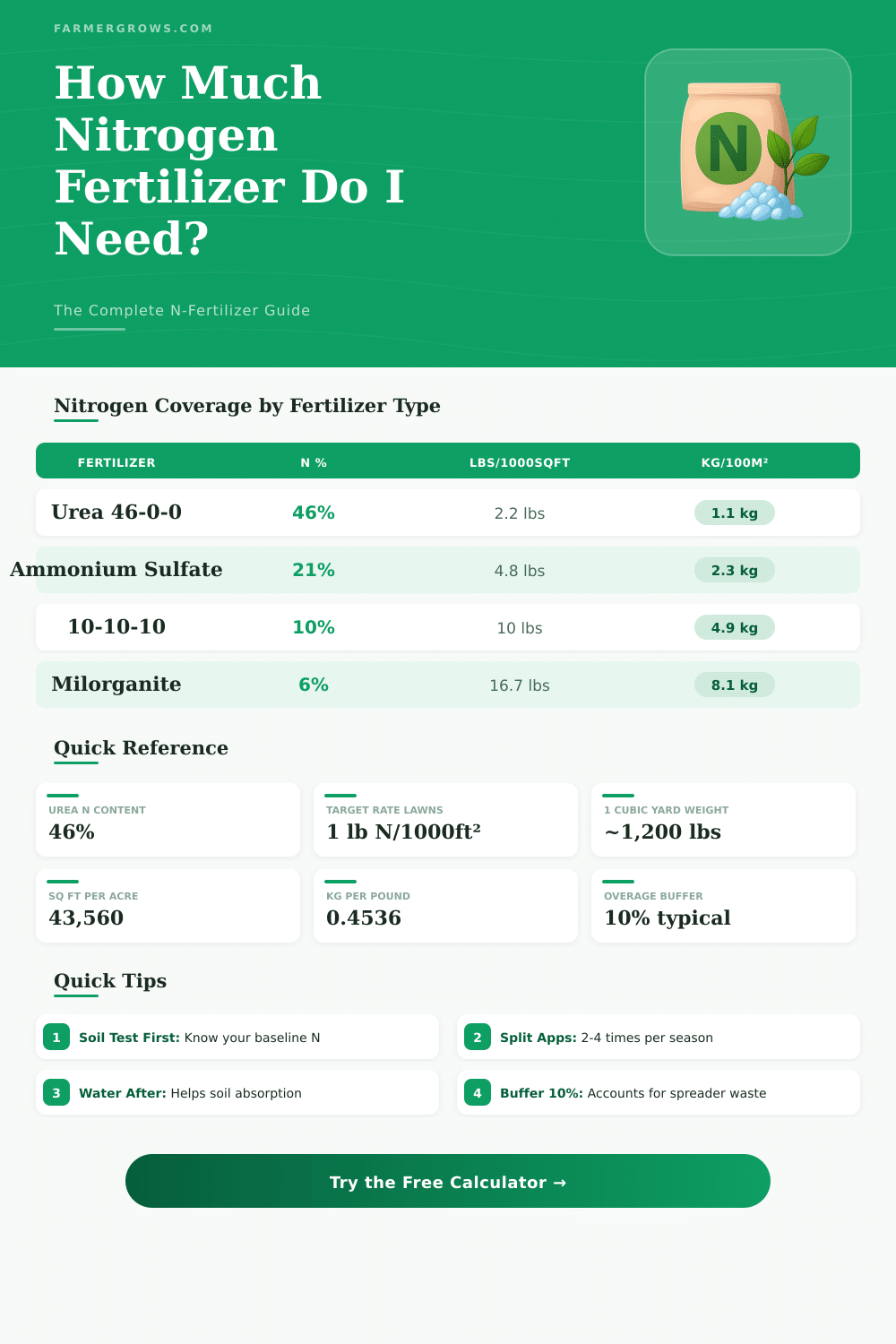
| Fertilizer Type | N % | Lbs for 1 lb N | Lbs for 0.5 lb N | Kg for 0.5 kg N / 100 m² |
|---|---|---|---|---|
| Urea (46-0-0) | 46% | 2.17 lbs | 1.09 lbs | 1.09 kg |
| Ammonium Sulfate (21-0-0) | 21% | 4.76 lbs | 2.38 lbs | 2.38 kg |
| Ammonium Nitrate (34-0-0) | 34% | 2.94 lbs | 1.47 lbs | 1.47 kg |
| Calcium Nitrate (15.5-0-0) | 15.5% | 6.45 lbs | 3.23 lbs | 3.23 kg |
| Potassium Nitrate (13-0-44) | 13% | 7.69 lbs | 3.85 lbs | 3.85 kg |
| Balanced 10-10-10 | 10% | 10.00 lbs | 5.00 lbs | 5.00 kg |
| Milorganite (6-4-0) | 6% | 16.67 lbs | 8.33 lbs | 8.33 kg |
| Blood Meal (12-0-0) | 12% | 8.33 lbs | 4.17 lbs | 4.17 kg |
| Area (sq ft) | Area (m²) | Urea (46%) | Amm. Sulfate (21%) | 10-10-10 (10%) | Milorganite (6%) |
|---|---|---|---|---|---|
| 500 | 46.5 | 1.09 lbs | 2.38 lbs | 5.00 lbs | 8.33 lbs |
| 1,000 | 92.9 | 2.17 lbs | 4.76 lbs | 10.00 lbs | 16.67 lbs |
| 2,500 | 232.3 | 5.43 lbs | 11.90 lbs | 25.00 lbs | 41.67 lbs |
| 5,000 | 464.5 | 10.87 lbs | 23.81 lbs | 50.00 lbs | 83.33 lbs |
| 10,000 | 929.0 | 21.74 lbs | 47.62 lbs | 100.00 lbs | 166.67 lbs |
| 43,560 (1 acre) | 4,046.9 | 94.70 lbs | 207.43 lbs | 435.60 lbs | 726.00 lbs |
| Product | Bag Size | N per Bag | Coverage at 1 lb N/1,000 sq ft |
|---|---|---|---|
| Urea (46-0-0) | 50 lbs | 23.0 lbs N | 23,000 sq ft |
| Ammonium Sulfate (21-0-0) | 50 lbs | 10.5 lbs N | 10,500 sq ft |
| Ammonium Nitrate (34-0-0) | 50 lbs | 17.0 lbs N | 17,000 sq ft |
| Calcium Nitrate (15.5-0-0) | 50 lbs | 7.75 lbs N | 7,750 sq ft |
| Balanced 10-10-10 | 40 lbs | 4.0 lbs N | 4,000 sq ft |
| Milorganite (6-4-0) | 32 lbs | 1.92 lbs N | 1,920 sq ft |
| Blood Meal (12-0-0) | 20 lbs | 2.4 lbs N | 2,400 sq ft |
| Potassium Nitrate (13-0-44) | 50 lbs | 6.5 lbs N | 6,500 sq ft |
| Project | Area (sq ft) | Urea Needed (lbs) | 10-10-10 Needed (lbs) |
|---|---|---|---|
| Small garden bed | 200 | 0.43 | 2.00 |
| Front lawn | 1,500 | 3.26 | 15.00 |
| Average backyard | 3,000 | 6.52 | 30.00 |
| Large lawn | 5,000 | 10.87 | 50.00 |
| Sports field | 10,000 | 21.74 | 100.00 |
| Full acre | 43,560 | 94.70 | 435.60 |
Urea with 46% Nitrogen is the densest solid Fertilizer that I used; only 2.17 pounds suffice to cover 1000 square feet at a rate of 1 pound Nitrogen. It is a surprisingly small amount. For instance, balanced 10-10-10 requires whole 10 pounds for same space.
Sulphate of ammonium requires around 4.76 pounds, and the advantage shows truly when one carries bags at big scale.
Simple Guide to Nitrogen Fertilizers
For 5000 square feet using urea? Around 11 pounds totally. For same area with Milorganite at 6% Nitrogen, you should use almost 83 pounds.
Not even close. Sandy soil loses Nitrogen 20-30% more quickly because of washing, so I raise the doses here. Clay soil keeps it more well, probably 10% less total.
Slopes above 5% grade can flush around 15% form granular applications, according to my experience. Splitting in 3 or 4 rounds each 0.5 to 1 pound Nitrogen, one controls the causes and lowers waste by around 25%.
The information below does not come from some calculator or converter. It is based on actual usage, forum talks and garden experiences from the net.
Nitrogen Fertilizers are supplements, in solid or liquid state, that put Nitrogen in the ground. They can be part of whole Fertilizer that also carries phosphorus and potassium, or simply add only Nitrogen. Nitrogen is one of the three main nutrients, that plants require, together with phosphorus and potassium.
Plants take oxygen, hydrogen and carbon dioxide from the air, and use sunshine to create carbohydrates. To produce proteins and amino acids, even so, they require 13 extra elements, and Nitrogen is important among them.
Such Fertilizers help in taking in of nutrients, boost plant growth and bless green foliage. They also can fix gaps in nutrients. Fertilizers rich in Nitrogen chiefly promote upward growth, so they work for grasses and, in smaller amounts, for trees, bushes and leafy vegetables.
Nitrogen specifically drives leaf development.
Urea is commonly used in Fertilizers as a Nitrogen source. When one applies urea, soil enzymes first change it to ammonia, and later ammonia joins with water in the ground to create ammonium. That is the form, that plants indeed absorb.
Sulphate of ammonium and nitrate of calcium also are cheap and useful options for Nitrogen Fertilizers.
Ideal past Fertilizers follow ratio 3-1-2 for Nitrogen against phosphorus against potassium. Something like 15-5-10 works for such plan. If the ground already has enough phosphorus and potassium, then pure Nitrogen like urea is the good choice.
Too much Nitrogen at times can cause burns on the grass, so one must mind.
Careless use of Nitrogen Fertilizers can lower the output of crops. Store-bought chemicals commonly carry a lot of fake Nitrogen, which can hurt plants if one overuses them. Too much Nitrogen makes the ground too bitter and weakens roots.
Nitrogen stays only briefly in the soil, so it must be part of a lasting Fertilizer program.
Between 2000 and 2020, the global use of Nitrogen Fertilizers grew from 81 TgN to 111 TgN. Corn and wheat depend strongly on Nitrogen Fertilizers and cover vast areas, which causes high levels of nitrous oxide. Around 98% of man-made Nitrogen Fertilizers are wasted, because it flows from the farmland before plants use it, which creates dead zones at the mouths of big rivers.
Nitrogen fixing is key to Fertilizers and about half of the world’s food production. Much Nitrogen in regular manure or compost originally came from crops, that received chemical Nitrogen. So in many organic Fertilizers the Nitrogen indeed existed first as inorganic Fertilizer.
Rising costs of gas made prices of Nitrogen Fertilizers rise, and some makers stopped producing it because ofexcessive cost. Nitrogen Fertilizers obviously play a central role to ensure enough and healthy food supply.