🌿 Purdue Turf Fertilizer Calculator
Calculate exact fertilizer amounts based on Purdue University turf management guidelines
| N Rate (lbs/1000 ft²) | Urea 46-0-0 | Amm. Sulfate 21-0-0 | 10-10-10 | Slow-Rel 32-0-4 |
|---|---|---|---|---|
| 0.50 lb N | 1.09 lbs | 2.38 lbs | 5.00 lbs | 1.56 lbs |
| 0.75 lb N | 1.63 lbs | 3.57 lbs | 7.50 lbs | 2.34 lbs |
| 1.00 lb N | 2.17 lbs | 4.76 lbs | 10.00 lbs | 3.13 lbs |
| 1.25 lb N | 2.72 lbs | 5.95 lbs | 12.50 lbs | 3.91 lbs |
| 1.50 lb N | 3.26 lbs | 7.14 lbs | 15.00 lbs | 4.69 lbs |
| Product | Common Bag Size | N Content per Bag | Covers at 1 lb N/1000 ft² |
|---|---|---|---|
| Urea (46-0-0) | 50 lbs | 23.0 lbs N | 23,000 ft² |
| Ammonium Sulfate (21-0-0) | 50 lbs | 10.5 lbs N | 10,500 ft² |
| Complete 10-10-10 | 40 lbs | 4.0 lbs N | 4,000 ft² |
| Slow-Release 32-0-4 | 50 lbs | 16.0 lbs N | 16,000 ft² |
| Milorganite (6-4-0) | 32 lbs | 1.92 lbs N | 1,920 ft² |
| Winterizer (24-0-11) | 50 lbs | 12.0 lbs N | 12,000 ft² |
| Potassium (0-0-60) | 50 lbs | 0 lbs N | K₂O based |
| Iron Supplement | 25 lbs | 0 lbs N | Label rate |
| Lawn Size | Urea (46-0-0) at 1 lb N | 10-10-10 at 1 lb N | Milorganite at 1 lb N |
|---|---|---|---|
| 1,000 ft² (93 m²) | 2.2 lbs | 10.0 lbs | 16.7 lbs |
| 2,500 ft² (232 m²) | 5.4 lbs | 25.0 lbs | 41.7 lbs |
| 5,000 ft² (465 m²) | 10.9 lbs | 50.0 lbs | 83.3 lbs |
| 10,000 ft² (929 m²) | 21.7 lbs | 100.0 lbs | 166.7 lbs |
| 20,000 ft² (1,858 m²) | 43.5 lbs | 200.0 lbs | 333.3 lbs |
| Grass Type | Annual N (lbs/1,000 ft²) | Apps per Year | Rate per App |
|---|---|---|---|
| Kentucky Bluegrass (high maintenance) | 3.0 – 4.0 | 3 – 4 | 0.75 – 1.0 lb N |
| Kentucky Bluegrass (low maintenance) | 1.5 – 2.5 | 2 – 3 | 0.75 – 1.0 lb N |
| Tall Fescue | 2.0 – 3.5 | 2 – 4 | 0.75 – 1.0 lb N |
| Perennial Ryegrass | 2.0 – 4.0 | 3 – 4 | 0.75 – 1.0 lb N |
| Fine Fescue | 1.0 – 2.0 | 1 – 2 | 0.5 – 1.0 lb N |
| Zoysiagrass | 1.0 – 2.0 | 2 – 3 | 0.5 – 0.75 lb N |
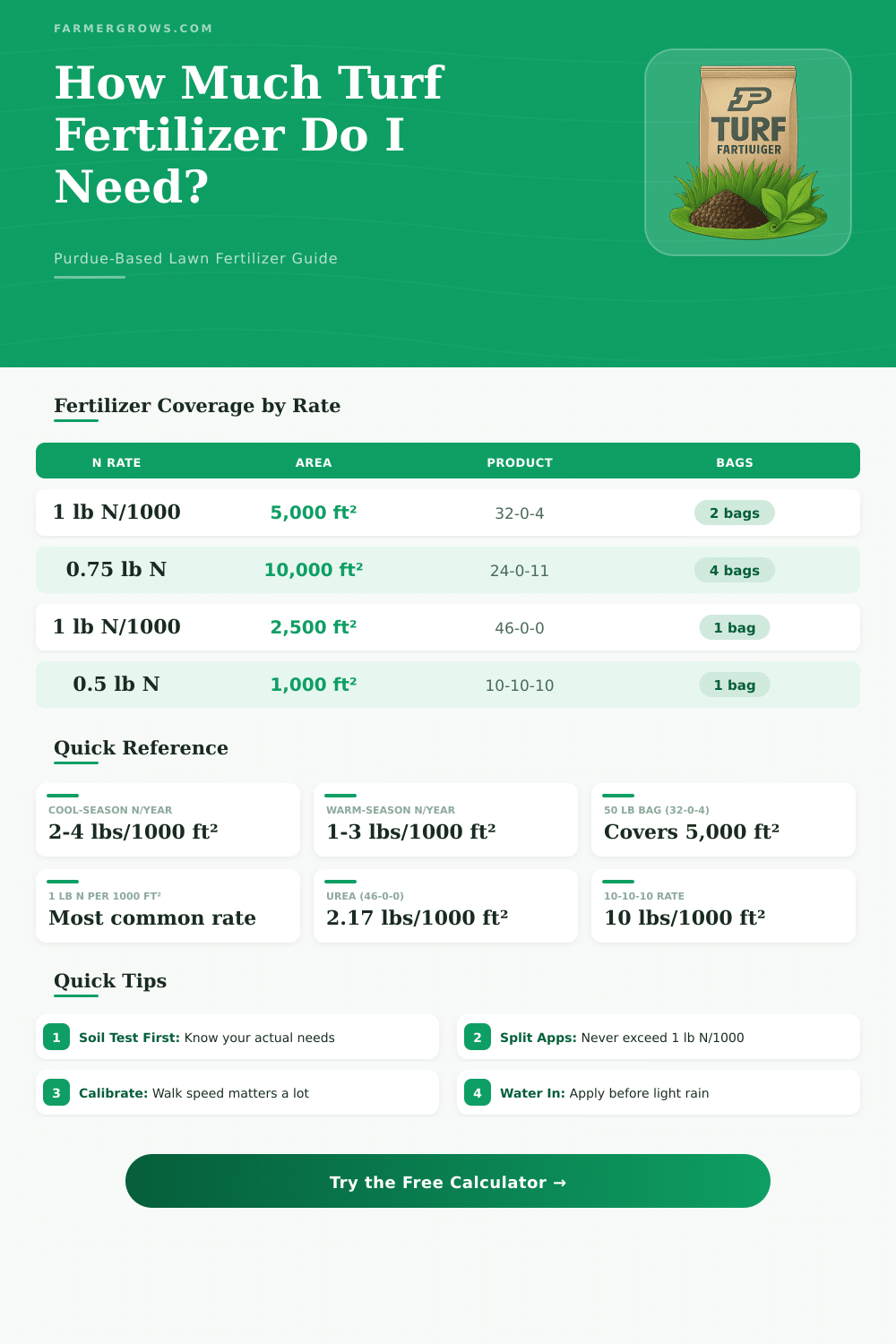
Urea with 46-0-0 requires only 2.17 pounds to give one pound of nitrogen per thousand square feet, that is a surprisingly small amount compared to Milorganite at 6-4-0 that requires almost 16.7 pounds for the same nitrogen dose. That makes a big difference. For 5 000 square feet of lawn with one pound of N per thousand, you need around 10.9 pounds of urea rather than almost 83 pounds of Milorganite, and I used both, so believe me, you will notice the difference.
Purdue suggests between 1.5 and 4 pounds of nitrogen yearly per 1 000 square feet depending on species of grass, Kentucky blue grass at the upper limit, tall fescue almost only 1 to 2. Splitting that into 3 or 4 applications, every dose stays under one pound of N, which lowers risk of burn by a big amount. A ten percent backup buffer covers overlap of spreading, and for 10 000 square feet of yard that means around two extra pounds of urea.
Simple Guide to Lawn Fertilizer
Not a lot of weight, but with heavy products it adds up.
The information below does not come from a calculator or converter tool. It is based on actual real experience, forum talks and community knowledge from the net.
Fertilizer for lawn plays a lead role in keeping it healthy and good-looking. Fertilizer gives grass the nutrients that it needs for strong, dense growth. Also it helps the ground recover from usage and protect it against pests, diseases and harsh weather.
Nitrogen, phosphorus and potassium form the three main nutrients that lawns need. Nitrogen is what most lawn minders focus on. It drives fast green growth and gives grass a greener look.
Even so too much nitrogen really can create troubles. The kneed for good lawn phosphorus, potassium and lime should be based on a test of soil health.
There are secondary nutrients like calcium, magnesium and sulphur. They need to be added only sometimes, usually through Fertilizer or lime. Tiny nutrients like iron, manganese, zinc, boron, copper, molybdenum and chlorine need very small amounts and rarely does one give them through Fertilizer.
For best results, a mix of liquid and granular Fertilizer works well. Liquid types care about short gaps, while granular ones give more steady nutrition. Fertilizer with slow release is a good option, because nitrogen exits slowly and avoids big growth spikes.
Setting the pH of soil before worrying about type of Fertilizer is a wise step. Improving soil structure can lower need of fungicides and herbicides and help to naturally form dense lawn. Feed the soil, not only the grass, is worth keeping in mind.
Too much ammonia or nitrate Fertilizer can build up in the ground and really hurt the grass over time.
Good choice of Fertilizer depends on soil chemistry, place and grass that grows. Different species of Turf grass have separate needs. Balanced Fertilizer can push lawn to grow much more thick.
Some lawns react best to mixes like 15-5-10.
Most bags of lawn Fertilizer are meant to cover 5 000 or 7 500 square feet. Read the label and use the right amount for the whole surface. Fall feeding for lawn gives energy and nutrients through winter into the coming growth season, making fall one of the most important Fertilizer times yearly.
There are also special repair mixes from natural and organic materials that give fast help for stressed lawns. One should avoid heavy rain within two days after application, but lightly watering the lawn witharound a quarter inch helps wash Fertilizer off the grass into the soil.