♻️ Rubber Mulch Calculator
Calculate exactly how much rubber mulch you need for any project
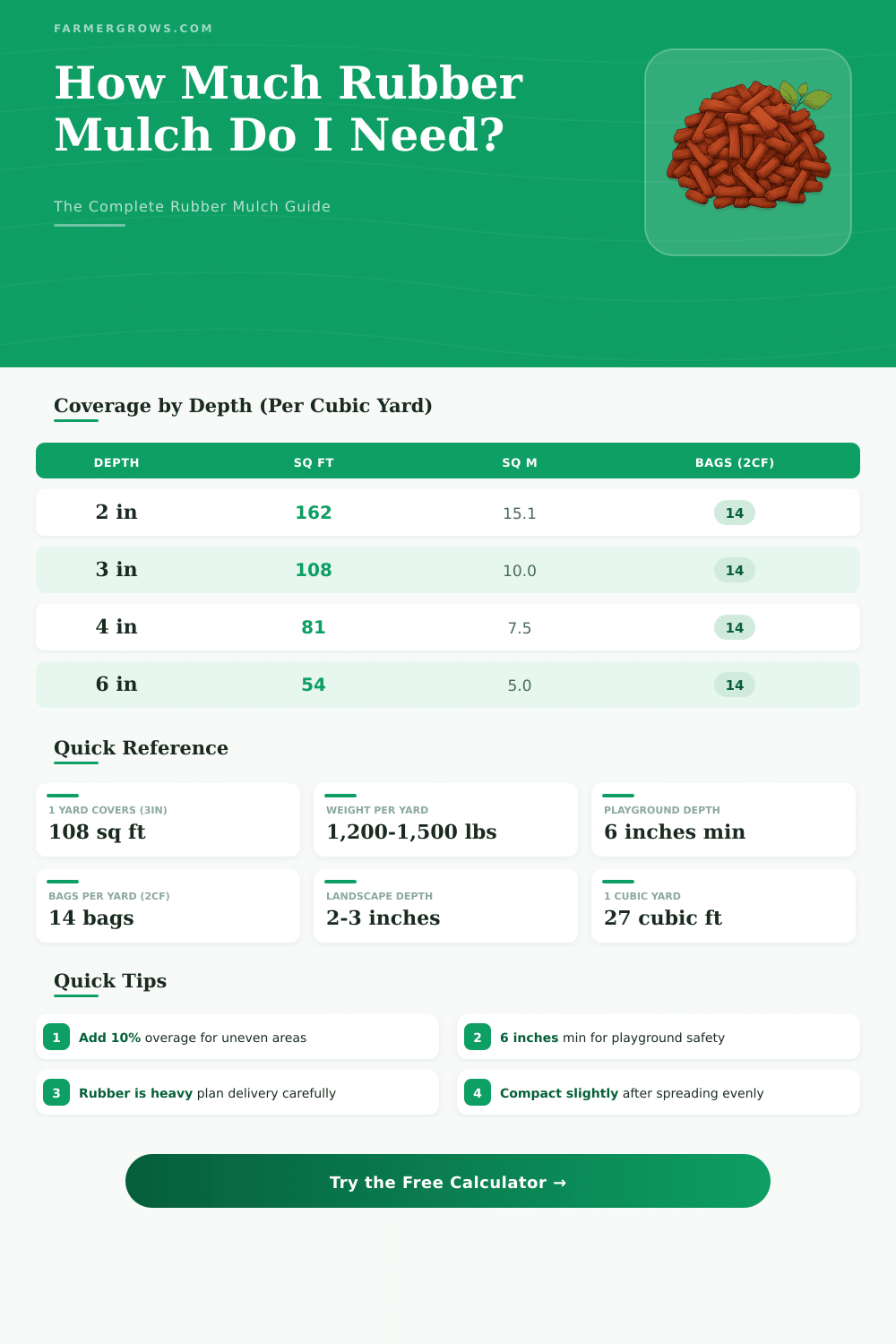
| Depth (in) | Depth (cm) | Sq Ft / Yard | Sq M / Yard |
|---|---|---|---|
| 1 | 2.5 | 324 | 30.1 |
| 2 | 5.1 | 162 | 15.1 |
| 3 | 7.6 | 108 | 10.0 |
| 4 | 10.2 | 81 | 7.5 |
| 6 | 15.2 | 54 | 5.0 |
| Bag Size | Volume / Bag | Bags / Cubic Yard | Coverage @ 3 in |
|---|---|---|---|
| Small Bag | 0.8 cu ft (22.7 L) | 33.75 | 3.2 sq ft (0.30 m²) |
| Standard Bag | 2.0 cu ft (56.6 L) | 13.5 | 8 sq ft (0.74 m²) |
| Large Bag | 3.0 cu ft (85.0 L) | 9.0 | 12 sq ft (1.11 m²) |
| Project | Area (sq ft) | Cubic Yards | Bags (2 cu ft) |
|---|---|---|---|
| Tree Ring | 28 | 0.26 | 4 |
| Small Flower Bed | 50 | 0.46 | 7 |
| Garden Bed | 200 | 1.85 | 25 |
| Side Yard Path | 100 | 0.93 | 13 |
| Playground (Small) | 225 | 4.17* | 57* |
| Large Landscape | 500 | 4.63 | 63 |
| Full Playground | 1,000 | 18.52* | 250* |
| Commercial Area | 2,500 | 23.15 | 313 |
rubber mulch weighs a lot compared to wooden chips, I saw that nuggets reach around 1 500 pounds per cubic yard, so almost triple the weight of wooden chips. That surprised me when I first heard it. One yard covers only 108 square feet at 3 inches thickness, but for playground at 6 inches that falls to 54 square feet each yard.
So it reaches around 5 square metres.
Rubber mulch: how much you need and its good and bad points
For a bed of 500 square feet at 3 inches I counted almost 4,6 yards… Actually more near 5 when one adds 10 percent extra. And for 1 000 square feet of playground at 6 inches?
Around 18,5 yards before adding reserves. Seriously, that passes 25 000 pounds of material. Slopes and irregular banks can grow the need by another 15-20 percent, so I always round upward.
Calculations with bags quickly become complicated. Every bag of 2 cubic feet covers 8 square feet at 3 inches. For 200 square feet of garden bed one needs around 25 bags.
Big amounts are a lot more pratcial compared to 3 yards (according to my experience at least).
The information below is not produced by a calculator or conversion tool. It comes from real user feedback, forum discussions and community experiences found across the web.
They make rubber mulch from recycled rubber, usually from used car tyres. The process includes removing almost 99,9 percent of the steel cables, shredding the rubber and then coloring it. Every year people dump around 290 millions of used car tyres, and the shredded rubber from them now serves as mulch in home landscapes, playgrounds and sporting areas.
The size of nuggets usually mixes grains and blocks of 3/8 until 3/4 inches.
It works like other mulch, it chokes unwanted grasses, keeps moisture and helps the ground stay fresh in summer and warm in winter. Rubber mulch creates an insulating layer above the soil, allowing water and nutrients to stay inside while it blocks growth of unwanted grasses. It does not absorb or keep water, so seeds of grasses less easily sprout in it.
Compared to wooden chips, it insulates more well, which matters in very warm or cold regions.
Lifespan is one of its main advantages. It does not fade, break down, compact or lose its look even after years of sun exposure. Some rubber mulch products have 12-year guarantees for color.
Usually it comes colored in black, brown or brick-red tone. The texture looks almost like natural wooden mulch. High density of grains helps them stay locally during strong reigns, rather than organic mulch that can wash away.
In playgrounds rubber mulch is especially useful. It has shock absorbing properties, which softens the impact of falls. Many products have references from IPEMA and match strict standards of ASTM about security, protection and cleaning.
It is thicker than organic mulch, which also is useful for control of unwanted grasses.
However there are disadvantages. It does not give nutrients to the soil or plants, unlike wooden mulch that breaks down and enriches the ground over time. It can smell like rubber.
It builds heat, which is bad for plants in sunny places and even can burn bare feet. In shady parts it can grow gentle mold smell. Once rubber mulch mingles with the soil, one hardly removes it.
There are also issues about chemicals that spill in the ground, because the original tyres can store unknown substances. It costs more than usual wooden mulch.
Keeping it contained is important. Use landscape timbers or edging around the area to stop spreading to other parts of the garden. Without edging it mingles with surrounding materials and becomeschaotic over time.
A leaf blower on low speed easily clears garbage from it.