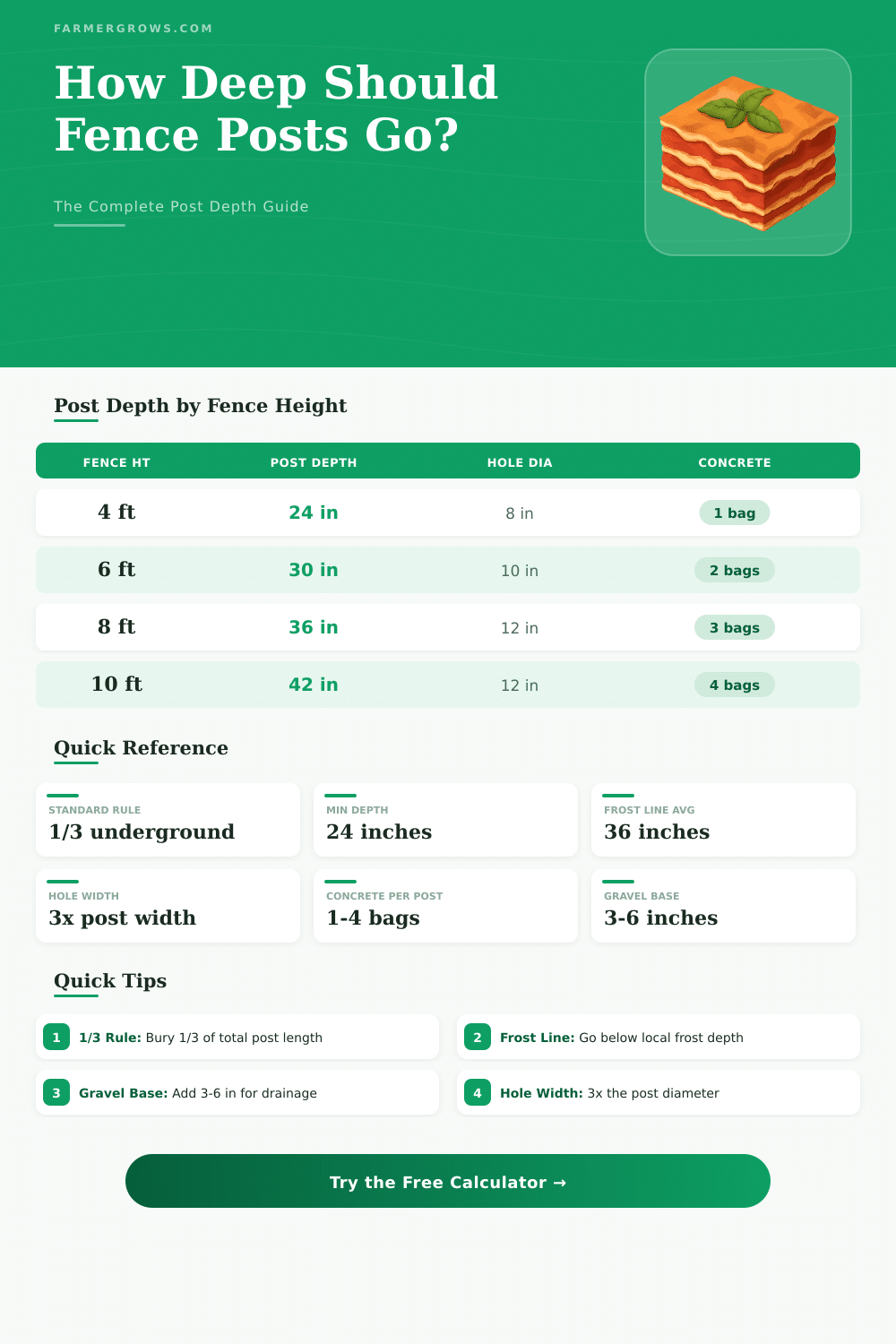
🛠 Fence Post Depth Calculator
Calculate the correct hole depth, diameter, and concrete needed for sturdy fence posts
| Fence Height | Post Depth (1/3 Rule) | Total Post Length | Hole Diameter |
|---|---|---|---|
| 3 ft (91 cm) | 18 in (46 cm) | 4.5 ft (137 cm) | 8 in (20 cm) |
| 4 ft (122 cm) | 24 in (61 cm) | 6 ft (183 cm) | 8–10 in (20–25 cm) |
| 5 ft (152 cm) | 27 in (69 cm) | 6.75 ft (206 cm) | 10 in (25 cm) |
| 6 ft (183 cm) | 30–36 in (76–91 cm) | 8 ft (244 cm) | 10–12 in (25–30 cm) |
| 8 ft (244 cm) | 36–42 in (91–107 cm) | 11 ft (335 cm) | 12 in (30 cm) |
| 10 ft (305 cm) | 42–48 in (107–122 cm) | 14 ft (427 cm) | 12–14 in (30–36 cm) |
| Hole Size (Dia × Depth) | Volume (ft³) | 80 lb Bags | 50 lb Bags |
|---|---|---|---|
| 8 in × 24 in | 0.58 | 1 | 1–2 |
| 10 in × 30 in | 1.14 | 2 | 3 |
| 10 in × 36 in | 1.36 | 2–3 | 4 |
| 12 in × 30 in | 1.64 | 3 | 4–5 |
| 12 in × 36 in | 1.96 | 3–4 | 5–6 |
| 12 in × 42 in | 2.29 | 4 | 6–7 |
| 14 in × 48 in | 3.56 | 6 | 9–10 |
| Region/Climate | Frost Depth | Min Post Depth | Notes |
|---|---|---|---|
| Southern US (FL, TX, AZ) | 0–6 in (0–15 cm) | 24 in (61 cm) | Frost rarely a concern |
| Mid-Atlantic (VA, NC, TN) | 12–18 in (30–46 cm) | 24–30 in (61–76 cm) | Moderate frost |
| Midwest (OH, IL, IA) | 30–42 in (76–107 cm) | 36–42 in (91–107 cm) | Must go below frost |
| Northern US (MN, WI, ND) | 42–60 in (107–152 cm) | 48–60 in (122–152 cm) | Deep frost line |
| Canada (Southern ON, BC) | 48–72 in (122–183 cm) | 48+ in (122+ cm) | Check local code |
| UK / NW Europe | 18–24 in (46–61 cm) | 24–30 in (61–76 cm) | Moderate climate |
| Project | Fence Length | Posts Needed | Concrete (80 lb bags) |
|---|---|---|---|
| Small Garden 25 ft | 25 ft (7.6 m) | 5 | 5–10 |
| Side Yard 50 ft | 50 ft (15.2 m) | 8–9 | 8–27 |
| Standard Backyard 100 ft | 100 ft (30.5 m) | 14–15 | 14–45 |
| Full Perimeter 200 ft | 200 ft (61 m) | 27–29 | 27–87 |
| Large Property 300 ft | 300 ft (91.4 m) | 39–43 | 39–129 |
| Ranch/Farm 500 ft | 500 ft (152 m) | 51–63 | 51–189 |
When you install fence posts, I always start with the third rule, that forms the base of everything. For a typical fence of 6 feet height that wants to say, that the posts must go around 30 inches in the ground. Of course, the kind of soil plays a role: sandy soil maybe needs some inches more, while clay is less demanding, so maybe 5% less deep.
When I first looked at the topic, I was surprised by the advised width for holes. So, one should dig a hole three times broader than the post itself. For a 4×4-post (that truly measures 3.5 inches), it equals a hole of 10-12 inches broad.
How to Set Fence Posts: Depth, Hole Size and Material
Many folks do it much smaller, but the numbers explain why it counts. Each of those empty holes has around 1.14 cubic feet, so you need two 80-pound bags of concrete for one post. For a 100-foot privacy fence with 14 posts, that means at least 28 bags, or almost 2240 pounds of concrete, truly hard work.
Also I laid 6 inches of grit in the bottom, what lowers the concrete depth, but really helps with drainage and life of the post.
Fence posts come in various materials, wood, steel and concrete most common. Treated pine and cedar is great for home and business fences. Steel posts usually outlast wood, because they do not rot or get eaten by small creatures.
Concrete posts offer a strong lasting solution, although their setup requires more effort.
The life of wooden posts changes by species. Black locust and Osage-orange delivers 20-25 years, red cedar 15-20, white oak about 10, and hickory only 5-7 years. This big range shows, that choosing the wood well is important.
The distance between posts forms another key element. In sheltered places with near trees, 8 feet between them usually works. In windy open areas however one must narrow to around 6 feet.
When posts stand two far, the fence sections can bend too much and start falling apart over time.
For a standard 6-foot privacy fence, 4×4 posts are the best choice. The basic rule wants to bury a third of the whole height of the post, so a 6-foot fence requires posts with 2 feet extra underground. The holes have around 3 feet depth and 8-12 inches wide, with extra 4 inches than the broadest part of the post.
Good anchoring of posts is important. I laid around 6 inches of grit in the bottom of the hole, so that the post does not sit in water. Crushed gravel works well for that.
With concrete, one can shape the top a bit, so that water flows down the sides. Even if concrete is used, gravel in the bottom helps drainage for wooden posts. And do not forget to cut the top at an angle to shed water, or regularly add stain or sealant, or lay a metal cover for extra guard.
Corner posts and gate posts must always be set in concrete. Straight posts sometimes simply get driven deep enough in the ground. Metal posts also work well, if one drives them deepenough.
Steel posts with caps as uniform covers for gaps, heavy anchor bases and reflective strips give a little extra quality. T-posts are common, cheap metal options, while chain link fence posts are round, usually 1⅝ or 2⅜ inches wide. For temporary fencing, portable posts with step flanges work well for fast setup of ways.