Bermuda Grass Seed Calculator
Estimate Bermuda grass seed for lawns, athletic turf, slopes, and pastures with pure live seed adjustment, hulled or unhulled seed form, soil temperature timing, method loss, slope buffer, and bag count.
Bermuda seed is tiny and should be planted into warm soil with shallow coverage and steady moisture. Use the seed tag germination and purity numbers whenever you have the bag in hand.
Bermuda Seed Estimate
Seed estimate updates as inputs change.
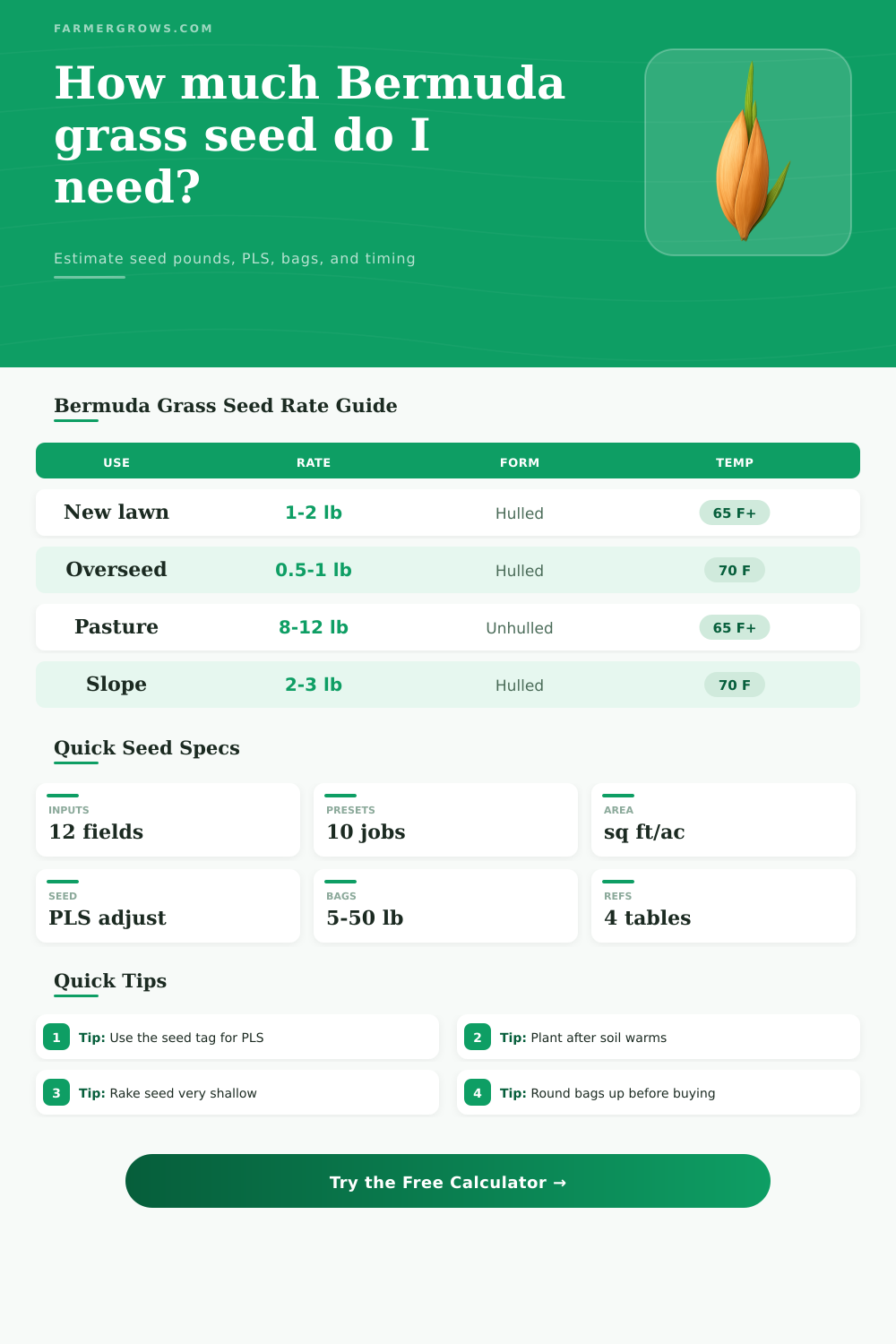
| Planting job | Typical PLS rate | Equivalent acre rate | Best seed form |
|---|---|---|---|
| New common Bermuda lawn | 1 to 2 lb per 1000 sq ft | 44 to 87 lb per acre | Hulled seed for warm soil |
| Improved seeded Bermuda lawn | 1.5 to 3 lb per 1000 sq ft | 65 to 131 lb per acre | Hulled or coated turf blend |
| Overseed thin Bermuda turf | 0.5 to 1 lb per 1000 sq ft | 22 to 44 lb per acre | Hulled seed, lightly covered |
| Pasture or hay field | 8 to 12 lb per acre | 0.18 to 0.28 lb per 1000 sq ft | Hulled for spring, unhulled for dormant timing |
| Soil temp | Bermuda response | Calculator message | Field action |
|---|---|---|---|
| Below 60 deg F | Slow or uneven germination | Wait | Delay seeding if possible |
| 60 to 64 deg F | Marginal start | Borderline | Seed only with stable warming weather |
| 65 to 69 deg F | Usable warm-season window | Ready | Plant with firm seedbed and moisture |
| 70 to 85 deg F | Strong germination window | Ideal | Plant, water lightly, and avoid deep burial |
| Method | Seed factor | Best use | Notes |
|---|---|---|---|
| Drill or slit seeder | 1.00 | Pastures and larger areas | Best seed placement and least waste |
| Broadcast and rake | 1.20 | Lawns and renovation | Needs shallow cover and firm rolling |
| Hydroseed | 1.10 | Slopes and exposed soil | Mulch helps hold moisture and seed |
| Hand patch seeding | 1.15 | Bare spots and edges | Extra seed accounts for uneven spreading |
| Bag size | At 1 lb per 1000 sq ft | At 2 lb per 1000 sq ft | Common use |
|---|---|---|---|
| 5 lb bag | 5,000 sq ft | 2,500 sq ft | Small lawn repair |
| 10 lb bag | 10,000 sq ft | 5,000 sq ft | Backyard seeding |
| 25 lb bag | 25,000 sq ft | 12,500 sq ft | Large lawns and slopes |
| 50 lb bag | 50,000 sq ft | 25,000 sq ft | Pasture and contractor jobs |
Seedbed tip: Bermuda seed should be pressed into firm soil and covered very lightly. Deep burial is one of the fastest ways to lose a stand.
Moisture tip: Keep the top layer damp with light, frequent watering until seedlings are visible, then slowly shift toward deeper irrigation.
Bermuda grass seeds require an accurate measurement of the quantities of Bermuda grass seeds to be used. The amount of Bermuda grass seeds to be used will determine whether the Bermuda grass lawn is to be thick or thin. Many people buys one bag of Bermuda grass seeds thinking that this amount will be sufficient for the lawn area they own, but because of an incorrect amount of Bermuda grass seeds, the Bermuda grass coverage is often spotty.
The success of Bermuda grass depend on the interaction between the Bermuda grass seeds, the soil temperature, and the method used to plant the Bermuda grass seeds. Bermuda grass seeds are extreme small in weight. A small change in the weight of Bermuda grass seeds will determine the result of the lawn seeded with these seeds.
How to Measure Bermuda Grass Seeds for Your Lawn
The label of the Bermuda grass seeds will contain information regarding the germination percentage and the purity percentage of the Bermuda grass seeds. The germination percentage will indicate how many Bermuda grass seeds will germinate, and the purity percentage will indicate the number of pure live Bermuda grass seeds in the bag of Bermuda grass seeds. A bag of Bermuda grass seeds with an 85 percent germination rate will contain fewer seeds that will germinate than a bag of Bermuda grass seeds with a 75 percent germination rate.
You can use a calculator to determine how many Bermuda grass seeds contains pure live seeds. Another factor that will affect Bermuda grass is the timing of when the Bermuda grass is planted. Bermuda grass seeds require warm soil to germinate.
Bermuda grass will not grow if the soil temperature are below 65 degrees. In many cases, people plant Bermuda grass too early in the season when the soil may not be warm enough for the Bermuda grass seeds to germinate. To determine the soil temperature, one should insert a soil thermometer into the soil to the same depth that the Bermuda grass seeds will be planted.
The soil temperature should be checked in the late morning to obtain the most accurately reading of the temperature of the soil. The method used to plant Bermuda grass will also change the amount of Bermuda grass seeds that will be needed to cover the lawn area. If a person uses a seed drill to plant Bermuda grass seeds, the Bermuda grass seeds will be placed at the correct depth into the soil.
If you are to be broadcasted and raked the Bermuda grass seeds into the soil, more Bermuda grass seeds should be purchased because some of the Bermuda grass seeds will land on the surface of the soil. Bermuda grass seeds that are on the surface of the soil will dry out and may wash away during rainfall. A calculator can be used to determine the number of Bermuda grass seeds that will be need with each planting method.
Additional variables will exist in lawns that contain slope or areas where the soil is directly exposed to the ground. In these areas, rain may move the Bermuda grass seeds, and the wind may move the Bermuda grass seeds as well. A buffer of Bermuda grass seeds should be purchased in addition to the amount of Bermuda grass seeds that is calculated to cover the lawn area.
In addition, the size of the bags of Bermuda grass seeds should be considered when purchasing the Bermuda grass seeds. If a person buys a 25-pound bag of Bermuda grass seeds but only needs 18 pounds for the lawn area, there will be 7 extra pounds of Bermuda grass seeds in the bag. This extra Bermuda grass seed may not store well, so the extra cost of the Bermuda grass seeds may or may not be worth the purchase of the bag of Bermuda grass seeds.
The rules for pasture seeding Bermuda grass is different than the rules for seeding Bermuda grass into a lawn area. The total area of a pasture is larger than the total area of a lawn. The amount of Bermuda grass seeds to be planted per square foot of pasture area is less than the amount of Bermuda grass seeds to be planted per square foot of lawn area but the total amount of Bermuda grass seeds is more for the pasture area.
Bermuda grass seeds that are unhulled may be used for pastures to allow the Bermuda grass to sit through the winter months. A calculator can be used to determine Bermuda grass seeding for lawns or pastures. The initial cost of Bermuda grass seeds is not the only cost that should be considered when seeding a lawn area with Bermuda grass.
A thin lawn will require more water and more fertilizer than a thick stand of Bermuda grass. It is more cost effective to purchase the correct amount of Bermuda grass seeds the first time rather than fix a thin Bermuda grass lawn later on. A calculator can be used to find the correct amount of Bermuda grass seeds based off the conditions of the area to be seeded.
After finding the correct amount of Bermuda grass seeds, the lawn area should be prepared by creating a firm seedbed and watering the area to provide moisture to the Bermuda grass seeds until the Bermuda grass seedlings emerges.