Soil and Mulch Calculator
Estimate separate soil fill and mulch cap quantities for raised beds, landscape beds, tree rings, berms, and custom garden areas.
Soil fill is reduced by the existing soil offset, while the mulch cap is calculated as its own top layer. Volumes, bag counts, bulk yards, and weights stay separated.
Soil And Mulch Results
Volumes include the selected overage. Soil depth is adjusted by existing soil offset; mulch cap depth is kept separate.
| Soil material | Typical weight per cu yd | Best use | Field note |
|---|---|---|---|
| Raised bed mix | 1,000 to 1,300 lb | Vegetable boxes and deep planters | Loose blend settles more than screened soil |
| Screened topsoil | 1,800 to 2,400 lb | Landscape beds and grading | Moist loads can be much heavier |
| Garden loam | 1,500 to 2,100 lb | General bed fill | Good middle estimate for mixed soil |
| Compost blend | 900 to 1,200 lb | Topdressing and soil improvement | Use as a blend, not always full-depth fill |
| Potting mix | 500 to 800 lb | Containers and light raised planters | Very light when dry, heavier after watering |
| Mulch material | Typical weight per cu yd | Common cap depth | Field note |
|---|---|---|---|
| Shredded hardwood | 500 to 800 lb | 2 to 3 in | Knits together on slopes and windy beds |
| Bark nuggets | 350 to 600 lb | 3 to 4 in | Chunky texture covers less tightly |
| Cedar chips | 300 to 500 lb | 2 to 3 in | Light, clean, and easy to spread |
| Pine bark mulch | 400 to 650 lb | 2 to 3 in | Fine grades settle faster than nuggets |
| Clean straw mulch | 120 to 250 lb | 3 to 5 in | Useful around berries and vegetables |
| Layer depth | Sq ft per cu yd | Sq m per m3 | Good fit |
|---|---|---|---|
| 1 in | 324 sq ft | 12.0 sq m | Light topdress or fine mulch touch-up |
| 2 in | 162 sq ft | 6.0 sq m | Annual mulch refresh on existing beds |
| 3 in | 108 sq ft | 4.0 sq m | Standard weed-suppressing mulch cap |
| 6 in | 54 sq ft | 2.0 sq m | Shallow soil fill or deep compost blend |
| 12 in | 27 sq ft | 1.0 sq m | Raised bed root-zone fill |
| Package or bulk unit | Volume | Units per cu yd | Coverage at 3 in |
|---|---|---|---|
| 1 cu ft bag | 0.037 cu yd | 27 bags | 4 sq ft |
| 1.5 cu ft bag | 0.056 cu yd | 18 bags | 6 sq ft |
| 2 cu ft bag | 0.074 cu yd | 14 bags | 8 sq ft |
| 3 cu ft bag | 0.111 cu yd | 9 bags | 12 sq ft |
| Bulk cubic yard | 27 cu ft | 1 yard | 108 sq ft |
| Common project | Area | Soil at 6 in | Mulch at 3 in | Bag check |
|---|---|---|---|---|
| 4 x 8 raised bed | 32 sq ft | 0.59 cu yd | 0.30 cu yd | 11 soil bags, 4 mulch bags |
| 6 ft round herb bed | 28 sq ft | 0.52 cu yd | 0.26 cu yd | 10 soil bags, 4 mulch bags |
| 30 x 4 strip bed | 120 sq ft | 2.22 cu yd | 1.11 cu yd | 40 soil bags, 15 mulch bags |
| 10 ft tree ring | 79 sq ft | 1.45 cu yd | 0.73 cu yd | 27 soil bags, 10 mulch bags |
| 180 sq ft island bed | 180 sq ft | 3.33 cu yd | 1.67 cu yd | 60 soil bags, 23 mulch bags |
Depth check: Measure from the settled soil surface, not the top edge of the bed frame. Boards, slopes, and old mulch can make the usable fill depth look larger than it is.
Ordering check: Round bulk yards upward when the calculated amount is near a delivery increment. For bagged material, round each layer separately so soil bags do not hide a mulch shortfall.
Soil and mulch is two different material that serve two different function in the garden. Soil act as a growing medium for the plants roots. Mulch work to protect the soil from direct contact with the plants emerging leaf.
Mulch moderate the soil’s temperature and prevent the growth of unwanted weed. Because soil and mulch are two separate materials, they must have separate calculation to determine how much of each is necessary for a given gardening project. If mulch and soil are treat as one material, it is possible for one or the other to be purchased in excessive amount.
How Much Soil and Mulch Do You Need
The depth of soil require for a gardening project depend on the type of project that is to be perform in the soil. Raised bed for vegetables may require eight to twelve inch of soil to allow for the roots to expand. This soil need to be well-draining to allow for the roots to breathe.
Existing landscape bed may require two to three inch of soil to be add to provide adequate growing medium for vegetable roots. These same existing bed, however, may require a thicker layer of mulch to be add on top of the soil. Tree ring and foundation strip may require little soil but require a significant amount of mulch to cover the area.
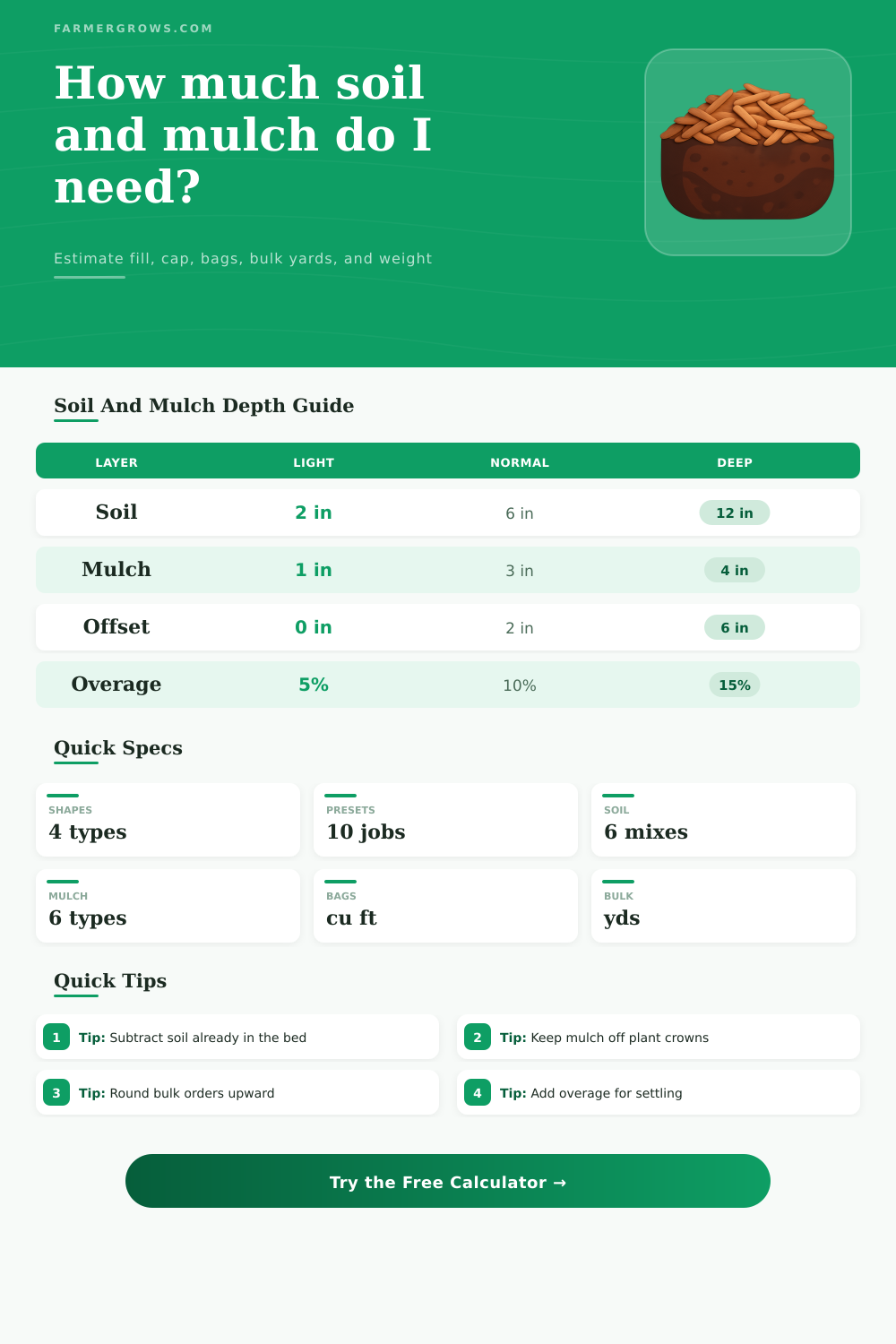
These separate calculation allow for customer to order the correct amount of soil and mulch without having to purchase one material to cover the other. The existing amount of soil and mulch in a garden bed will change the amount of soil and mulch that is require. The user can enter the depth of existing soil in a bed into the calculator.
The mulch layer will always be on top of the soil, so the depth of existing soil will not impact the amount of mulch that is require. The depth of existing soil will be account for in the calculation of soil that is require. If soil is already in place in a garden bed, but the depth of soil is set to zero in the calculator, it is likely that the customer will order too much soil.
In addition to calculate the amount of soil and mulch that will be required to fill a garden bed, there are additional factor to consider before purchasing the soil and mulch. When soil and mulch are add to a garden bed, soil settle and mulch compress when people walk on the mulch. To account for the settling and compressing of soil and mulch, there should of an over-ordering of soil and mulch by ten or fifteen percent of the calculated amount.
Both soil and mulch will be give this percentage increase in the calculator. The amount of soil and mulch will then be convert to the number of bags of soil and mulch or in bulk in yards. The weight of soil and mulch will vary depending on the type of soil or mulch that is to be add to a garden.
Screened topsoil will be heavy and weigh twice as much per yard as the light raised-bed soil. Mulch will also have different weight. Straw will be more light than mulch made from hardwoods or bark nugget.
The numbers in the range in the reference table will help a customer to determine the weight of soil or mulch that will be required in there project. Knowing the weight of soil and mulch will help a customer to determine whether they have the tool to transport the soil and mulch to their garden or whether they should purchase smaller load of mulch and soil. Depending on the type of gardening project in which soil and mulch will be used, the ratio of soil to mulch may change.
For instance, a vegetable bed that is four feet wide and eight feet long and that require ten inch of soil and two inch of mulch will require more soil than mulch. However, a long strip of mulch that require only a small amount of soil to be add to the strip will require more mulch than soil. These ratio are provide to customers so that they dont have to memorize the formula for soil and mulch.
As a planning tool, this calculator will assist with determine the amount of soil and mulch that a customer need to order for their gardening project. With the dimension of the garden bed and the desired depth of soil and mulch, a customer can determine the number of bags of soil or mulch that will be required. Furthermore, the customer can also adjust for the different type of soil and mulch.
The calculation for soil and mulch will remain separate in the calculator, allowing customer to order each material separately.