Small Square Bale Storage Calculator
Estimate how many small square bales fit in a barn bay, how much shed footprint and aisle space they need, and how much usable dry matter remains after storage loss.
Use actual bale measurements if your baler makes a different size. The calculator treats the stack bay as rows of bales per tier, then adds wall clearance, row ventilation gaps, and an aisle to estimate the needed barn or shed footprint.
Storage Estimate
Results include the bale stack, ventilation gap, wall clearance, aisle width, dry matter, and storage loss settings you entered.
| Bale type | Typical dimensions | Common weight | Storage note |
|---|---|---|---|
| Two-string hay | 14 x 18 x 36 in | 40 to 60 lb | Standard for horse hay and small barns. |
| Compact two-string | 14 x 16 x 32 in | 35 to 50 lb | Fits shorter bays but needs more rows. |
| Three-string hay | 16 x 23 x 44 in | 80 to 110 lb | Fewer pieces, heavier handling, larger footprint. |
| Wheat straw | 14 x 18 x 36 in | 30 to 45 lb | Often lower density, useful for bedding inventory. |
| Small baleage | 16 x 18 x 36 in | 55 to 85 lb | Higher moisture raises as-fed weight. |
| Pattern | Footprint basis | Capacity effect | Best fit |
|---|---|---|---|
| Flat, strings down | Length x width | Baseline | Dry hay, moderate tiers, fast stacking. |
| On edge | Length x height | Often tighter | More air exposure and careful hand stacking. |
| Cross-tied | Flat with allowance | About 3% space added | Taller stacks where stability matters. |
| Vented chimney rows | Flat plus gaps | About 8% space added | Humid barns, warm bales, or long storage. |
| Space item | Typical range | Use in calculator | Why it matters |
|---|---|---|---|
| Row air gap | 0 to 6 in | Ventilation gap | Lets heat and moisture move out of the stack. |
| Wall clearance | 6 to 24 in | Clearance each side | Keeps bales off sweating walls and splash zones. |
| Hand aisle | 3 to 5 ft | Aisle width | Works for small hand-loaded stacks. |
| Loader aisle | 8 to 12 ft | Aisle width | Allows cart, skid steer, or wagon access. |
| Storage condition | Typical loss | Moisture concern | Calculator setting |
|---|---|---|---|
| Dry hay under roof | 3 to 8% | Usually 10 to 18% | Use low loss when floor is dry. |
| Open-sided shed | 5 to 12% | Edge weathering | Add wall gap and a moderate loss. |
| Damp floor or wall | 10 to 20% | Mold risk | Increase loss and keep a wider gap. |
| Wrapped small baleage | 5 to 15% | High moisture | Dry matter is much lower than as-fed tons. |
Air gap: If bales were put up warm or the barn has damp walls, use a real ventilation gap instead of counting every inch as storage.
Usable feed: Storage loss should be applied after dry matter so the final tonnage better reflects feed actually available from the stack.
To calculate the number of small square bale that will fit under a barn’s roof, it is first important to understand the dimension of the area under the barns roof, the dimensions of the bales to be stack under the roof, and how those dimensions will impact the number of bales that can be stored. To determine the number of bales that will fit into the area under the barn’s roof, it is first necessary to measure the area of the barn bay in which the bale will be stored, and to measure the dimension of the bales to be stored within that barn bay. The dimensions of the bales will impact the number of bales that can fit into that area; if the dimensions of the bales are not accounted for, it is possible that the bales will not fit into the barn bay altogether.
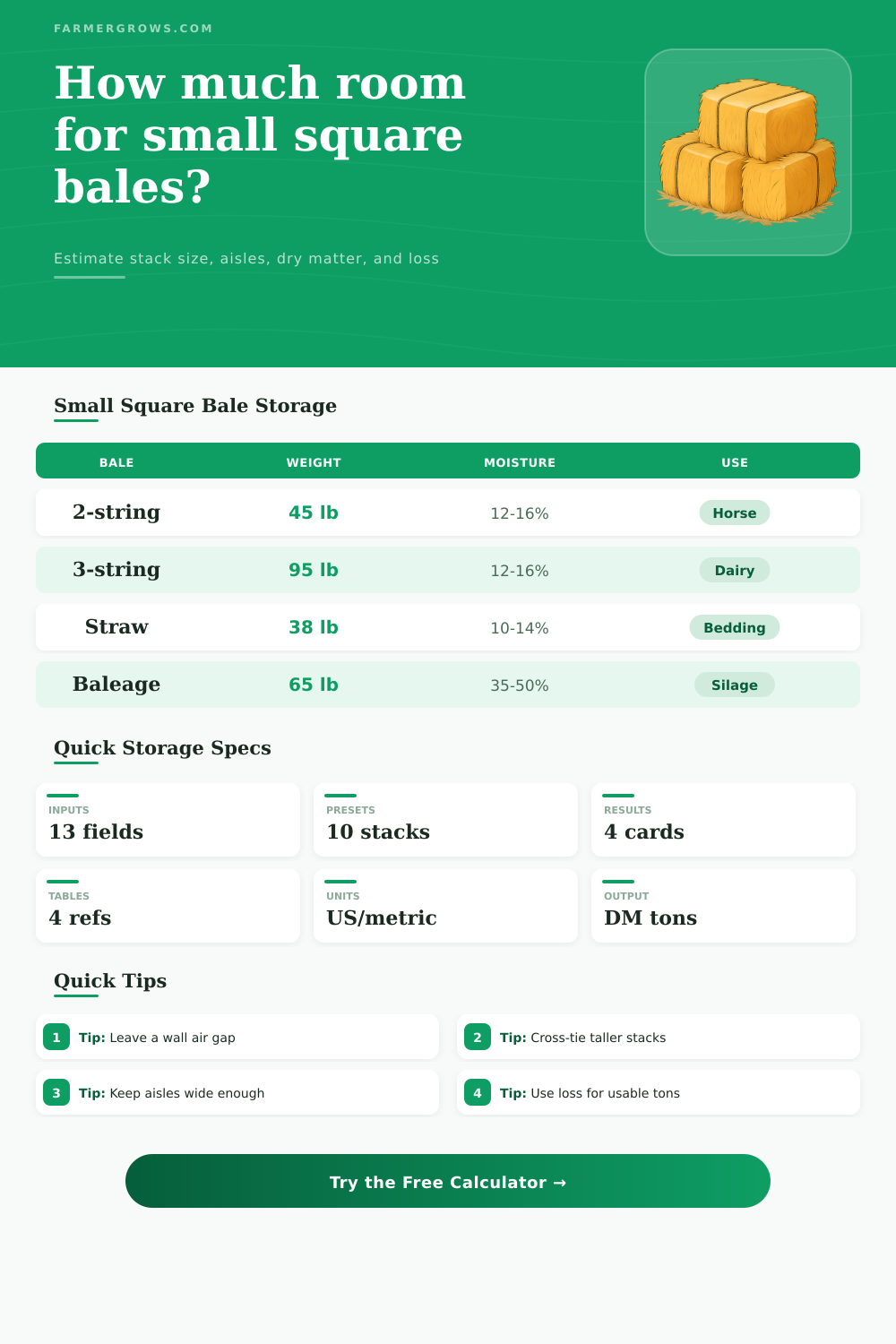
Small square bales is not a term that refers to a group of bales of the same size and weight. For instance, small square bales that contains two strings of hay may weigh 45 pounds and be 36 inches in length, while small square bales that contain three strings of hay may weigh 95 pounds and be longer than 40 inches in length. The difference in the weight and length of these bales impact both how many bales can fit along the barn bays wall, as well as how high those bales can be stacked.
How Many Small Square Bales Will Fit Under a Barn Roof
The dimension of each type of small square bale must be entered into any calculator that estimate how many small square bales will fit under a barns roof. In addition to understanding the dimensions of small square bales, it is also important to consider how to stack those bales within the barn bay. You can lay small square bales flat on the barn bay with the strings of hay facing down, or the bales can be laid on their edges.
Placing the bales on their edges will require more area within the barn bay to store the bales, but will increase the stability of that stack of bales. Small square bales can also be stored in rows within the barn bay with gap between the bales to allow moisture to escape from each bale. Each of these different possible stacking pattern will impact the footprint of the area that is covered by the bales; thus, it is important to test each of these patterns to determine how each impact the total number of bales that will fit under the barns roof.
Another factor that you must consider in determining how many small square bale will fit into a barn bay is the moisture content of the bales. Each small square bale will contain some amount of moisture, indicated by the weight of the bale and the amount of dry matter that is contained within the bale. For instance, a small square bale that weighs 50 pounds and contains 14% moisture will contain less dry matter than a small square bale of the same weight that contain less moisture.
Consequently, the bales may lose some of their mass as a result of moisture loss during storage. The loss of these small square bales mass will impact the amount of hay that the farms animals can use. Another way to calculate the mass of these bales is to use a calculator that accounts for the amount of moisture that is contained within the small square bales.
Another consideration in the storage of small square bales is the aisle width for the loader of the hay bales, and the need to leave clearance between the bales and the barn walls. The barn bay will need to contain an aisle wide enough for the loader of the bales, and that aisle should be between 8 and 12 feet in width. An aisle of only 4 feet in width is only required if you will use that aisle by hand to load the small square bales into hay storage vehicle.
In either case, such an aisle must be planned for the storage of small square bales. Additionally, the small square bales must be stored a distance from the barn walls to allow the bales to avoid resting upon damp concrete within the barn. Most barn that are to be used for the storage of small square bales are rarely constructed as perfect rectangles, and often contain various obstructions within there barns.
For instance, barns may contain posts or roof trusses that the builder constructs into their barn walls, which reduce the area available for the storage of hay bales. Additionally, the barns may contain uneven floors, which can also reduce the amount of area that can be used for storing small square bales. Furthermore, many older barn sheds have lower eaves than moddern barn sheds, limiting the height to which the small square bales can be stacked.
A planning table that indicates the dimension of the specific barn in which the hay is to be stored can help to account for these factor. For instance, calculators that determine the length of and the width of a shed can assist in planning the storage of small square bales. You should of used a more detailed plan for the storage.