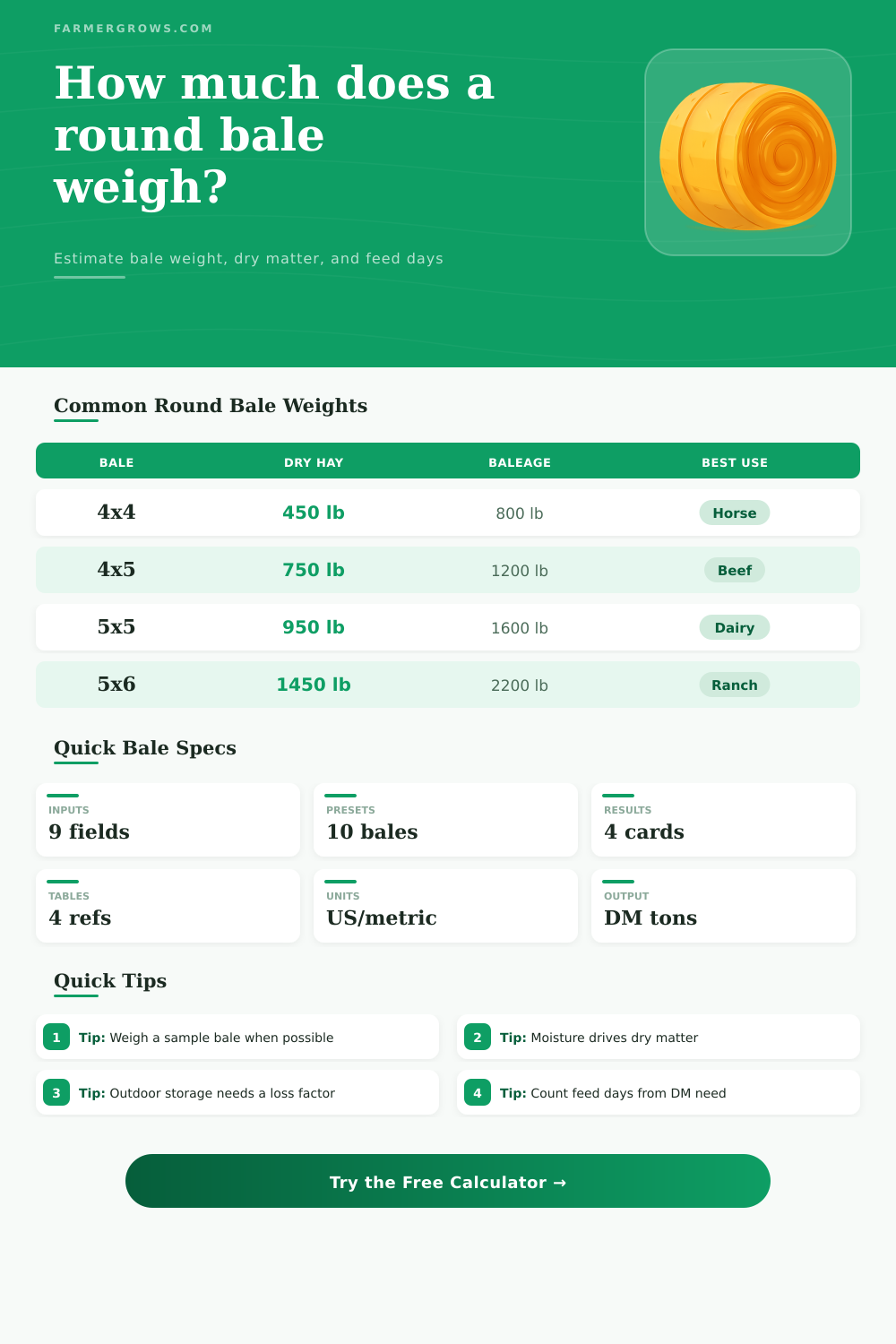
Round Bale Weight Calculator
Estimate as-fed bale weight, dry matter, usable hay or baleage tonnage, and feed days from round bale size, density, forage type, moisture, wrap, storage loss, and bale count.
Use the scale ticket or a few weighed bales when you have them. This calculator uses bale cylinder volume and as-fed density, then separates moisture and storage loss so inventory totals are more useful for feeding plans.
Round Bale Weight Results
Calculated from bale volume, density, forage moisture, packaging, storage loss, and feed demand.
| Bale size | Volume | Dry hay range | Baleage range |
|---|---|---|---|
| 4 ft x 4 ft | 50.3 cu ft | 400 to 650 lb | 700 to 1,000 lb |
| 4 ft x 5 ft | 62.8 cu ft | 550 to 850 lb | 950 to 1,350 lb |
| 5 ft x 4 ft | 78.5 cu ft | 650 to 1,000 lb | 1,150 to 1,600 lb |
| 5 ft x 5 ft | 98.2 cu ft | 850 to 1,250 lb | 1,450 to 1,900 lb |
| 5 ft x 6 ft | 117.8 cu ft | 1,100 to 1,600 lb | 1,800 to 2,400 lb |
| Forage | Typical density | Common moisture | Planning note |
|---|---|---|---|
| Alfalfa hay | 9 to 14 lb/cu ft | 12% to 18% | Leafy hay can test high in dry matter value. |
| Grass hay | 8 to 13 lb/cu ft | 12% to 18% | Density varies heavily with baler pressure. |
| Mixed hay | 9 to 14 lb/cu ft | 12% to 20% | Use field averages if lots were baled differently. |
| Wrapped baleage | 14 to 24 lb/cu ft | 40% to 60% | Heavy as-fed bales may still have moderate DM. |
| Wheat straw | 6 to 10 lb/cu ft | 8% to 14% | Good for bedding estimates, not ration energy. |
| Corn stalks | 7 to 11 lb/cu ft | 12% to 22% | Outdoor storage loss can climb quickly. |
| Moisture | Dry matter factor | Typical material | Inventory effect |
|---|---|---|---|
| 10% | 0.90 | Dry straw | Most of the as-fed weight is dry matter. |
| 15% | 0.85 | Good dry hay | Common target for stored hay inventory. |
| 20% | 0.80 | Borderline hay | Check heating risk and storage conditions. |
| 45% | 0.55 | Haylage or baleage | Heavy bales contain substantial water weight. |
| 60% | 0.40 | Wet baleage | Feed days should be based on DM, not tons. |
| Storage method | Typical loss | Best fit | Watch point |
|---|---|---|---|
| Inside barn | 2% to 6% | High-value hay and horse hay | Ventilate to keep dry hay from sweating. |
| Under tarp or cover | 5% to 12% | Seasonal beef or dairy forage | Keep edges tight and water off the top. |
| Outside on gravel | 10% to 20% | Short-term field storage | Bottom loss still matters after rain. |
| Outside on soil | 18% to 35% | Low-cost bedding or roughage | Ground contact can ruin the outer layer. |
| Wrapped baleage | 3% to 10% | High-moisture fermented forage | Patch holes quickly to limit spoilage. |
For buying hay: Compare dollars per dry-matter ton, not just dollars per bale. A heavy wet bale can look cheaper while delivering fewer usable feeding days.
For winter inventory: Recalculate after changing storage loss. Moving bales from ground contact to covered storage can recover a surprising amount of dry matter.
When you calculates how many bales of hay you have, you must look at more than just the number of hay bale. Beyond considering how many day each hay bale will provide for your herd, you must also consider the amount of hay that may be lost to moisture, spoilage, and waste within each hay bale. A hay bale weight calculator will help you to finding the amount of usable feed within each hay bale, as the size of each hay bale doesnt necessarily indicate the amount of usable feed that it will contain.
Bales of hay will weigh differently amounts due to the volume of each hay bale and the density of the hay within each bale. Each hay bale will have a specific diameter and width, but the density will change with how tightly the hay baler packed the hay into each bale. Density is the factor that will determine the weight of hay within each bale, and the density can change based on the type of forage that was baled and the settings of the hay baler.
How to Use a Hay Bale Weight Calculator
Rather than using the average density of hay within the bales to calculate the weight of the hay, a hay bale weight calculator allows you to input the specific density of the hay within each bale. Another factor that will impact the weight of hay bale is the moisture content of that hay. Each pound of water included within the hay is a pound of weight that isnt edible feed for your herd.
Dry hay will contain low moisture level, but baleage (hay that has been stored for long periods) will contain high levels of moisture. By inputting the total weight of each hay bale into the calculator, you can view the difference between the total weight of the bales vs. The dry matter load that the hay bales contain. By comparing the price of dry hay to that of baleage, both based off dry matter weight, you will gain a better understanding of which hay cost more per unit of weight.
The conditions in which the hay bales is stored will impact the amount of usable hay that you can extract from each bale. Hay bales that are stored upon the soil will lose more hay than hay bales that are stored under a cover. The hay loss within each bale is significant.
A hay bale weight calculator will apply a percentage to the total weight of the hay bales to account for the fact that storage method and type of wrap will impact the amount of hay bales that can be used. For instance, net wrap and plastic stretch film are two different types of wraps that can be applied to the hay bales, and the different types of hay bales will contain a different amount of usable hay bales. The hay bale weight calculator provides an estimate of the usable tonnage of hay bales that you will be able to extract from your hay bales.
With this information from the hay bale weight calculator, you can create a hay feeding plan for your herd. By dividing the total amount of usable dry matter by the amount of dry matter that your herd consumes daily, you can calculate the number of days that the hay will last. This number can be used to compare the difference in hay supply if you change the storage method for hay bales.
For instance, moving hay bales to gravel or covering the hay bales with a tarp will reduce the amount of hay that is lost to elements within the barn. By reducing hay loss, you will increase the number of days that the hay will last for your herd, which will help to prevent the purchasing of additional hay for your farm. Within hay purchasing, it is often tempting to purchase a heavy bale of hay that may appear to be inexpensive when observed relative to other hay bales.
However, the price of that hay may end up being very expensive if calculated on a per-pound cost of dry matter of hay. The hay bale weight calculator will allow you to convert the price of each hay bale into a price per pound of dry matter; this price can be used to allow for an easy comparison between different lot of hay. Thus, hay buyers can easily compare the price of different suppliers of hay, using only arithmetic calculations within the hay bale weight calculator.
While hay bales may vary in size, it is the density and moisture levels of each hay bale that are the most important characteristic of hay bales. Even if the diameter of hay bales is changed, it is the density and moisture levels of hay that will impact the total number of pounds of hay available from each bale. Thus, a smaller bale of hay may contain more usable feed than a larger bale of hay if the smaller bale has a higher density or lower moisture percentage than the larger hay bale.
The goal in calculating the number of hay bales that you have is to change from considering the number of hay bales to the number of days of feed that you will get from those hay bales. While a stack of hay bales may appear to be a large amount of hay for feeding your herd, that same stack of hay bales may be too small if you dont account for the amount of hay that will be lost with time. Each of the factor described above must be considered separately within the hay bale weight calculator to ensure that you have an accurate calculation of the number of days of hay that your herd will be supplied with.
You should of used this calculator to avoid any surprises.