Post Hole Volume Calculator
Estimate hole volume, concrete bags, gravel base, post displacement, bell footing add-on, and excavated spoil for fence, deck, gate, and farm structure posts.
Use measured hole dimensions and your local footing requirements. The calculator subtracts the buried post volume from the concrete zone, keeps gravel separate, and reports loose spoil after swell.
Post hole material estimate
Volume accounts for hole shape, post displacement, gravel base, optional bell footing, bag yield, and spoil swell.
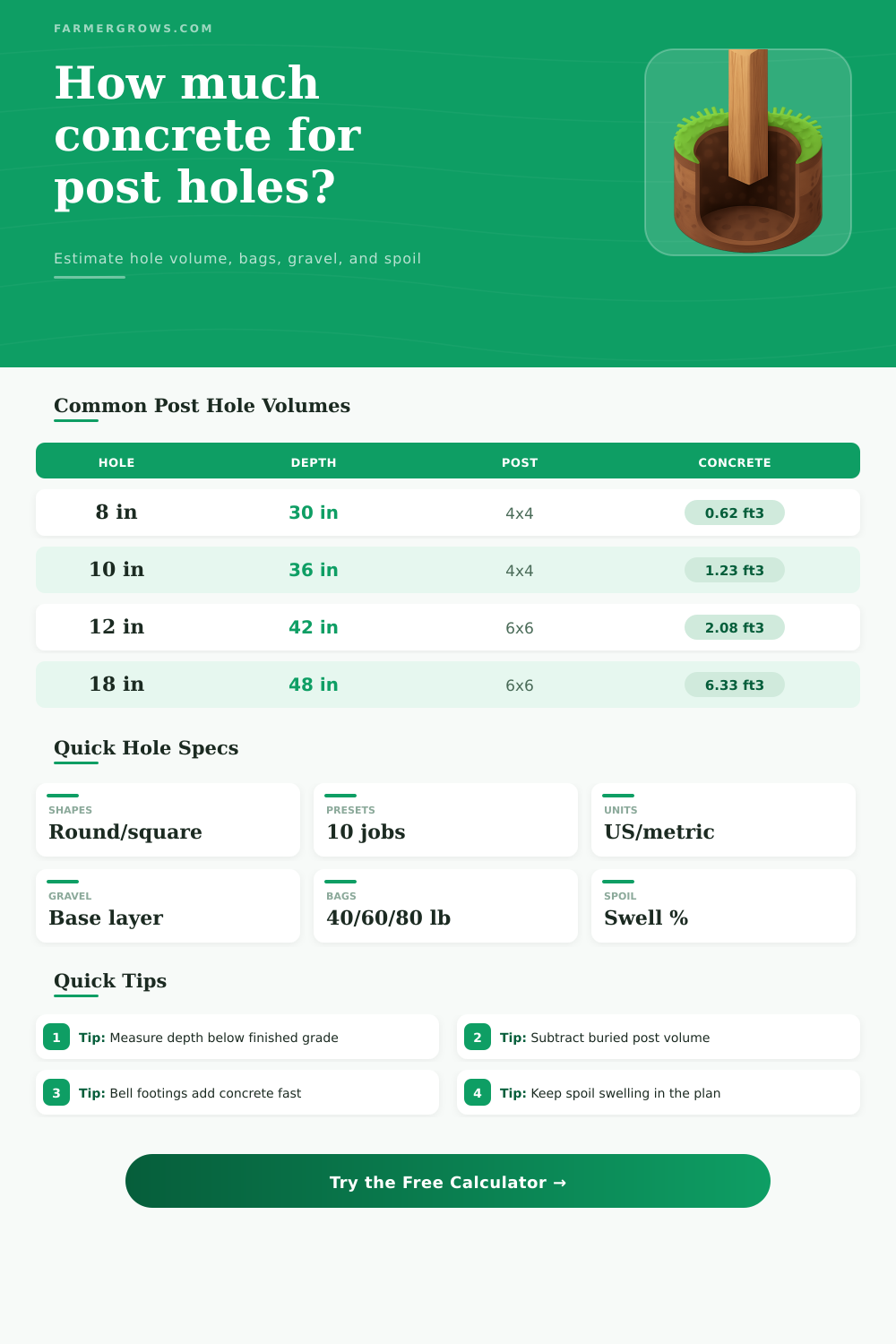
| Round hole diameter | Depth | Gross hole volume | 40 lb bags | 60 lb bags | 80 lb bags |
|---|---|---|---|---|---|
| 8 in | 24 in | 0.70 ft³ | 3 | 2 | 2 |
| 10 in | 30 in | 1.36 ft³ | 5 | 4 | 3 |
| 12 in | 36 in | 2.36 ft³ | 8 | 6 | 4 |
| 15 in | 42 in | 4.30 ft³ | 15 | 10 | 8 |
| 18 in | 48 in | 7.07 ft³ | 24 | 16 | 12 |
| Post type | Actual size used | Area displaced | Volume displaced per 36 in | Why it matters |
|---|---|---|---|---|
| 4x4 wood post | 3.5 in x 3.5 in | 12.25 in² | 0.26 ft³ | Reduces concrete in a narrow fence hole |
| 6x6 wood post | 5.5 in x 5.5 in | 30.25 in² | 0.63 ft³ | Important for deck and gate footings |
| 2 in pipe | 2.375 in OD | 4.43 in² | 0.09 ft³ | Small but noticeable over many posts |
| 3 in pipe | 3.5 in OD | 9.62 in² | 0.20 ft³ | Common for farm gates and braces |
| No post in pour | 0 in | 0 in² | 0 ft³ | Use for empty piers or sleeves |
| Gravel base depth | 12 in round hole | 18 in round hole | 300 mm round hole | Field note |
|---|---|---|---|---|
| 2 in | 0.13 ft³ | 0.29 ft³ | 0.0044 m³ | Light leveling layer under small posts |
| 4 in | 0.26 ft³ | 0.59 ft³ | 0.0088 m³ | Common drainage base for wood posts |
| 6 in | 0.39 ft³ | 0.88 ft³ | 0.0133 m³ | Deeper base where drainage is poor |
| 8 in | 0.52 ft³ | 1.18 ft³ | 0.0177 m³ | Check embedment before using this much |
| Soil or dig condition | Typical swell | Loose spoil from 1 yd³ bank | Handling note |
|---|---|---|---|
| Clean sand or gravel | 10% to 15% | 1.10 to 1.15 yd³ | Settles quickly, easy to rake back |
| Loam garden soil | 20% to 30% | 1.20 to 1.30 yd³ | Good default range for fence rows |
| Clay soil | 30% to 40% | 1.30 to 1.40 yd³ | Clods hold air and pile higher |
| Rocky or rooty spoil | 35% to 50% | 1.35 to 1.50 yd³ | Plan extra cleanup space along the run |
Check the real hole: Augers often wander wider near the top or scrape an oval in loose soil. Measure a few holes before ordering all concrete.
Keep zones separate: Gravel, post displacement, bell volume, and concrete allowance each change the final bag count in a different direction.
Calculating an correct amount of concrete for a fence post or footing for a deck involve accounting for various variables that changes the total amount of concrete that is required. The total volume of a hole have many variables related to the fence itself that can alter the total volume. For example, the shape of the hole will impact the total volume of the hole.
Holes dug by augers are typical round, but square holes may be easier to digging by hand. The depth of the hole is a critical dimension to consider, as different depths will create different volume of holes. Another factor to consider is the displacement of the post that will be placed into the hole.
How to Calculate Concrete Needed for Fence Posts
The post will take up some of the volume within the hole, thus reducing the amount of concrete that is require to fill the hole. A 4×4 fence post that is thirty inch in depth will take up some volume in the hole; the larger the number of fence posts to be installed, the more greater the volume of concrete that the fence posts will save. Finally, there is the volume of gravel that will be placed at the bottom of the hole.
The gravel will improve the drainage under the post, but it will also reduce the depth of the poured concrete. The total volume of the hole must be calculate to account for the gravel. Belly footing add to the complexity of the calculations.
Belly footings are a structure created at the bottom of a fence post that increase the uplift resistance of the fence post. Thus, belly footings are an additional volume to the concrete require for the hole. The calculator allow the user to calculate the volume of the belly footing to determine how much extra concrete is required to place a belly footing at each fence post.
Another variable is spoil swell. When digging holes in the ground, the soil is typicaly loose. The loosened soil take up more space then the soil that is compacted in the ground.
The amount of swell that the soil exhibit can change with the type of soil that is being excavated. For instance, clay soil hold more air within the particles of the soil than sand soil. Thus, clay soil will swell more than sand soil when it is loosen during excavation of fence post holes.
The percent swell of the soil to be excavated must be entered into the calculator to determine how much concrete is required to fill the holes. An allowance must be made for waste. Some waste result from over-excavation; for instance, the edge of fence post holes may be rough or soil may fall into the hole when digging the holes.
These factors will require additional concrete to be pour into each fence post hole. An allowance for waste of ten percent is typicaly made; however, more waste may be create in sandy soil or wet ground; thus, a higher percentage for waste may be required. The percentage of waste are applied to the total volume of concrete that is required to fill the holes in the ground.
Finally, reference table can be used to determine the relationship between the size of the holes, the depth of the holes, and the number of bag of concrete required to fill those posts. These tables can be helpful in the estimating process; however, the calculations that the user can make themselves are more important and should be relied upon than the tables. When using the calculator, the user should make certain to measure the dimensions of the fence posts holes in the ground.
The dimensions that is entered into the calculator should take into account spoil swell, auger wander, oval holes in loose soil, and the difference between the nominal vs actual size of fence posts. If the dimensions of the holes and the percentage of spoil swell are accurate entered into the calculator, the calculator will provide the order for concrete bag that will be required to order sufficient concrete to fill each hole. Thus, the order for concrete bags that the calculator determines will ensure that the job gets completed without having to make a second trip to the concrete supplier for additional bags of concrete.