Fence Post Hole Calculator
Estimate hole depth, hole volume, gravel base, concrete fill, bag count, and frost clearance for wood, metal, corner, and gate posts.
Use this estimator for layout and material planning. Final post depth should follow local code, utility markings, fence manufacturer guidance, and site conditions.
Fence Post Hole Results
Calculated from hole cylinder volume, post displacement, gravel base depth, concrete depth, soil factor, drainage factor, and load factor.
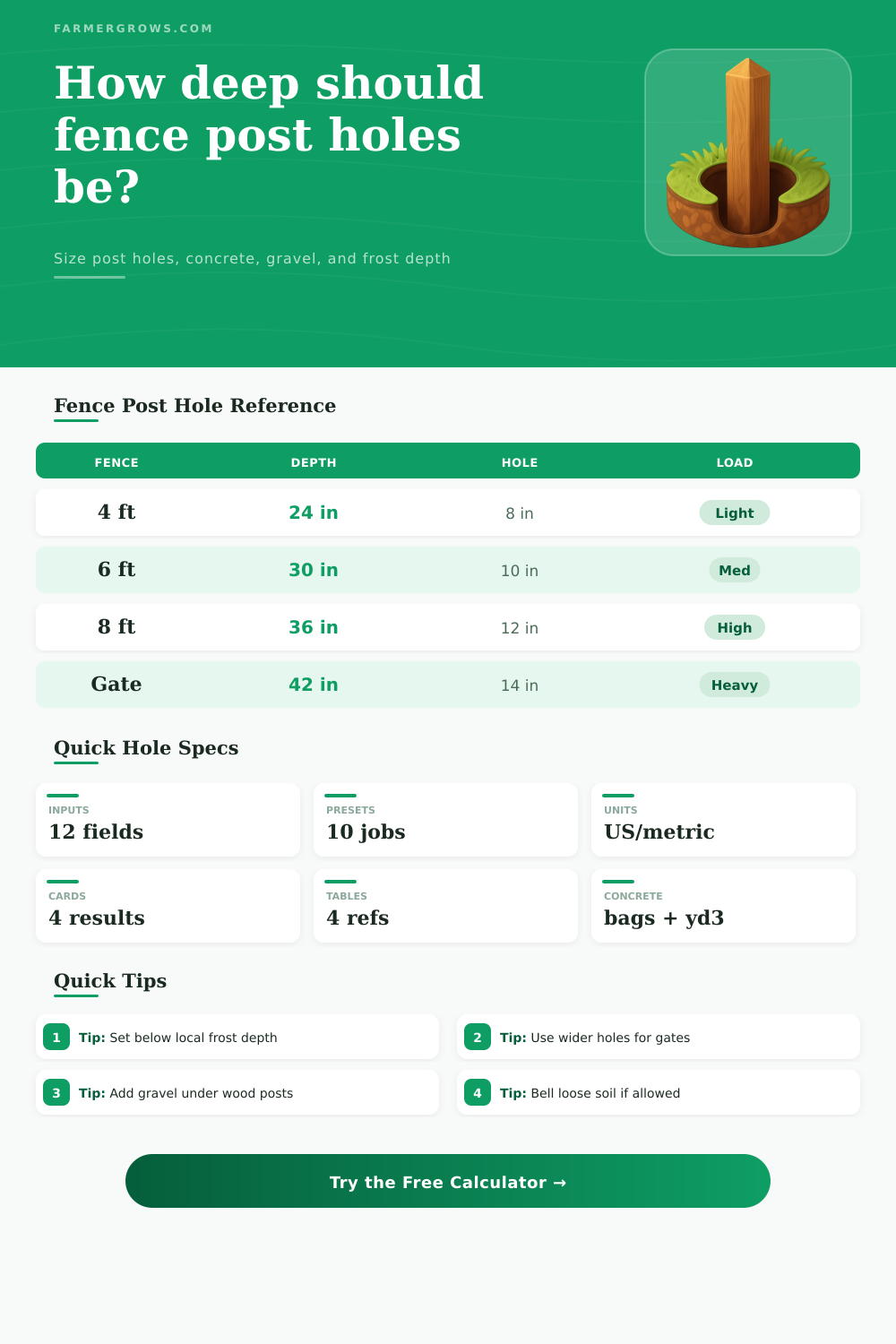
| Fence height | Typical embedment | Loaded post adjustment | Common hole diameter | Field note |
|---|---|---|---|---|
| 3 to 4 ft | 18 to 24 in | Add 4 to 6 in for corners | 8 to 10 in | Good for garden, rail, and light animal barriers |
| 5 to 6 ft | 24 to 36 in | Add 6 to 10 in for gates | 10 to 12 in | Common for privacy, chain link, and paddock lines |
| 7 to 8 ft | 36 to 48 in | Add 8 to 12 in for wind load | 12 to 16 in | Use larger holes where panels are solid or exposed |
| Gate posts | 36 to 54 in | Widen and brace hinge posts | 14 to 18 in | Match gate weight, hinge height, and latch tolerance |
| Frost band | Typical frost depth | Minimum target | Hole planning note |
|---|---|---|---|
| Warm coastal or deep south | 0 to 12 in | Use height-based embedment | Drainage and wind load usually matter more than frost |
| Mild freeze belt | 12 to 24 in | Set bottom below frost line | Gravel helps reduce trapped water under wood posts |
| Cold winter belt | 30 to 42 in | Use frost depth plus margin | Clay and wet soils need conservative depth |
| Severe northern zone | 48 to 60 in | Check local code first | Long holes may need staged tamping or engineered piers |
| Soil type | Digging difficulty | Stability factor | Drainage concern | Practical adjustment |
|---|---|---|---|---|
| Sandy or gravelly | Easy to moderate | 1.06 | Low, but sides may slough | Keep hole clean and use a full-width base |
| Firm loam | Moderate | 1.00 | Average | Baseline condition for most calculators |
| Clay or expansive | Hard when dry, sticky when wet | 1.10 | High heave risk | Go below frost and avoid water pockets |
| Rocky or fill | Variable | 1.12 | Depends on voids | Budget extra concrete for irregular walls |
| Wet low spot | Messy and unstable | 1.16 | High | Use drainage stone and consider alternate post detail |
| Bag size | Typical yield | Bags per cu yd | Good use | Planning note |
|---|---|---|---|---|
| 40 lb concrete | 0.30 cu ft | 90 bags | Small repairs | Handy but slow for many posts |
| 50 lb concrete | 0.375 cu ft | 72 bags | Light fence work | Often manageable for small crews |
| 60 lb concrete | 0.45 cu ft | 60 bags | Average post holes | Common choice for residential fencing |
| 80 lb concrete | 0.60 cu ft | 45 bags | Deep or wide holes | Fewer bags but heavier handling |
For frost: Compare the calculated depth with the local frost depth, then use the deeper value so freezing soil is less likely to lift the post.
For concrete: Irregular auger holes, rocky soil, bell-shaped bottoms, and gate posts usually consume more mix than a clean cylinder.
A fence post hole calculator are a construction tool that determine the dimension needed to dig fence post holes and to pour concrete into those holes for the fence posts. A fence post hole calculator works because it change variables like soil types and frost depth into numbers. Based off these number, a fence post hole calculator can allow a contractor or homeowner to plan the fence installation process.
Additionally, using a fence post hole calculator can help to ensuring that fence posts will not lean within the ground. Depth is a critical component of fence installation. The depth to which a contractor will install a fence post into the ground will determine the stability of that fence post.
Using a Fence Post Hole Calculator
If a fence post is installed into the ground to a depth that is not sufficient for the local soil and climate condition, the fence post may shift within the ground if the ground freeze. Fence post hole calculators consider the frost depth of the local area. However, a fence post hole calculator will also add a certain depth to that frost depth to account for ground shifting cause by expansion of the soil when it freezes.
Additionally, the soil type will adjust the depth. For example, clay soil will hold water and require more deeper installation of fence posts than sandy soil. A fence post hole calculator will provide a depth for fence posts that account for these various factor.
The diameter of the hole into which the fence post will be installed is another important measurement. The diameter of the hole will depend on the type of fence post that will be installed. For instance, the diameter of the hole for a line post will be less than the diameter of the hole for a gate post.
This is because a gate post will experience more physical load than a line post. Fence post hole calculators will take into account these different load requirement for different types of fence posts so that posts will not shift within the ground. Another component of installing fence posts is the addition of gravel to the bottom of the holes into which the fence posts will be placed.
This gravel serve two important purposes. First, it allow water to sit on the gravel rather than on the fence post. Second, the gravel create a stable pad for the poured concrete within the fence post hole.
The fence post hole calculator will determine the depth of this gravel layer because gravel is required in areas of the fence ground that has drainage issues to allow water to drain away from the fence. Calculating the volume of concrete required for each fence post is a difficult task to complete by hand. A fence post hole calculator account for the volume of the fence post that will displacing the volume of concrete.
Additionally, the fence post hole calculator account for the total number of fence posts, the waste allowance in concrete pouring, the soil factor, and drainage factor. The output of a fence post hole calculator will show the volume of concrete that will be required for the fence in both cubic feet and bag of concrete. This output will allow the contractor to purchase the necessary bags of concrete for the fence installation project.
Additionally, the fence post hole calculator will show the recommended depth for the fence post holes next to the depth that the contractor enters. One of the factor that must be entered into the fence post hole calculator is the type of soil in which the fence will be installed. Different types of soil require different amount of concrete for stability.
A fence post hole calculator perform differently according to the type of soil in which the fence posts will be installed. For example, a fence post hole calculator will require different factor for sand, loam, clay, rocky fill, and wet ground. These factor will not affect the appearance of the fence.
However, they will change the amount of concrete that is required for the fence posts. If a fence post is installed into a wider hole, the fence post will not shift within the soil. In addition to running the fence post hole calculator once to determine the dimension and volume of concrete for fence installation, it is also necessary to run the fence post hole calculator more than once.
For example, the initial run of the fence post hole calculator will use initial estimate for the depth and the weight of the gates. However, you can make a second run of the fence post hole calculator after these value have been adjusted. The difference between the first and second calculation by the calculator will be larger for fences that will be installed in clay soil than for good soil.
Finally, using a fence post hole calculator will ensure that a contractor is aware of the depth of the hole that will be dug for the fence posts, the amount of gravel that will be required for the bottom of each hole, and the number of bags of concrete that will be required for each fence post.