Fence Calculator
Estimate total fence line, line posts, corner braces, gate posts, wire, rails, panels, concrete, and hardware for farm paddocks, gardens, corrals, orchards, and yard enclosures.
Use field measurements for final ordering. This calculator separates gate openings from fence fabric, counts structural posts around corners and gates, and adds terrain waste so irregular ground is not treated like a clean drawing.
Fence Material Estimate
Results separate the measured perimeter, gate openings, structural posts, line posts, fabric or rail material, concrete, and small hardware.
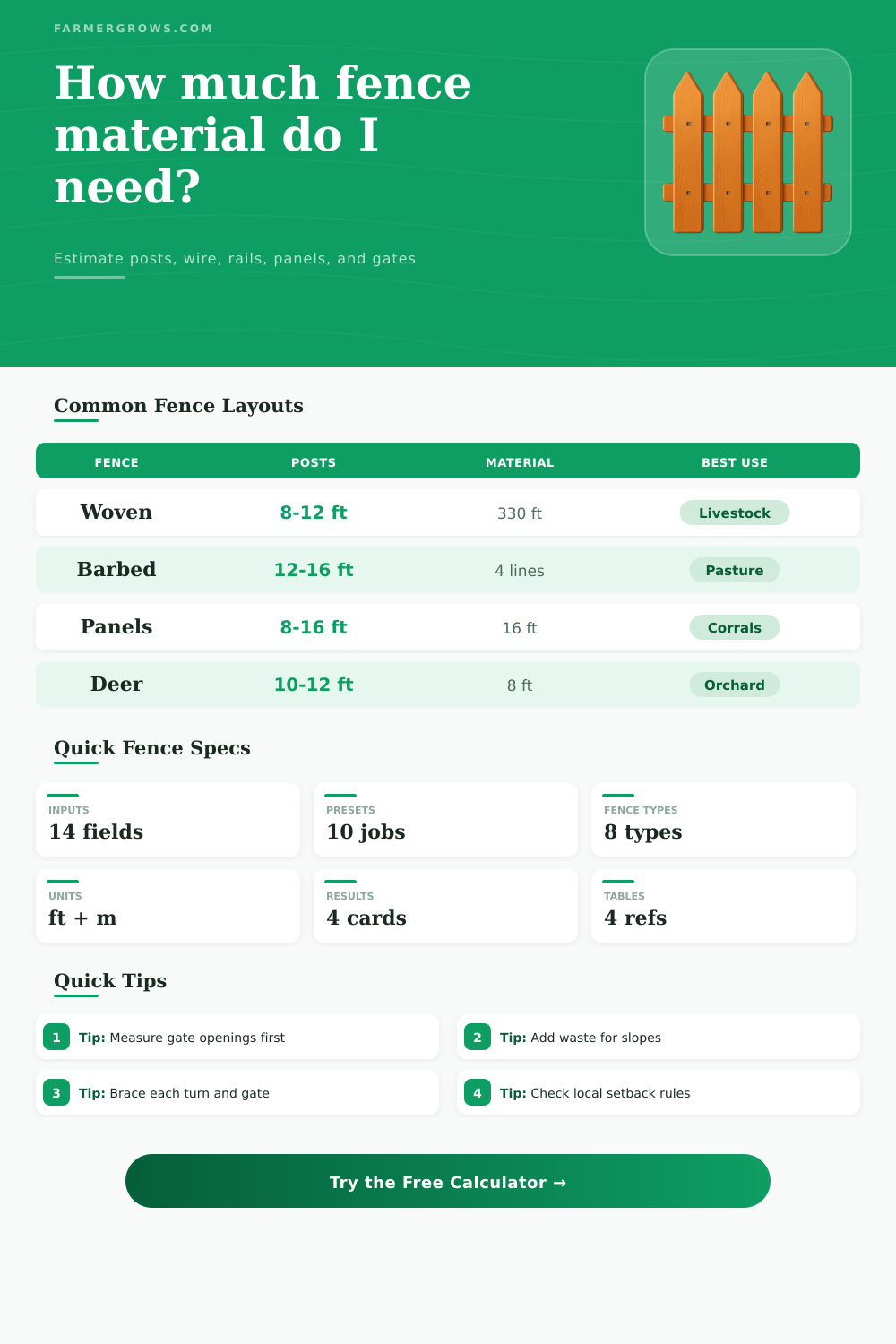
| Fence type | Typical post spacing | Main material unit | Common height | Field note |
|---|---|---|---|---|
| Woven field fence | 8 to 12 ft | 330 ft roll | 39 to 48 in | Use brace assemblies at corners, ends, and gates. |
| Barbed wire pasture | 12 to 16 ft | 1,320 ft spool | 42 to 54 in | Four strands are common for cattle boundary lines. |
| High tensile electric | 25 to 50 ft | 4,000 ft coil | 42 to 54 in | Long spacing depends on strong end braces and tensioners. |
| Board fence | 8 ft | 16 ft boards | 48 to 60 in | Four rail rows are counted across the fence line. |
| Chain link yard fence | 8 to 10 ft | 50 ft roll | 48 to 72 in | Terminal posts are counted at gates, corners, and ends. |
| Material unit | Unit length | Calculator count | Useful for |
|---|---|---|---|
| Woven fence roll | 330 ft | Fence line after gates and waste divided by roll length | Goats, sheep, calves, gardens, mixed farmyard enclosures |
| Barbed wire spool | 1,320 ft | Fence line times strand count, then divided by spool length | Cattle pasture and long boundary fences |
| High tensile coil | 4,000 ft | Fence line times energized or grounded wire strands | Rotational grazing, lanes, and perimeter hot wires |
| Fence boards | 16 ft | Fence line divided by board length, times rail rows | Horse paddocks, yard fronts, and visible farm entries |
| Cattle panels | 16 ft | Fence line after gates and waste divided by panel length | Working corrals, small pens, and rigid garden barriers |
| Post role | What triggers it | Typical hole | Concrete logic | Hardware note |
|---|---|---|---|---|
| Line post | Spacing along straight fence runs | 8 in x 24 to 30 in | Optional share selected in the form | Clips, staples, ties, or rail screws are counted here. |
| Corner post | Every turn in a closed or jogged layout | 10 in x 36 in | Always included in structural concrete | Wire fences need tension hardware at corners. |
| End post | Open lane ends and terminal fence stops | 10 in x 36 in | Always included in structural concrete | Ends often share brace kits with tensioned wires. |
| Gate post | Two posts for each gate opening | 10 to 12 in x 36 to 42 in | Always included in structural concrete | Calculator adds hinges, latches, and brace hardware. |
| Terrain condition | Added material | Post adjustment | When to use it |
|---|---|---|---|
| Flat measured line | 5% | No extra line posts | Straight yard, garden, or level paddock perimeter. |
| Rolling yard or paddock | 8% | About 5% extra line posts | Gentle slopes, shallow swales, and small layout corrections. |
| Brushy or uneven farm edge | 12% | About 8% extra line posts | Creek edges, brush lines, uneven bends, and overlap-heavy rolls. |
| Steep, rocky, or irregular boundary | 15% | About 12% extra line posts | Hard setting, steep grade changes, and rough boundary repair work. |
Before you count rolls: Walk the line and subtract actual gate openings. Gate gaps need posts and hardware, but they do not need fence fabric, rails, panels, or strands across the opening.
Before you set posts: Mark every corner, jog, end, and gate first. These structural posts control tension, then line posts can be spaced evenly between them.
Fence calculation involve many different decisions. A fence project involve many different types of material and measurement. A person must determine the total amount of material that is need for the fence, the number of fence post that will be required to set into the ground, and how the terrain will impact the fence material.
Additionally, a person must determine the type of materials that will be used for the corners and gates in the fence, since those area of the fence will require different types of materials than those use for the remainder of the fence. If the person does not carefuly measure the layout of the fence before they install fence posts, it is possible that there will not be enough material for the fence. While it is true that many people measure the outside perimeter of there yard to determine the length of the fence that they will build, the measurement of the perimeter is not sufficient for many yard.
How to Calculate Fence Materials and Posts
Yards often contain slope that will require extra rolls of fence material to be purchased to cover those slope, or the fence line may contain a jog that will require the purchase of additional fence material. Fence calculator allow individuals to enter both the layout of their yard, as well as the dimension of any gate that will be constructed within the fence, as well as the terrain of their yard. These fence calculators will automatically subtract the area cover by gates from the total length of the fence fabric that will be used to build the fence, will automatically add fence post only where they are needed for the structure of the fence, and will also apply a waste factor for the ground condition of the yard.
The type of fence that will be constructed will have an impact upon the type of fence material and fence post that are required for building that fence. For instance, woven mesh fence require small distance between fence post, as well as solid brace for the corners of the fence; animals may push against the woven mesh of the fence. Barbed wire fence have the potential to stretch farther between fence post, but require H-brace at each corner of the fence to maintain the integrity of the barbed wire.
Board fence may appear complete when finish being constructed, but may require additional fence rail if four row are selected instead of three row of fence board. High tensile wire fence allow for wide distance between fence post, but require end brace for the fence wire to maintain their integrity. Fence calculator typically have option for selecting the type of fence that will be constructed, and will adjust the requirement of the fence material, unit of measurement of the fence material, and the number of brace for the fence post according to the type of fence.
Gate for a fence can often be underestimated when calculating the total amount of fence material that will be required. Fence gate will reduce the amount of fence fabric that is required, but will increase the number of fence post, hinge, and latch for the gate. The number of fence post for the fence will change if gate are constructed, the load on the fence brace will change, and the amount of concrete that will be mixed for the fence will change.
Fence calculator will separate the area designated for gate to prevent individuals from purchasing fence fabric for the area that will remain an open gate. The terrain for which the fence will be constructed will affect the amount of fence material that are required to be purchased. The terrain of the area will determine the amount of extra fence material that may be required in case of slope, for instance.
Terrain calculator account for flat area with simple line and five percent extra material to account for error in placement of the fence post. Rocky terrain may require twelve or fifteen percent extra material to allow for correction to the placement of fence post. Extra line post may be required in area where the terrain has high spot and low spot for the fence to remain intact.
The fence calculator applies these percentage automatically so that individuals dont run short of the material for their fence. Beyond the fence post, there are other material for a fence beyond the fence fabric that must be accounted for. For instance, not all fence post will require concrete to hold them in place; instead, the gate post, corner post, and the post used to brace the fence may require a quantity of concrete to be mixed for construction of the fence.
Fence calculator will account for the number of structural fence post required, and allow individual to select how many of the line fence post will be constructed in concrete. The fence calculator will also calculate how many bag of concrete will be required for the fence construction by converting the size of the hole for the fence post into the number of bag of concrete required. The number for the fence should of been calculated prior to ordering the material for the fence.
Fence calculator will allow individuals to input the number of fence post, the number of fence material, and the number of line post that will require concrete. By calculating the fence prior to ordering the material, individuals can ensure that they will not make any mistake in constructing there fence. If the measurement of the yard, the length of the fence, and the type of terrain is accounted for in the fence calculator, the individual will be able to build the fence without any need for additional fence material or fence post.