Rabbit Gestation Period Calculator
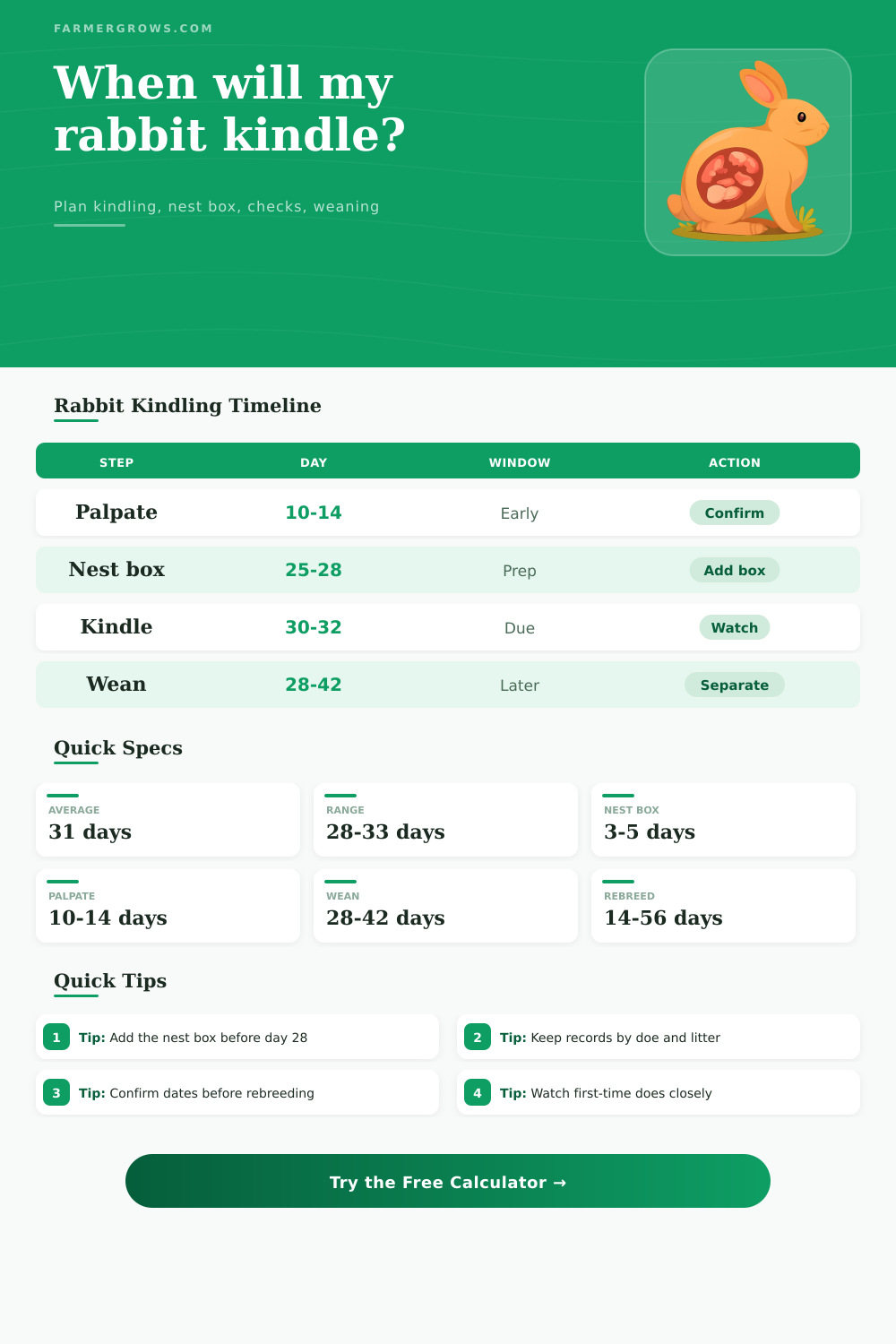
Estimate due date, early and late kindling window, nest box placement, palpation checks, weaning date, and rebreed timing from your breeding date and doe history.
Usually plan around 31 days with smaller litter expectations and close first-litter observation.
2-6 kitsRex, Dutch, and similar does fit the common 30 to 32 day kindling window well.
4-8 kitsNew Zealand, Californian, and Silver Fox does often use robust nest boxes and larger kit counts.
7-10 kitsLarge does may trend toward the later side, so the calculator widens the watch period slightly.
6-10 kitsEnter the actual breeding date if possible. The calculator uses a practical 28 to 33 day rabbit gestation range, then adjusts the expected day slightly for breed size and litter history.
Rabbit Kindling Schedule
Enter breeding details and calculate to see the kindling timeline.
Calculation Breakdown
| Breed size | Expected day | Watch window | Planning note |
|---|---|---|---|
| Dwarf and very small breeds | About day 31 | Day 29 to 33 | Small litters can still need careful nest and kit checks. |
| Small to medium breeds | About day 31 | Day 28 to 33 | Good default for pets, show rabbits, and mixed small rabbitries. |
| Commercial meat breeds | About day 31 | Day 28 to 33 | Plan nest box space and bedding for larger litters. |
| Giant breeds | About day 32 | Day 29 to 34 | Give the doe a little extra space and a wider late-watch window. |
| Task | Typical timing | Calculator input | Reason to track it |
|---|---|---|---|
| Palpation or confirmation | Day 10 to 14 | Palpation day | Helps identify misses without waiting until the due date. |
| Nest box placement | Day 25 to 28 | Nest box lead days | Early enough for nesting, not so early it becomes a litter box. |
| Daily kindling checks | Day 28 onward | Early check day | Focuses morning and evening checks near the real risk period. |
| Late breeding review | Day 33 to 35 | Late check day | Flags possible misses, false pregnancy, or record errors. |
| Litter history | Litter estimate effect | Schedule effect | Management note |
|---|---|---|---|
| Maiden doe | Lower kit estimate | No major date change | Watch nest-building behavior and kit scattering closely. |
| Small past litters | Slightly lower estimate | Normal due day | Record whether small litters match the same buck or season. |
| Average proven doe | Uses breed default | Normal due day | Best baseline for routine rabbitry planning. |
| Large past litters | Higher kit estimate | Watch the early side | Prepare extra bedding and check milk start after kindling. |
| Plan type | Weaning age | Rebreed interval | Best fit |
|---|---|---|---|
| Conservative pet or show plan | 42 to 56 days | 56 to 90 days | Prioritizes doe recovery, kit growth, and lower production pressure. |
| Balanced homestead plan | 35 to 42 days | 35 to 56 days | Good middle ground for small meat or show rabbitries. |
| Production plan | 28 to 35 days | 14 to 35 days | Requires strong records, feed, condition scoring, and culling discipline. |
| After a difficult litter | 42 days or more | 56 days or more | Use more recovery after losses, poor condition, or hard kindling. |
This calculator is a planning aid for domestic rabbits. If a doe seems distressed, overdue, off feed, or unable to kindle normally, contact a rabbit-savvy veterinarian or experienced breeder.
A rabbit gestation period calculator are a tool that will allow you to create a timeline for your breeding rabbit. The schedule for breeding rabbits can be complex and challenging to manages due to the number of tasks that must be performed at specific times in the breeding cycle of a doe. A breeding schedule that contains many tasks to perform can become confusing for the owner of the breeding rabbit.
A gestation period calculator will allow you to turn the breeding detail of your does into a timeline that you can use to plan the various event of that breeding cycle. Thus, you can use a gestation period calculator to determine when the doe will kindle, as well as when you must prepare the nest box for the kit. The gestation period of a doe will occur over a specific length of time; however, the gestation period can range between does.
How to Use a Rabbit Pregnancy Calculator
A maiden doe is a doe who has not yet had any litters of kit. Maiden does may have a longer gestation period than does that have had litters before (referred to as proven does). Proven does may have a shorter gestation period than maiden does because they are more familiar with the birthing process.
Breeding calculator allow for the input of these variable (such as the breed size of the does and the history of their litters) to provide an accurate due date for each doe. The variables that you input into the calculator will affect the outcome of the calculator. The breed size of the does can affect the length of the gestation period.
The history of the does litters may also impact both the number of kit that the does will have, as well as the due date for the does litters. Does that consistently has large litters may kindle earlier than does that have small litters. Additionally, you can enter the number of lead day for the nest box into the calculator.
This will indicate to the owner when to prepare the nest box for the kits. Furthermore, the owner can enter settings related to palpation days and checks so that they knows when to examine the does more close during the breeding cycle. The calculator will output several different variable during the breeding cycle of the does.
The calculator can determine the kindling date; however, the watch window is an important variable to determine how to monitor the does. The calculator can determine the date at which the nest box should be placed. If the nest box is placed too early, it can become dirty from the kits; if placed too late, the doe may kindle without the nest box.
Additionally, the calculator will output date related to the weaning and rebreed of the kits. These dates can allow the owner to determine whether the cage and feeding program are appropriate to support the population of does and kits. Although a gestation period calculator can determine the dates related to the breeding cycle of the does, it cannot indicate the behavior that the does will exhibit during the cycle.
Does may display behaviors that indicate when they will kindle, such as pulling at their fur or eating more or less than normal. Does may also become restless or rearrange their sleeping bedding. These behaviors must be watched for even if the calculator provide an indication of the date upon which the does will kindle.
Maiden does must be watched with more care than proven does. Maiden does have not yet established a cycle for caring for their kit. Thus, maiden does may ignore the nest box or scatter their kit outside of the nest box.
The status of each doe can be entered into the calculator as a maiden doe. When you enter each doe as a maiden doe, the calculator will automatically adjust the litter size for that doe, as well as the length of the check window. Another important aspect of the breeding cycle are the decision regarding the rebreeding of the kits after they have been weaned.
The calculator can be used to evaluate rebreed interval of various lengths. Shorter rebreed intervals will allow for more kits to be born each year by the does; however, very short intervals may detract from the physical condition of the does. The calculator can show the effect of various rebreed intervals on the length of the breeding cycle.
In a colony of does, the due date of one doe can impact the behavior of other does in the colony. A gestation period calculator is useful within a colony because you can enter the litter history of each doe into the calculator. For instance, if the breeding of one doe is yet to be confirmed, that breeding can be entered as “uncertain” in the litter history.
This will automatically widen the late check window to remind the owner of the breeding of the need to confirm that it was successful. Rabbits may have made the mistake of treating the expected kindling date of a doe as a set date. The expected kindling date is only the middle date of a range of dates during which the doe may kindle.
Additionally, the lead days for the nest box can be used to find a compromise between placing the nest box too early (and leading to dirty nest box) versus too late (and the doe kindling without a nest box). In order to increase the accuracy of the breeding cycle and the subsequent care of the kits, owner may wish to keep records of the date that each doe kindled, as well as the size of each doe’s litter. By keeping these records, owners can determine whether their does tend to kindle early or late in the gestation period.
Calculators save time for owners of does because it is not necessary to remember each date associated with the does’ breeding cycle. Simply entering the date on which the does will be bred will reveal each date associated with the breeding cycle.