Candle Wax Calculator
Plan container candle batches from jar volume, fill level, wax density, fragrance load, candle count, wick tab displacement, and melt loss in imperial or metric units.
Use the marked container capacity or a water test volume, choose a realistic fill level, subtract wick tab displacement, then apply wax density and fragrance load. The calculator treats fragrance as a percentage of wax weight, which is the common candle-making convention.
Wax, Fragrance, and Batch Results
Your candle batch weights will appear here after calculation.
usable mL = container mL x fill level - wick tab mL
wax g = usable mL x wax density g/mL x candle count
fragrance g = wax g x fragrance load / 100
batch g = (wax g + fragrance g) x (1 + melt loss / 100)
Density affects weight because candle containers are measured by volume. Use supplier data when available, especially for blends with additives, high fragrance loads, or waxes sold for specific vessel types.
| Wax Type | Typical Density | Approx Ounces Per Cup | Common Fragrance Load |
|---|---|---|---|
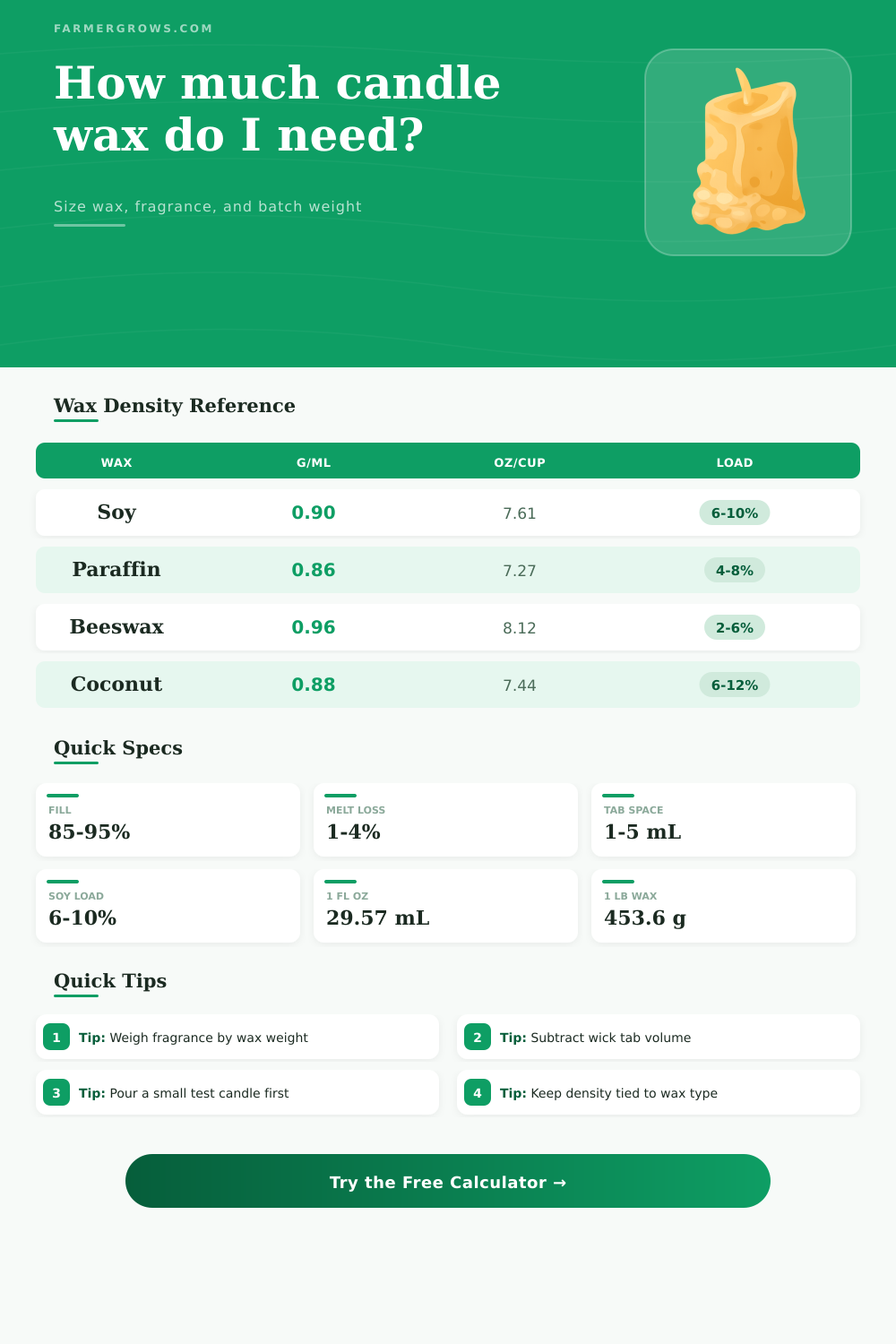
| Soy container wax | 0.88-0.92 g/mL | 7.4-7.8 oz/cup | 6-10% of wax weight |
| Paraffin wax | 0.84-0.88 g/mL | 7.1-7.4 oz/cup | 4-8% of wax weight |
| Beeswax | 0.95-0.97 g/mL | 8.0-8.2 oz/cup | 2-6% of wax weight |
| Coconut wax | 0.86-0.90 g/mL | 7.3-7.6 oz/cup | 6-12% of wax weight |
| Coconut soy blend | 0.88-0.91 g/mL | 7.4-7.7 oz/cup | 6-12% of wax weight |
| Rapeseed wax | 0.89-0.92 g/mL | 7.5-7.8 oz/cup | 6-10% of wax weight |
| Palm wax | 0.88-0.91 g/mL | 7.4-7.7 oz/cup | 4-8% of wax weight |
| Gel wax | 0.86-0.89 g/mL | 7.3-7.5 oz/cup | 0-6% when compatible |
| Liquid Container Size | Milliliters | 90% Fill Volume | Soy Wax Weight at 90% |
|---|---|---|---|
| 2 fl oz tea light cup | 59.1 mL | 53.2 mL | 47.9 g / 1.69 oz |
| 4 fl oz small tin | 118.3 mL | 106.5 mL | 95.8 g / 3.38 oz |
| 8 fl oz tin or jar | 236.6 mL | 212.9 mL | 191.6 g / 6.76 oz |
| 9 fl oz tumbler | 266.2 mL | 239.6 mL | 215.6 g / 7.61 oz |
| 12 fl oz mason jar | 354.9 mL | 319.4 mL | 287.5 g / 10.14 oz |
| 16 fl oz large jar | 473.2 mL | 425.9 mL | 383.3 g / 13.52 oz |
| Wax Weight | 6% Fragrance | 8% Fragrance | 10% Fragrance |
|---|---|---|---|
| 250 g / 8.8 oz wax | 15 g / 0.53 oz | 20 g / 0.71 oz | 25 g / 0.88 oz |
| 500 g / 17.6 oz wax | 30 g / 1.06 oz | 40 g / 1.41 oz | 50 g / 1.76 oz |
| 1,000 g / 35.3 oz wax | 60 g / 2.12 oz | 80 g / 2.82 oz | 100 g / 3.53 oz |
| 2,500 g / 5.51 lb wax | 150 g / 5.29 oz | 200 g / 7.05 oz | 250 g / 8.82 oz |
| 5,000 g / 11.02 lb wax | 300 g / 10.58 oz | 400 g / 14.11 oz | 500 g / 17.64 oz |
| Adjustment | Typical Range | Use When | Calculator Effect |
|---|---|---|---|
| Fill level | 85-95% | Leaving lid clearance or matching a target line | Reduces usable vessel volume before density is applied. |
| Wick tab displacement | 1-5 mL each | Metal sustainer tabs and adhesive pads take up space | Subtracts volume from each candle before wax weight. |
| Melt loss | 1-4% | Pour pots, strainers, and transfer steps hold residue | Adds wax and fragrance to the total batch only. |
| Fragrance load | 4-12% | Wax supplier and fragrance safety data allow it | Adds fragrance weight based on wax weight. |
| Rounding | 5-50 g | Scaling batch totals on a production scale | Rounds total batch upward for easier measuring. |
Volume tip: If the jar label lists a retail candle weight, do a water test instead. Fill to the intended line, weigh the water in grams, and use that number as milliliters.
Fragrance tip: Keep fragrance load within the wax maker's tested range. Too much fragrance can soften the candle, affect burn quality, or seep from the finished surface.
Calculating the correct amount of wax needed for container candles is a necessary part of the candle making process. However, calculating the amount of wax for container candles can be dificult in that the volume of the container isnt the same as the weight of the wax that will be poured into the containers. When viewing the size of a container, the fluid ounce or milliliter measurement represent the amount of space that the container will take up when filled with wax.
This amount includes the space that the metal wick tab will take up within the container, but does not include the space that the wax will occupy within that container. Furthermore, the volume of wax that will be used to fill the containers will have a specific weight based off the type of wax that is to be used within the containers. Additionally, the weight of the fragrance oil that you will add to each of the containers will also contribute to the total weight of the candles that are to be made.
How to Calculate Wax and Fragrance for Container Candles
The calculator that is included on this page will allow you to account for each of these variables and arrive at an accurate calculation of the total weight of the candles that will be made using the inputs of the user. The calculator will first ask that you select your unit system to be used in the calculations, and which type of wax will be used to make your candles. Each type of wax have a specific density, and the calculator must utilize the correct density based upon the type of wax that is to be employed.
Following the selection of wax type, you will be asked for the volume of your container, as well as the percentage of that container that you wish to fill with your wax. Based upon these variables, the calculator will automatically calculate the amount of wax that will be required to fill each of your container. Finally, the calculator will include the weight of the fragrance oil that will be utilized in each batch of candles, as well as an allowance for melt loss.
It is critical that you calculate the fragrance oil load in relationship to the weight of the wax that will be used for each batch of candles, rather than the total weight of the batch of candles that will be created. If the fragrance load is calculated in relationship to the total batch weight, the strength of the scent of each of the candles will not be consistent. By calculating the fragrance load in relationship to the weight of the wax that is to be used, the strength of the scent of each candle will remain the same from batch to batch.
Density is a measurement of the amount of weight that a specific type of wax will have within a specific amount of volume. Each type of wax will have a different density. For instance, soy wax will have a density of around 0.90 gram per milliliter, while paraffin wax may have a density of around 0.86 grams per milliliter.
As a result, if the same amount of volume for each type of candle is selected for each batch of candles, the soy wax candles will weigh more than those made with paraffin wax. The calculator allows for the wax type to be changed, and will automatically update the density of the wax that is selected. Melt loss is the amount of wax that can become stuck to the melting pot or tools that are used to transfer the wax from one container to another to the candle containers.
Each time that wax is moved from one container to another, some of the wax becomes stuck to the tools and cannot be poured into the containers. Some melt loss must be accounted for in the calculations to ensure that enough wax is obtained to fill the containers. A three percent melt loss rate is common for small batches of candles.
However, a higher percentage of melt loss may be required if the batches of candles to be made are very large. Wick tab displacement is the amount of space that will be taken up by the metal wick tab that will be added to the bottom of each candle container. Since the wax will not be able to fill the container to the very top, the volume of the container will have to be adjusted to account for the space that the wick will take up.
If the volume of the container is not adjusted for the wick, then the amount of wax that will be calculated will be more than the amount of wax that will be needed to fill the containers. The reference tables included with this calculator will allow you to view the different amounts of wax that will be required by each type of container at each percentage of fill. These tables will also allow you to view the amount of fragrance oil that will be required by each specific weight of candle wax.
Each of these tables will allow you to easily understand the amount of each ingredient that will be required for each batch of candles that are to be created. In order to ensure that the percentage of melt loss is accurate, it is recommended that you create a test batch of candles with the ingredients and methods that are to be utilized for the remaining batches. By creating this test batch, you will be able to determine the amount of wax that was poured into the containers.
By comparing this amount of wax to the amount that was calculated for the batch, you will be able to either add to or subtract from the melt loss percentage within the calculator. The percentage of melt loss within the calculator will automatically update the amount of total batch weight that is calculated within the calculator. By following these steps and utilizing this calculator, you will be able to consistently produce candles with the same amount of each ingredient, with the same strength of scent, and with the same amount of wax that is required for each container of candle.