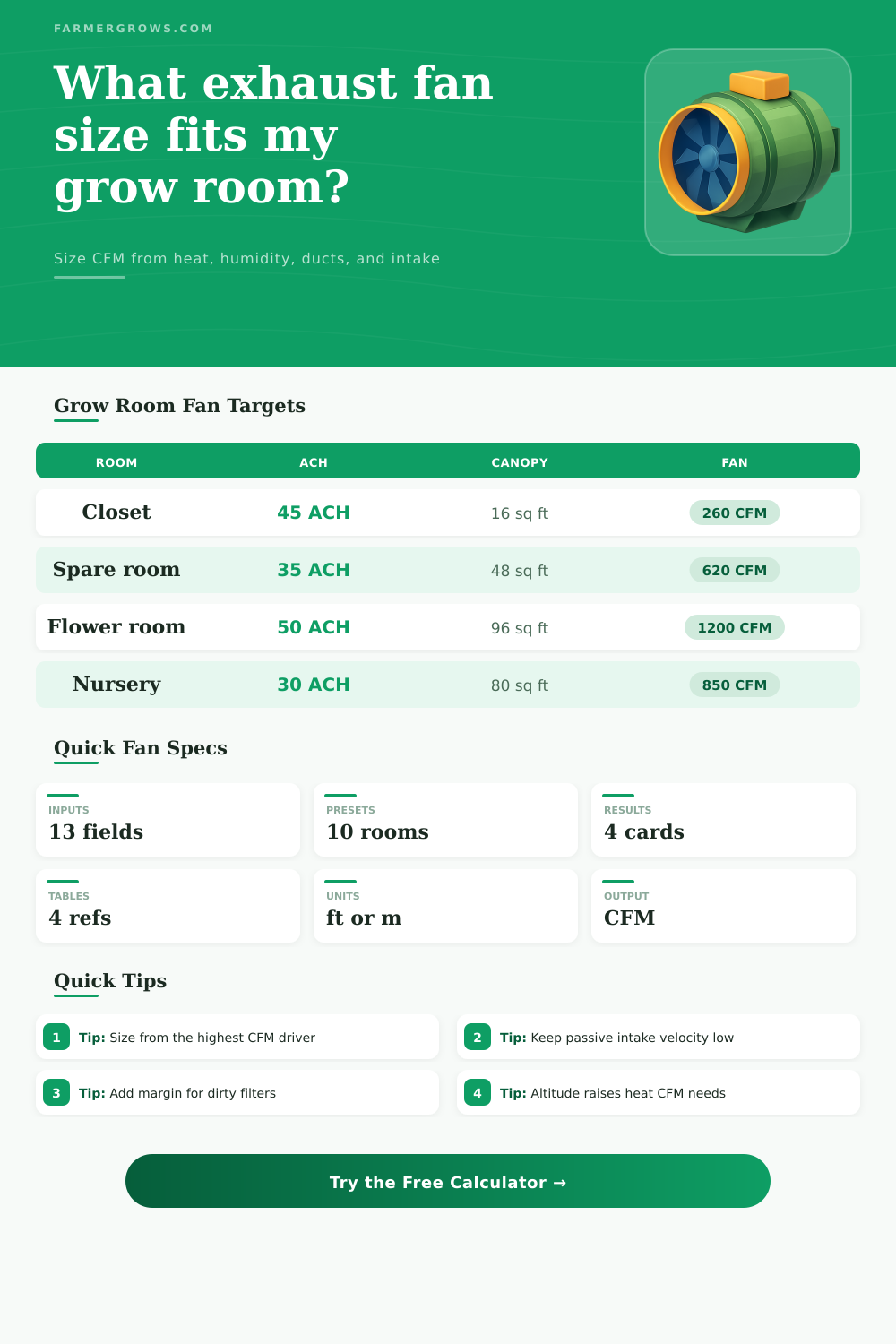
Grow Room Exhaust Fan Calculator
Size a room exhaust fan from full room volume, crop canopy, lighting watts, extra heat, air changes, filter loss, duct loss, passive intake area, humidity mode, and altitude.
This calculator is for a dedicated grow room, not a tent shell. It compares the airflow required for room air changes, heat removal, and crop humidity pressure, then upsizes the fan rating for real filter and duct losses.
Grow Room Exhaust Fan Result
Results compare ACH, heat, and humidity drivers, then convert the required effective CFM into a nameplate fan target.
| Room Use | Typical ACH | When to Go Higher | When to Go Lower |
|---|---|---|---|
| Propagation or seedlings | 20 to 35 ACH | Warm lights, stagnant corners, or open trays | Humidity domes or very tender plants |
| Vegetative production | 30 to 45 ACH | Dense leaf mass or high watering frequency | Cool rooms with strong dehumidification |
| Flowering or fruiting canopy | 45 to 60 ACH | High light, dense canopy, or odor filter pressure | Sealed room with separate HVAC control |
| Drying or night purge room | 20 to 40 ACH | Moist crop load or fast humidity climb | Very dry climate or active dehumidifier control |
| Component | Typical Loss | Calculator Input | Practical Note |
|---|---|---|---|
| Clean carbon filter | 10% to 20% | 15% to 20% | Use more if the filter is small for the fan. |
| Loaded carbon filter | 20% to 35% | 25% to 35% | Dust and moisture both reduce real airflow. |
| Short straight duct | 5% to 12% | 5% to 10% | Large smooth duct keeps the fan curve happier. |
| Long duct with bends | 15% to 35% | 20% to 35% | Each tight bend can behave like added duct length. |
| Effective CFM | Quiet Intake Area | Acceptable Area | Restriction Risk |
|---|---|---|---|
| 250 CFM | 105 sq in | 65 sq in | Under 45 sq in strains small fans |
| 500 CFM | 205 sq in | 130 sq in | Under 90 sq in creates high velocity |
| 750 CFM | 310 sq in | 195 sq in | Under 135 sq in can whistle or pull doors |
| 1000 CFM | 410 sq in | 260 sq in | Under 180 sq in needs active intake |
| Altitude | Approx. CFM Factor | Heat Removal Effect | Room Note |
|---|---|---|---|
| Sea level | 1.00x | Baseline heat carrying capacity | Use standard CFM formulas. |
| 2500 ft | 1.09x | About 9% more heat CFM | Round up if lights run hot. |
| 5000 ft | 1.19x | About 19% more heat CFM | Check fan curve at static pressure. |
| 7500 ft | 1.30x | About 30% more heat CFM | Extra margin matters for summer rooms. |
Use the controlling driver: A large room may be ACH-limited, while a bright room is often heat-limited and a dense wet canopy can be humidity-limited.
Measure intake free area: Light traps, screens, and louvers reduce the open path, so the visible hole is usually larger than the actual free area.
To choose an exhaust fan for a grow room, you must calculate the amount of air that need to move through the grow room. The amount of air that needs to move through the grow room depends on several factor beyond the grow room size. The amount of air that needs to move through a grow room is dependent on the heat produced by the grow room lights, the moisture release by the plants, the resistance created by the grow room filters, and the altitude of the grow room.
Once you understand these variable, you can choose the right exhaust fan for a grow room according to a calculation rather than a guess. The amount of air that needs to move through the grow room due to the grow room volume is the first variable to consider. A grow room with a small volume requires less airflow than a large grow room with many plant.
How to Choose the Right Exhaust Fan for a Grow Room
This is due to the fact that a large grow room requires more air changes per hour than a small grow room. However, the air changes per hour are not the only factor that need to be considered when choosing an exhaust fan. The amount of heat that the grow room lights produce will increase the amount of air that must move through the grow room.
The heat created by grow room lights can increase the amount of air that must be moved through a sealed grow room to allow for the removal of the heat created by the lights. The heat load of a grow room is a primary factor in determining the amount of airflow that is required. Most of the electricity used by the grow room lights becomes heat within the grow room.
Thus, the exhaust fan must remove the heat created by the lights so that the grow room does not become too hot. If the allowable temperature increase within the grow room is small, then the amount of air that will pass through the exhaust fan will have to be greater than if the allowable temperature rise of the grow room is large. Another important factor to consider is the humidity of the grow room.
The dense canopy of plants within a grow room can release moisture into the air. Therefore, if the grow room has high humidity, the exhaust fan must work harder to remove the moisture from the grow room. Humidity is often the main factor that determine the amount of airflow that is required within a grow room.
This factor can be calculated with a grow room exhaust fan calculator that takes into account the dimension of the grow room, the wattage of the grow room lights, and the desired humidity within the grow room. The altitude of the grow room is another factor to consider. The air that is present at high altitudes is thinner than the air that is present at low altitude.
This means that the air at high altitudes does not contain as much heat as the air at low altitudes. Therefore, if a grow room is established at a high altitude, then the exhaust fan will need to move more air than if the grow room was established at a low altitude. Furthermore, grow room exhaust fans often lose some of the air that passes through the exhaust fan filters and into the exhaust duct.
Thus, the factors that must be considered include the initial output of the exhaust fan, the factors that reduce the output of the exhaust fan (filters, ducts), and a reserve margin for these factors to reduce the airflow created by a dirty filter. The intake area of a grow room is often an afterthought when determining the amount of airflow that is required in a grow room. However, the intake area of a grow room is necessary for the exhaust fan to move air through the grow room.
If the intake area of a grow room is too small for the exhaust fan that is installed in that grow room, a negative pressure will be created within the grow room. This can cause the rooms doors to close shut, or the grow room may lose air through the gaps in the grow room. Thus, you should check the velocity of the air moving through the intake area to ensure it does not create noise or fight with the exhaust fan.
Depending on the type of grow room, different air changes per hour are required to move the air in the grow room. Vegetative grow rooms have fewer air changes per hour than flowering room. This is due to the fact that flowering rooms tend to create more heat and odor than vegetative rooms.
However, drying rooms may require fewer air changes per hour than other types of grow rooms. This is due to the fact that drying rooms require the movement of air at a steady rate through the plants instead of rapidly changing the air within the room. According to calculations, each of these factors will determine the amount of airflow that is required within a grow room.
Sometimes the main factor that determines airflow within a grow room is the amount of heat created by the lights. Other times the main factor is humidity. Occasionally, the volume of the grow room is the main factor.
Based off the main factor that determines airflow within the grow room, you can make further decisions about the exhaust fan that will be installed within the grow room. For instance, if one chooses to use a larger filter in a grow room, it will help to reduce the odor that can leave the grow room, but it will also create more static pressure within the grow room. One of the mistakes that people often make when establishing a grow room is choosing an exhaust fan based on the size of the grow room and the amount of plants that are to be grown in that grow room.
Furthermore, people often choose an exhaust fan that is sized to handle the peak conditions of the grow room, but then the exhaust fan is always running at 100% capacity. Running an exhaust fan at 100% capacity all of the time will waste energy and may dry out the grow room too much. Furthermore, if a person chooses a grow room exhaust fan without considering the airflow that is lost due to the dirty filters, then the exhaust fan will become dirty, and the airflow will decrease.
A reserve margin should of been included in the calculations to provide insurance for the airflow that is lost due to a dirty filter. Another mistake is treating the intake area of a grow room as an afterthought. Often, passive intake systems work well in grow rooms with a large intake area and a path for the intake air that is as straight as possible.
However, many grow rooms have light traps that can significantly reduce the area in which air can enter the grow room. Thus, you must check the intake area to ensure that the exhaust fan is not fighting against the intake area of the grow room. The goal is not to purchase the exhaust fan that is the largest in size.
However, a grow room exhaust fan that can maintain stability within the grow room under all growing condition is the best exhaust fan for that grow room. Thus, if the grow room needs to have a high rate of airflow for the removal of heat and for humidity control, then the exhaust fan will need more headroom. If the grow room only requires air changes per hour, then the exhaust fan does not have to be loud or powerful as compared to a grow room that has high requirements for both airflow and air changes per hour.
The exhaust fan needs to manage the balance of heat, moisture, and the exhaust fans headroom to allow for healthy plants within the grow room.