DLI Calculator
Convert PPFD, photoperiod, fixture schedule, canopy area, and light loss into daily light integral for greenhouse benches, racks, and indoor crop rooms.
The core formula is DLI mol/m2/day = PPFD x seconds / 1,000,000. The calculator adjusts measured or converted PPFD for schedule output and canopy light loss before comparing it with the crop target.
DLI Results
Your daily light integral is ready.
| Crop group | Typical DLI | Best stage | Planning note |
|---|---|---|---|
| Propagation trays | 4-8 mol/m2/day | Rooting | Keep light gentle until roots can support growth. |
| Vegetable seedlings | 8-14 mol/m2/day | Transplant stage | Enough light to prevent stretch without excess stress. |
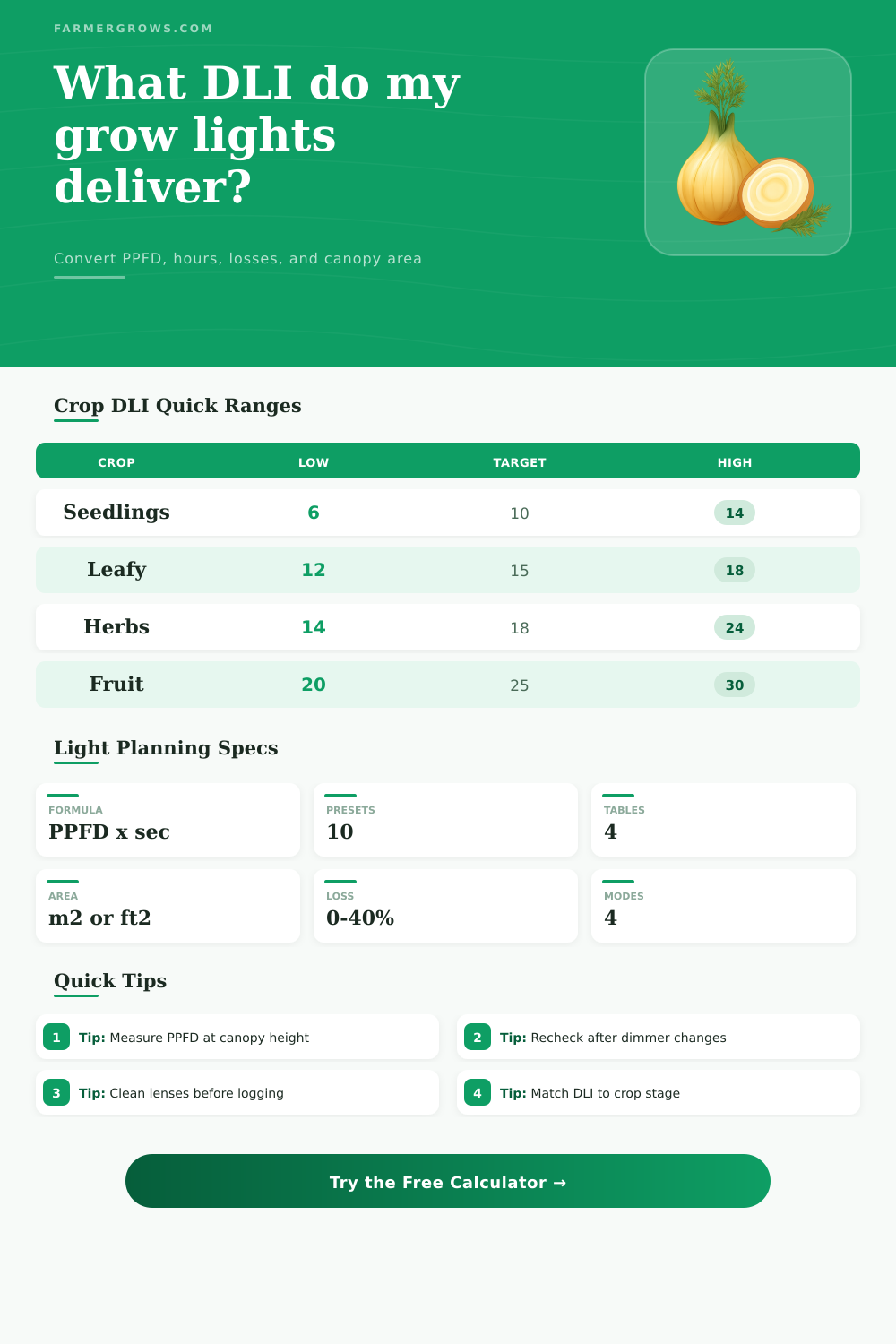
| Lettuce and leafy greens | 12-18 mol/m2/day | Finish | Quality often improves with steady moderate DLI. |
| Basil and culinary herbs | 14-24 mol/m2/day | Vegetative | Higher DLI can increase compactness and harvest mass. |
| Tomato, cucumber, pepper | 20-30 mol/m2/day | Flower to fruit | Fruit crops need more daily photons for yield load. |
| Low-light ornamentals | 3-10 mol/m2/day | Maintenance | Many shade crops prefer lower targets. |
| Average PPFD | 12 hours | 16 hours | 18 hours |
|---|---|---|---|
| 100 umol/m2/s | 4.3 DLI | 5.8 DLI | 6.5 DLI |
| 200 umol/m2/s | 8.6 DLI | 11.5 DLI | 13.0 DLI |
| 300 umol/m2/s | 13.0 DLI | 17.3 DLI | 19.4 DLI |
| 500 umol/m2/s | 21.6 DLI | 28.8 DLI | 32.4 DLI |
| 700 umol/m2/s | 30.2 DLI | 40.3 DLI | 45.4 DLI |
| Conversion | Factor used | Input example | Output example |
|---|---|---|---|
| Lux to PPFD | lux / lux-per-PPFD | 10,800 lux | 200 PPFD at factor 54 |
| Foot-candles to lux | fc x 10.7639 | 1,000 fc | 10,764 lux |
| Square feet to square meters | ft2 / 10.7639 | 16.1 ft2 | 1.50 m2 |
| DLI formula | PPFD x seconds / 1,000,000 | 300 PPFD for 16 h | 17.28 mol/m2/day |
| Factor | Typical range | Calculator input | When to use it |
|---|---|---|---|
| Clean fixture, close canopy | 0-5% loss | Light loss | Fresh lenses and measured uniform benches. |
| Average rack or bench | 5-15% loss | Light loss | Normal fixture aging and minor height variation. |
| Dusty lens or tall hang | 15-30% loss | Light loss | Use until cleaning or height correction is done. |
| Dawn and dusk ramping | 80-95% output | Schedule output | Average dimmed output over the full photoperiod. |
| Pulsed schedule | 50-90% output | Schedule output | Use duty cycle average, not peak output. |
Take several PPFD readings across the canopy and use the average, then rerun the calculator for dim rows or corners.
Use lower DLI targets for propagation, then raise PPFD or hours as roots, leaf area, flowers, and fruit load increase.
Lighting in a grow room is difficult to manage because many of the factors related to lighting are in areas that are not visible to a person. The plants dont react to the brightness of the lights as visible to a person, but instead, the plants respond to the total amount of photons that is reaching the leaves of the plants. This daily amount of light to the plants is referred to as a daily light integral, and the value of that daily light integral will determine whether the crop will remain compact, flower at the proper time, or fail to reach it’s full potential in terms of yield.
The daily light integral is not a single measurement of light, but rather the product of the light intensity and the number of hours that the grow room maintain that intensity. A sensor placed at the height of the plant canopy can measure the light intensity, and this sensor will reveal the PPFD (photosynthetic photon flux density). The PPFD will reveal the number of photons per second that reach the plants.
How to Measure Light in a Grow Room
If you multiply the PPFD value by the number of seconds in the photoperiod that the lights are on, you can obtain the value of the daily light integral. However, a few factors that impact the grow room may reduce that amount of light that reaches the plants. For instance, after standing in the grow room for several weeks, the light fixtures may have evened with time.
The lenses of the light fixtures may have collected dust. Additionally, the hanging height of the lights may have changed over the course of growing the plants. Any reduction in the amount of light that reaches the plants due to these factors will reduce the amount of daily light integral that is delivered to the plants compared to the amount of light that was calculated when the grow room was newly established and with new light fixtures in there ideal positions.
A calculator is a helpful tool to account for these potential variables in determining the amount of daily light integral that will be delivered to the plants in the grow room. The calculator must account for variables that include the measured light reading from the canopy, the number of hours that the lights will run, the percentage of the light output that will be delivered to the plants (as opposed to the percentage of the output that the light fixture may project into the grow room), and the estimated loss of light between the lights and the plant canopy. These variables can be entered into the calculator to provide the resulting daily light integral, the difference between the daily light integral of the grow room and the target daily light integral of the plants, and the total amount of photons that will land on the plants in the grow room.
By being able to enter these variables into a calculator, growers can experiment with different settings and make small alterations to the lighting for the grow room without having to perform the calculations by hand each time. The growth stages of the plants is another variable that may affect the daily light integral that is provided to the plants in a grow room. For instance, young seedlings and plants whose cuttings are being started have root systems and leaves that are thinner and smaller in area than the mature plants, and can therefore be exposed to less light before becoming stressed by the amount of light.
After the root systems of the plants have become established, however, the plants are able to better handle higher levels of light and benefits from more light being provided. During the flowering stages of the plants, though, the flowers and fruits require an accumulation of energy from the light that falls on the plants; if the daily light integral during this phase of growth is too low, the yield of the plants will suffer. These growth stages have impact on the target light levels for the plants and can be entered into the calculator to account for the differing requirements of the various stages.
Another variable that will impact the amount of light that reaches the plants is the schedule for the light fixtures within the grow room. For instance, grow rooms with light fixtures may expose the lights to the plants for periods of time in which the lights are being dimmed, or pulsed to other rates to prevent the plants from overheating. Each of these variations in the schedule of the light fixtures will reduce the amount of light that is delivered to the plants compared to the amount of light that can be emitted by the same light fixtures in bright cycles.
By entering the percentage of the light output of the fixtures that may be emitted during these different schedules into the calculator, the amount of daily light integral that will be delivered to the plants can be accounted for. Additional factors that may impact the amount of light that reaches the plants include the number of hours that the lights are on in the plants, and how much light is lost between the light fixtures and the plants. For instance, light fixtures that are positioned close to the plants may lose very little light as it passes from the light to the plants.
However, light fixtures that have been standing on the same grow room for six months may lose 15% or more of the light that it emits due to the aging of the reflectors of the light fixture, the amount of light that is reflected from other light fixtures, and the amount of dust that settles on the fixture. The amount of light that is lost between the light and the plants can be entered into the calculator to determine the resulting daily light integral to the plants, despite these additional variables. The area of the plants that is covered by the light fixtures is a factor that must be accounted for in the calculation of the total amount of photons that land on the plants in the grow room.
For instance, the small propagation area that is to grow more mature plants may expose the plants to a lower amount of daily light integral than a large area of plants in their flowering stages. Small areas of plants require less total light to provide to those plants than areas of plants that cover a larger portion of the grow room. The area of the grow room that is covered by the light fixtures can be entered into the calculator to provide the total amount of photons that will land on the plants within that grow room.
Many mistakes are made in determining the amount of daily light integral to the plants. For instance, growers may only measure the brightness of the light at the brightest portion of the grow room, rather than measuring the light at a number of different areas within the grow room and entering the average measurement into the calculator. Growers may also ignore the way that light may be lost between the light fixtures and the plants, as described above.
Finally, the target daily light integral may be ignored altogether when the plants go from propagation to flowering stages. By measuring the light at various locations within the grow room, determining the amount of light that may be lost between the lights and the plants, and adjusting for the changes in the plants’ stages of growth, the growers can avoid these common mistakes. One of the factors in the relationship between light and grow room management is that the type of light fixtures that are used within the grow room affects the amount of daily light integral that may fall on the plants.
For instance, two identical light fixtures will have a similar amount of light distributed as they project their light into the grow room; however, the amount of daily light integral that falls on the plants will change with the number of hours that the lights are on, the height of the lights above the plants, and the cleanliness of the lenses of the light fixtures. Thus, by calculating the daily light integral of the plants, the plants may be able to make adjustments to these variables without having to purchase additional light fixtures for the grow room. Another additional layer of complexity for the relationship between light and grow room management is the way that light interacts with the other environmental factors of the grow room.
For instance, if the amount of daily light integral that falls on the plants is high, but the area of the plants where the leaves accumulate the most light reaches high temperatures with the light that falls on those leaves, the efficiency with which the plants perform the process of photosynthesis may decrease. Thus, although the amount of light may be correct, the environment within the grow room may not be. A calculator will provide growers with the necessary baseline of the amount of light that should fall on the plants, allowing them to control the other environmental variables in the grow room so that the grow room becomes an environment that is beneficial to the growth of those plants.
Finally, the main goal in establishing a grow room and growing plants within it is to ensure that the amount of daily light integral that is delivered to the plants falls within the range of that which will allow the plants to exhibit the best growth. Small shortfalls of daily light integral can be corrected in a way that is different than large shortfalls of daily light integral. By measuring the amount of daily light integral that falls on the plants in the grow room, growers can make sure that the plants have the amount of daily light integral that will allow them to grow well, and provide for a successful harvest of the plants of interest to the growers.