Boer Goat Kidding Calculator
Plan Boer goat due dates, kidding watch windows, expected kid crop, flushing start, weaning timing, and market age from one breeding date or buck exposure.
Boer Kidding Output
Dates are calculated from your breeding date plus the selected gestation days. The full watch window also includes your buck exposure spread.
Planning Breakdown
Target: 85-95% conception with good buck power.
Kid crop: often 1.6-2.0 kids per kidding doe.
Best for: predictable meat kid groups.
Target: tighter service dates and records.
Kid crop: manage singles, twins, and triplets separately.
Best for: pedigreed sales timing.
Target: breed only well-grown doelings.
Kid crop: use a conservative 1.2-1.6 expectation.
Best for: low-stress first kiddings.
Target: match nutrition to season and rest.
Kid crop: protect body condition before rebreeding.
Best for: larger or frequent groups.
| Reference point | Planning value | What it means | Use in calculator |
|---|---|---|---|
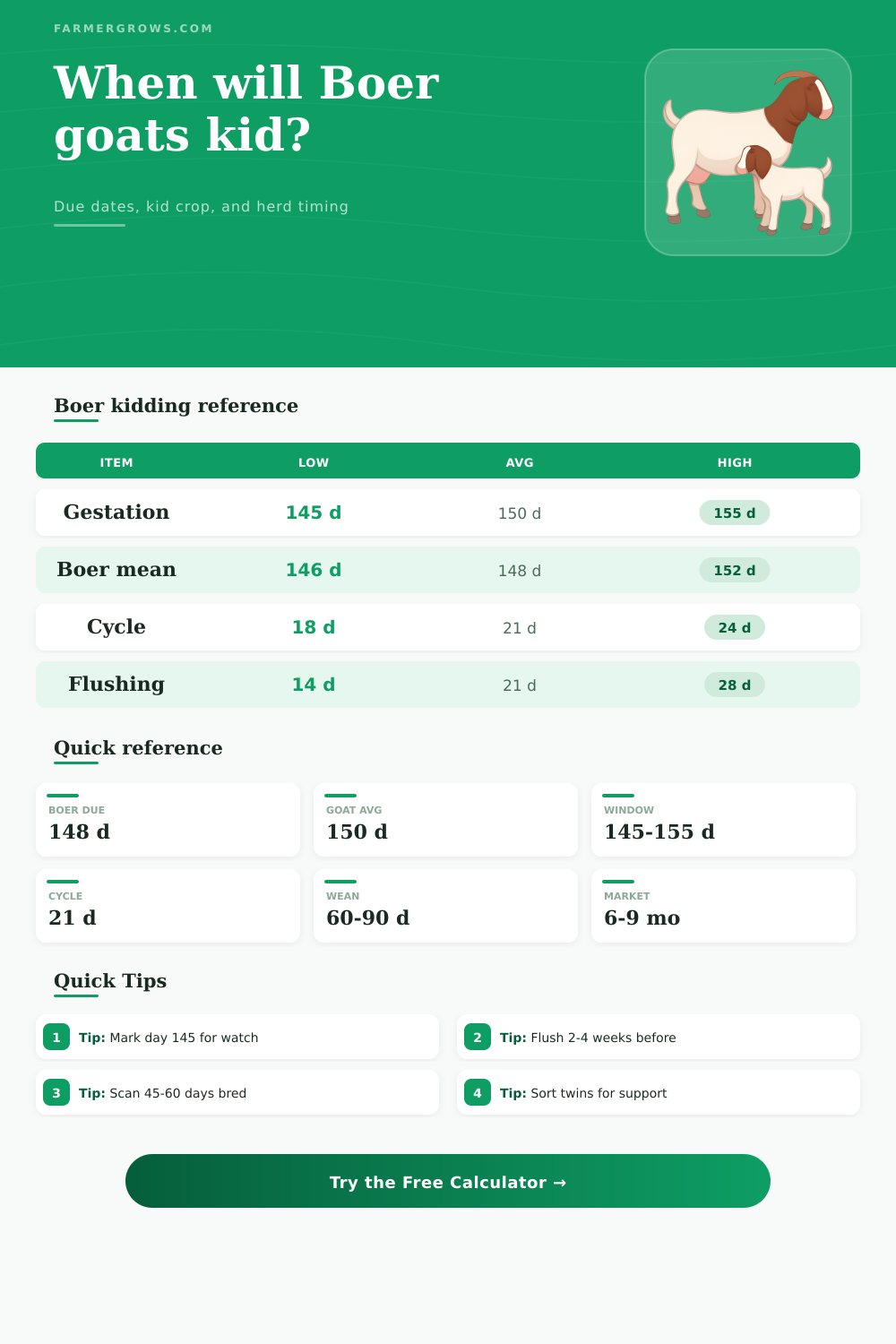
| Boer breed mean | About 148 days | Published Boer reproduction data reports a mean near 148.2 days. | Default gestation setting |
| General goat average | 150 days | Common veterinary and extension reference for goats. | Standard average option |
| Normal watch range | 145-155 days | Healthy does can kid several days before or after the center date. | Window start and end |
| Estrous cycle | About 21 days | Most doe heat cycles fall near 18-24 days. | Buck exposure planning |
| Pregnancy check | 45-60 days bred | Useful window for ultrasound or blood-test scheduling. | Breakdown date range |
| Doe group | Body condition target | Flushing length | Breeding note |
|---|---|---|---|
| Thin mature does | Move toward BCS 2.5-3.0 | 28-35 days | Improve feed before buck-in, not after losses appear. |
| Fit mature does | BCS about 3.0 | 14-21 days | Often enough for a compact kidding group. |
| Heavy does | Avoid overfat condition | 0-14 days | Do not push energy if does are already fleshy. |
| Yearling does | Well-grown and gaining | 21-28 days | Keep first-kidders separate for feeding and kidding watch. |
| Range does | Rising plane of nutrition | 21-35 days | Time breeding to forage rise or supplement strategically. |
| Program expectation | Conception rate | Kid crop per kidding doe | Planning interpretation |
|---|---|---|---|
| Conservative first-kidders | 70-82% | 1.2-1.5 | Use for young or recently stressed doe groups. |
| Average commercial Boer | 82-90% | 1.5-1.8 | Good default when records are limited. |
| Strong managed herd | 88-95% | 1.8-2.1 | Requires buck fertility, nutrition, and health records. |
| High-prolificacy group | 90-96% | 2.0-2.4 | Plan extra colostrum, pens, and triplet support. |
| Range low-input group | 75-88% | 1.3-1.7 | Use wider windows and conservative survival assumptions. |
| Milestone | Typical timing | Calculator field | Management use |
|---|---|---|---|
| Early kidding watch | Day 145 from breeding | Automatic window start | Prepare pens, lights, towels, iodine, and colostrum plan. |
| Center due date | Day 148-150 | Gestation setting | Main date for staffing and barn checks. |
| Late kidding edge | Day 155 plus exposure spread | Automatic window end | Helps avoid stopping watch too early. |
| Weaning | 60-90 days | Weaning age | Sort by weight, dam condition, and sale plan. |
| Market age | 6-9 months | Market age | Schedule finishing, health papers, or sale lots. |
Breeding dates for does cannot always be scheduled on a single day; does can becomes pregnant during multiple heat cycles with the bucks. The longer that a buck is with a group of does, the longer that the kidding date window will be for those does. The planner can adjust the exposure field in the calculator to reflect this longer window; adjusting this field makes it possible to plan for a longer period of labor and supplies for the kids.
For example, if the breeding window is short, such as with a narrow synchronization window for the does and bucks, there will be a small exposure window. However, if the buck is with the does for many weeks, the does will cycle during that period and there will be a longer exposure window for the does to become pregnant. The gestation length for goats is the central figure in the breeding date calculator.
How to Plan Goat Breeding and Kidding Dates
The gestation length for Boer does is 148 days; however, the average gestation length for all goat does is approximately 150 day. The planner can select each of these lengths in the calculator, as well as a custom gestation length for those does in the herd. The length of the kidding season should be planned for a range between 145 and 155 days; does may deliver kids early or late in there gestation period.
Furthermore, selecting a date for the kidding season that is earlier in the range will allow the planner to check the does for pregnancy at an earlier period, and a later date will require the does to be check for pregnancy over a longer period of time. The number of does that are exposed to the bucks and the conception rate for those does will determine how many does will be prepared for kidding. It is important to account for the fact that not all does will become pregnant; the concept of the expected conception rate will permit the planner to determine how many does will be pregnant and how many does may need to be rebred to include in the number of does that is being prepared for kidding.
Furthermore, the planner can enter the number of kid that will be born by each kidding does in the kid-crop-per-kidding-doe field in the calculator. For instance, mature does will produce more kids than yearling does; the kid-crop-per-kidding-doe field will permit the planner to account for this fact in preparing for the kids. The flushing field in the calculator permits the planner to determine how many days before breeding that the planner will improve the nutrition of the does.
By flushing the does to improve there nutrition prior to breeding, the planner may experience an increased rate of ovulation by the does. This field will calculate the start date of flushing, which will help in ordering extra feed for the does. Furthermore, if the planner knows the start date of flushing, the does can be moved to a better pasture prior to the breeding date.
The timeline of the herd will include fields for weaning age and market age. The weaning age for kids is the age at which they are separated from their does; this age should not be reached too soon, or the does and kids may be stress by the separation. Market age is the age at which the kids are prepared to be sold.
Market age can be used to create plans for feeding the does to produce kids with more body weight, or to create sale listings for those kids. Furthermore, the live-kid-rate field will permit the planner to determine the number of kids that will survive from birth until weaning age; not every kid born will survive to eight weeks of age. Many different programs for goats may use different dates for breeding the does and for the birth of there kids.
For instance, registered seedstock programs may use shorter breeding dates for the does and expect the does to produce a high kid crop; range and low-input programs for goats may use longer breeding dates for the does but expect a lower kid crop from those does. Each of these types of does has notes associated with it within the breeding date calculator, which will aid the planner in understanding which dates are appropriate for each type of does. The breeding date calculator shows the relationship between the various tasks that the planner will perform with the does and kids in the herd.
For instance, the start date of flushing, the length of the pregnancy check period, and the market age can be seen together in the calendar for the herd. Each of these tasks will impact the others; changing just one task will impact the others. Furthermore, the connection of each of these dates to each of the other tasks will help to ensure the success of the breeding and kidding season of the does and kids in the herd.