🌱 Greenhouse Arch Calculator
Estimate the circular arch radius, rise, chord, arc length, and film takeoff for hoop houses, quonsets, and gothic tunnels. The calculator turns span and rise into a practical cover plan.
Pick a greenhouse shape and size to seed the inputs. Each preset sets span, rise, length, arch spacing, roll width, end allowance, layers, and waste for a fast starting point.
Greenhouse Arch Output
Geometry summary will appear here.
| Formula | Equation | Use | Note |
|---|---|---|---|
| Radius from chord and rise | R = c^2 / (8h) + h / 2 | Primary solve | Use when span and rise are known |
| Rise from radius and chord | h = R - sqrt(R^2 - (c/2)^2) | Check height | Useful when radius is fixed |
| Chord from radius and rise | c = 2 * sqrt(2Rh - h^2) | Recover span | Matches the hoop footprint |
| Arc length from angle | s = R * theta | Film width | Theta is the central angle in radians |
| Style | Span | Rise | Arc note |
|---|---|---|---|
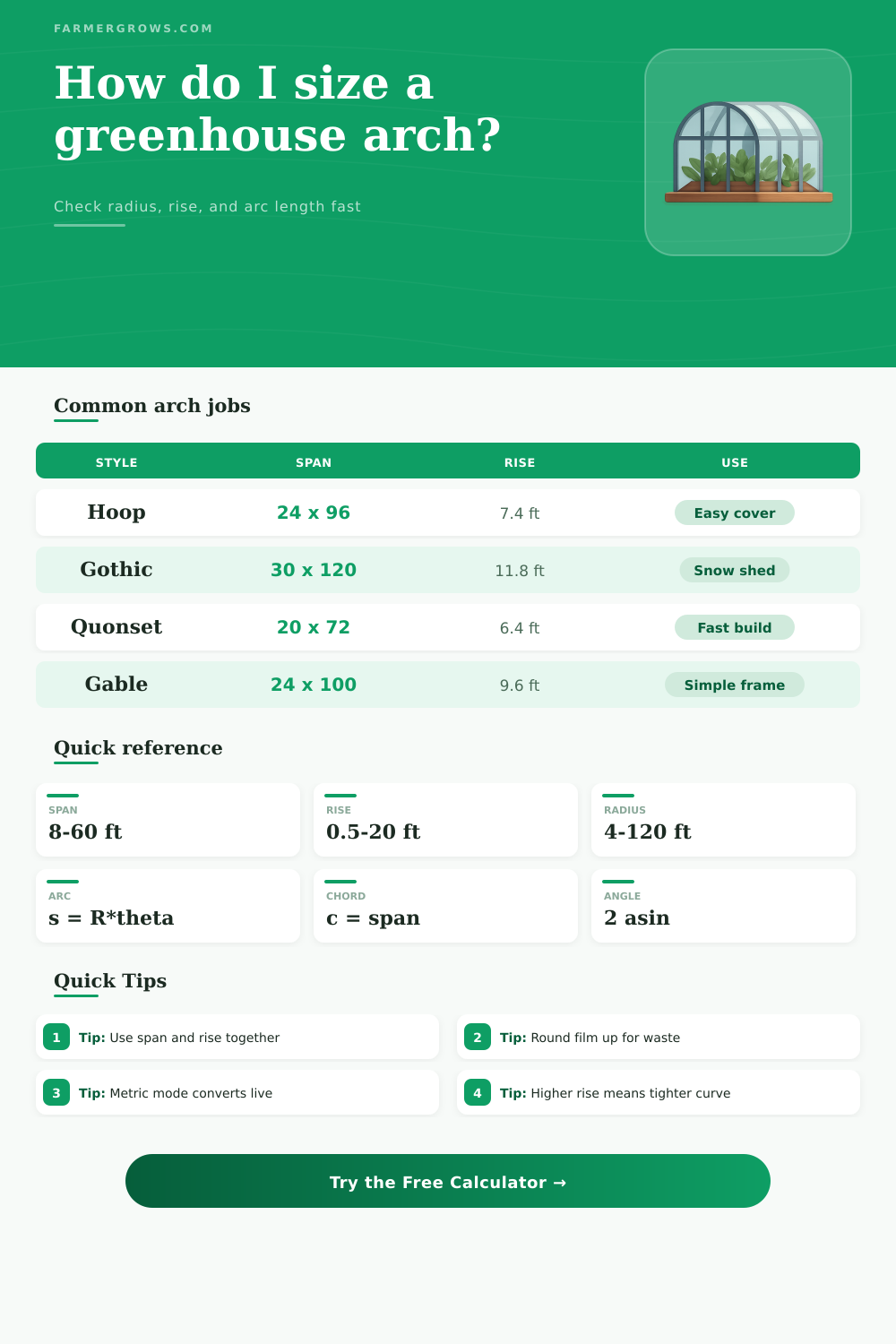
| Starter hoop | 12 x 24 | 4.0 ft | Easy plastic pull |
| Market tunnel | 20 x 48 | 6.5 ft | Good for roll film |
| High tunnel | 30 x 72 | 9.0 ft | Balanced curve |
| Gothic bay | 30 x 120 | 11.8 ft | Better snow shed |
To build a hoop house, a person must first understand the mathematical relationship between the spans, the rise, and the arc length of the structure. The span of the hoop house is the distance between the two base point of the hoop house. The rise of the hoop house is the distance between the ground and the highest point of the arch.
The arc length of the hoop house is the distance along the arc of the pipe that a person will use to build the hoop house. The arc length will determine how much plastic film are necessary to cover the hoop house. Therefore, the span and rise of the hoop house will dictate the arc length of the hoop house.
How to Measure and Plan a Hoop House
The arch of the hoop house impacts how well the hoop house can handle the weather and how much material are required to build the hoop house. For instance, if the hoop house has a gothic arch shape, then that structure will allow the snow on the structure to naturaly slide off the structure. Another example of an arch shape that can be used in a hoop house is a quonset arch.
A quonset arch is more easy built than a gothic arch because a qusonet arch is more forgiving of any unevenness of the ground. Additionally, a qusonet arch require more plastic because a qusonet arch covers more surface area for the same length of pipe. The type of arch that you use will impact how well the hoop house can manage snow loads, so it is important to choose an arch type according to you climate.
Another critical measurement of a hoop house is the rise of the arch. If a person chooses a low rise for their hoop house, then the arc of the hoop house will have a relatively flat curve. A flat hoop house may be easier to cover with wider rolls of plastic films.
However, if a person chooses a high rise for their hoop house, then the arc of the structure will have a tight curve. A tight curve may be beneficial for rapid drainage of any standing water within the hoop house. However, it may be difficult to find the type of pipes requiring for that rise of the hoop house arch.
The spacing of the hoops can impact the strength of the hoop house. Most growers of hoop houses use a distance of between four and six feet between hoops. However, placing hoops closer together can create a sturdier structure.
However, if hoops are placed closer together, more pipe will be required to build the hoop house. To determine how many hoops are necessary to build a hoop house, the person should measure the length of the hoop house, and the necessary length for the ends of the hoop house should be added to that measurement. When ordering the plastic film for the hoop house, a person must purchase more than the measurement of the hoop house.
Plastic film comes in specific width. To account for the cuts of the plastic film needed for the hoops of the hoop house, a person should add five to ten percent to the measurement of the hoop house. To account for additional waste when cutting the plastic film, a person should add eight to fifteen percent to the measurement of the hoop house.
Additionally, a person must purchase additional plastic film for the ends of the hoop house to secure the plastic film to the ground. Without securing the plastic film to the ground, the wind may lift the plastic film. In climates with very low temperatures, two layer of plastic film may be ordered for the hoop house to provide more insulation.
However, two layers of plastic film will cost more for the grower. The site where a person chooses to build there hoop house will influence the measurements of that hoop house. If a person intends to build their hoop house on a slope, they will have to adjust the rise of the hoops to ensure that the beds within the hoop house are even.
In areas that are exposed to much wind, a hoop house with a lower profile will be less likely to have the plastic film of the hoop house lifted by the wind. Additionally, the height of the knee walls will impact the span of the hoop house. Therefore, when building a hoop house, a person must measure the span and rise of the hoop house to ensure that it will perform as intend.