🪓 Log Splitter Pump Calculator
Size your hydraulic pump flow, pressure, and horsepower for any log splitter cylinder
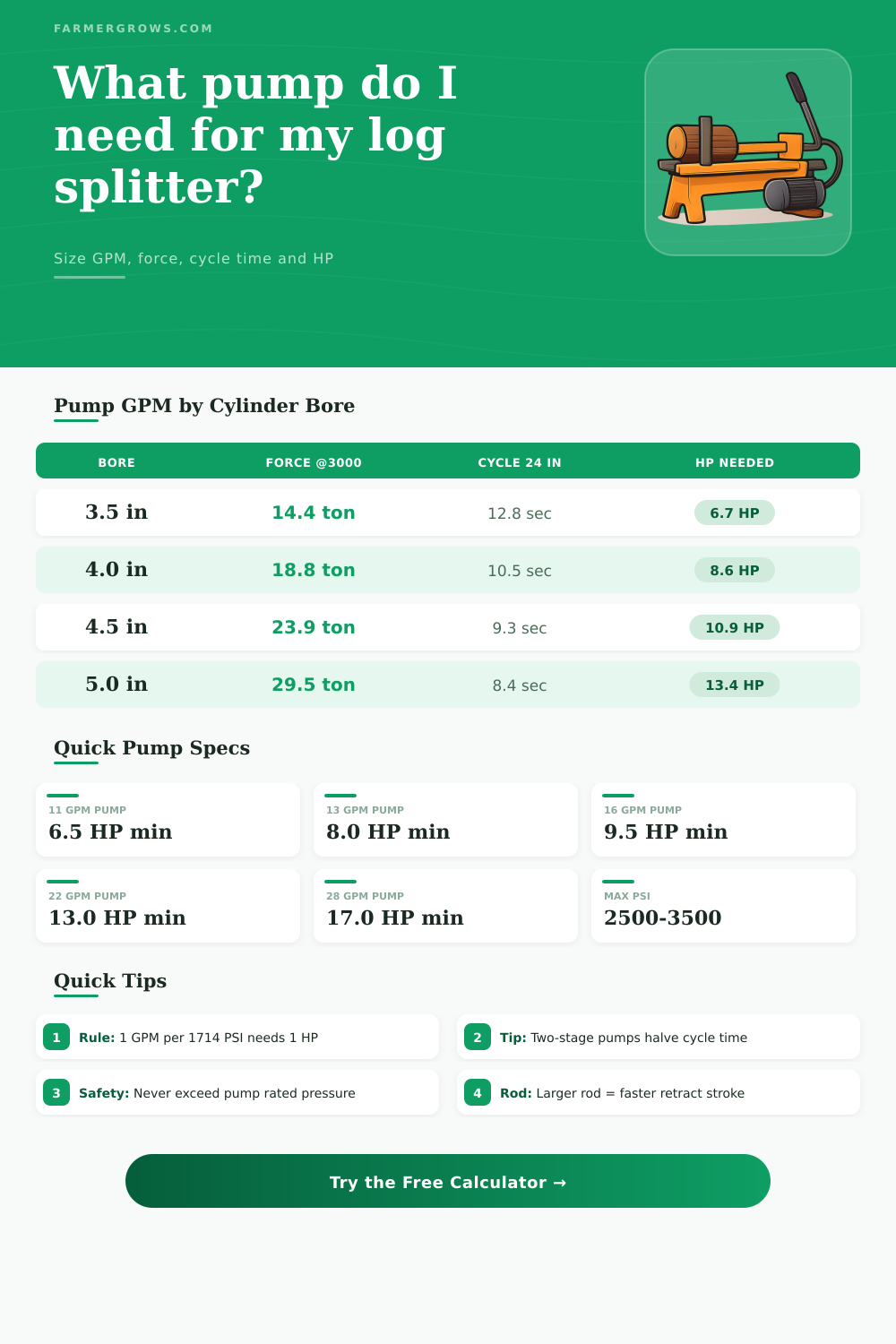
| Bore (in) | Area (in²) | Force @ 2500 PSI | Force @ 3000 PSI | Force @ 3500 PSI |
|---|---|---|---|---|
| 3.0 | 7.07 | 8.8 ton | 10.6 ton | 12.4 ton |
| 3.5 | 9.62 | 12.0 ton | 14.4 ton | 16.8 ton |
| 4.0 | 12.57 | 15.7 ton | 18.8 ton | 22.0 ton |
| 4.5 | 15.90 | 19.9 ton | 23.9 ton | 27.8 ton |
| 5.0 | 19.63 | 24.5 ton | 29.5 ton | 34.4 ton |
| 5.5 | 23.76 | 29.7 ton | 35.6 ton | 41.6 ton |
| Pump GPM | 3.5 in Bore | 4.0 in Bore | 4.5 in Bore | 5.0 in Bore |
|---|---|---|---|---|
| 8 GPM | 20.8 sec | 27.2 sec | 34.4 sec | 42.4 sec |
| 11 GPM | 15.1 sec | 19.7 sec | 25.0 sec | 30.8 sec |
| 13 GPM | 12.8 sec | 16.7 sec | 21.1 sec | 26.1 sec |
| 16 GPM | 10.4 sec | 13.6 sec | 17.2 sec | 21.2 sec |
| 22 GPM | 7.5 sec | 9.9 sec | 12.5 sec | 15.4 sec |
| 28 GPM | 5.9 sec | 7.8 sec | 9.8 sec | 12.1 sec |
| Splitter Class | Bore × Rod × Stroke | Pump GPM | Engine HP |
|---|---|---|---|
| 16-Ton Portable | 3.0 × 1.25 × 20 | 8 GPM | 5–6 HP |
| 20-Ton Homeowner | 3.5 × 1.50 × 24 | 11 GPM | 6.5 HP |
| 25-Ton Vertical | 3.75 × 1.75 × 24 | 11 GPM | 8 HP |
| 28-Ton Medium | 4.0 × 1.75 × 24 | 13 GPM | 10 HP |
| 35-Ton Pro | 4.5 × 2.0 × 24 | 16 GPM | 13 HP |
| 40-Ton Commercial | 4.5 × 2.0 × 26 | 22 GPM | 18 HP |
| 45-Ton Ranch | 5.0 × 2.5 × 26 | 22 GPM | 20 HP |
| 50-Ton Hardwood | 5.0 × 2.5 × 28 | 28 GPM | 23 HP |
| 60-Ton Industrial | 5.5 × 3.0 × 30 | 32 GPM | 27 HP |
| Pump GPM | @ 2000 PSI | @ 2500 PSI | @ 3000 PSI | @ 3500 PSI |
|---|---|---|---|---|
| 8 GPM | 9.3 HP | 11.7 HP | 14.0 HP | 16.3 HP |
| 11 GPM | 12.8 HP | 16.1 HP | 19.3 HP | 22.5 HP |
| 13 GPM | 15.2 HP | 19.0 HP | 22.8 HP | 26.5 HP |
| 16 GPM | 18.7 HP | 23.3 HP | 28.0 HP | 32.7 HP |
| 22 GPM | 25.7 HP | 32.1 HP | 38.5 HP | 44.9 HP |
| 28 GPM | 32.7 HP | 40.9 HP | 49.0 HP | 57.2 HP |
To ensure that a log splitter will function correctly, a specific combination of hydraulic flow, hydraulic pressure, and engine horsepower must be selected. If the hydraulic pump is too small for the log splitter, the cycle time will be slow. Slow cycle times are inefficiently to split the logs.
To ensure that a log splitter work efficienty, the hydraulic flow and hydraulic pressure must be equal to the specifications of both the cylinder and the engine’s horsepower. The bore of the cylinder will determine the force that the log splitter will be able to apply to the logs. For instance, a 4-inch cylinder bore with 3000 PSI will create 19 tons of force.
How to Match the Parts of a Log Splitter
You calculate the force by multiply the PSI and the square inches of the cylinder bore and then dividing the number by 2000 to find the tons of force. High force isnt enough to make the log splitter work quick. There must also be a specific number of gallon per minute to push the hydraulic oil quickly into the cylinder.
The number of gallons per minute will dictate the speed of the cylinder. The cycle time is the length of time it takes for the cylinder to extend and then retract. Many log splitters will cycle between 10 and 20 seconds to split the logs.
The extension stroke will require the hydraulic fluid to fill the volume of the cylinder. The volume of the cylinders increases with the length of the stroke. For the retraction stroke, the hydraulic oil must fill the annulus.
The annulus is the area around the cylinder rod. If the rod is thicker, there is less volume in the annulus that must be filled. If there is less volume to fill, the retraction stroke can happen at a faster rate.
Therefore, a thicker rod will result in a faster retraction stroke for the log splitter. The horsepower of the engine will determine the size of the hydraulic pump for the log splitter. The formula will determine how many horsepower the engine should have to move the logs effectivly.
The formula is that for every 1714 units of PSI times the gallons per minute, there should be one horsepower for the engine. The engine will also have an efficiency of 85% for the hydraulic pump. If the engine is too small for the log splitter, the engine will struggle to move the logs and will overheat.
Instead, the engine should be slightly larger to account for cold weather and high altitudes for the engine. When sizing the log splitter, it is important to consider the efficiency of the hydraulic pump. Hydraulic pumps will lose 10 to 20% of the total power due to volumetric and mechanical losses.
For those looking to split the logs faster without buying a larger engine for the log splitter, two-stage hydraulic pumps can be used. Two-stage hydraulic pumps will allow for high flow at low pressure to split the logs quickly. Once the cylinder reaches 700 PSI, the two-stage pump will switch to high pressure to split the logs.
Using this two-stage pump can significantly reduce the cycle time of the log splitter. Many people will ignore the retraction stroke of the cylinder. The focus is typically on the force of the cylinder to split the log.
However, the retraction stroke will also affect the logs that are split. Using a larger cylinder rod will increase the speed of the retraction stroke of the log splitter. As the diameter of the cylinder rod increases, the force applied to the log will decrease.
The size of the bore and the rod need to be balanced correctly. A 2-to-1 ratio of the bore to the rod is typically used and effective for most log splitter operation. The size of the cylinder bore can be based off the size of the logs that will be split.
For instance, someone that splits small scraps of oak will use a 3.5-inch cylinder bore and 11 gallons per minute. A commercial log splitter will use a 5-inch cylinder bore and 22 gallons per minute. If any component is not correctly matched to another component, then the log splitter will be underpowered or the engine will waste fuel.
Another essential component is the pressure that the log splitter will function at. Most hydraulic pumps will have a maximum rating of 2500 to 3500 PSI. Using the log splitter at a higher pressure for long periods can damage the seals within the hydraulic pump.
Therefore, build a 15% safety buffer into the engine’s requirements for the hydraulic pressure. The type of wood that is being split will also impact the log splitter’s requirements. For example, hickory is a hard wood and will require more pressure than elm wood to split the logs.
Several factors will impact the performance of the log splitter that is bought and used in the woods. The hydraulic oil used in the log splitter can become too thick when the outside temperature is too cold for the area where the wood is split. Another issue that can be faced with the log splitter is dirty hydraulic filters that will reduce the gallons per minute that can be dispensed by the pump.
Finally, how the log splitter is mounted and the type of valves that are used will significantly impact the cycle time of the log splitter. Using auto-return valves will significantly reduce the cycle time of the log splitter. However, care must be taken to ensure that the hoses used on the log splitter are the correct size.
Using a hose that is too small for the log splitter will cause a drop in the hydraulic pressure of the fluid moving through the hoses. A drop in hydraulic pressure will reduce the efficiency of the log splitter. You should of checked the hoses first.