Well Water Volume Calculator
Estimate stored water from casing diameter, water column height, reserve buffer, and pump flow so you can plan runtime and recovery with confidence.
This calculator treats the well as a cylinder, then subtracts reserve, drawdown, and measurement margin to show a practical usable volume.
Use the actual casing inside diameter and the active water column, not the total drilled depth. The calculator converts units internally.
Well volume results
Stored volume, usable volume, pump runtime, and days of cover all update from the same water column.
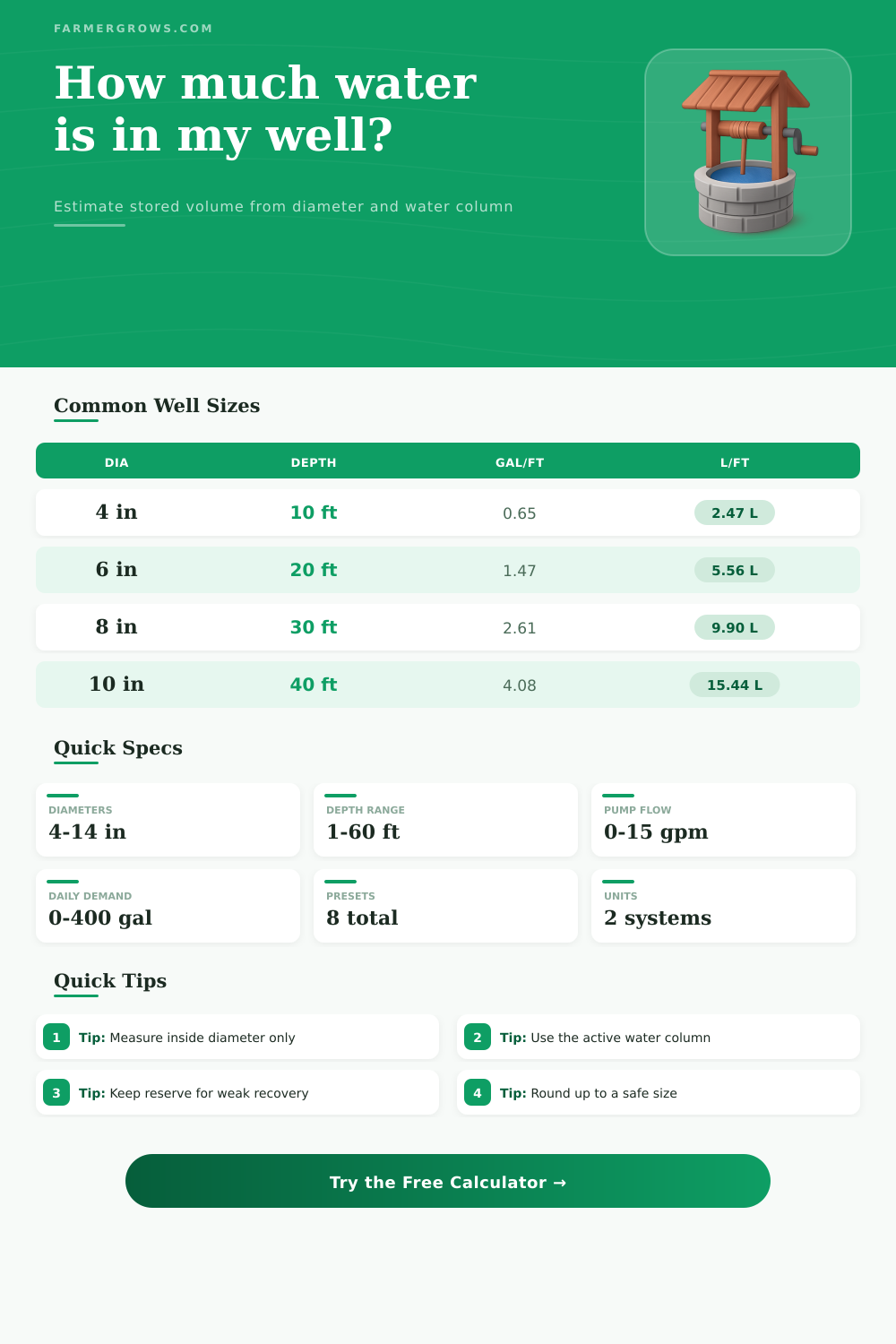
These quick cards show how much water one foot of column adds in common casing sizes.
| Diameter | Gal / ft | L / ft | Use case |
|---|---|---|---|
| 4 in | 0.65 | 2.47 | Small dug wells |
| 6 in | 1.47 | 5.56 | Home supply |
| 8 in | 2.61 | 9.90 | Farm supply |
| 10 in | 4.08 | 15.44 | Irrigation |
| 12 in | 5.88 | 22.27 | Deep casing |
| 14 in | 8.01 | 30.35 | High yield |
| Scenario | Diameter x column | Stored volume | Notes |
|---|---|---|---|
| Cabin | 6 in x 15 ft | 22 gal | Light weekend use |
| Home | 6 in x 30 ft | 44 gal | Basic daily supply |
| Farm | 8 in x 30 ft | 79 gal | More reserve buffer |
| Irrigation | 10 in x 40 ft | 163 gal | Higher draw needs |
| Item | Imperial | Metric | Meaning |
|---|---|---|---|
| Diameter | in | mm | Inside size |
| Water depth | ft | m | Active column |
| Flow rate | gpm | L/min | Pump output |
| Demand | gal/day | L/day | Daily use |
Tip: Measure the inside diameter only, because outside pipe size will overstate volume.
Tip: Keep reserve if the well recovers slowly or the water level changes seasonally.
Calculating the volume of a well is a necessary process for those who wish to understand how much water can be extracted from that well. The volume of a well is an amount of water that can be stored within the casing of the well. Furthermore, the volume of that well is a critical measure for determining how long the pumps can be running before the water level within the well becomes too low to continue to effectively extract water from that well.
Thus, one must calculate both the volume of the water column within the well to ensure that either the pump will not become dry within the well, or that the water supply will meet the demands of the individuals daily water use. The first step in calculating the volume of a well is to determine the inside diameter of the well casing. Although individuals who are performing the calculation of the volume of the well often measure the outside diameter of the casing, the inside diameter of the casing actualy determines the volume of the well.
How to Calculate the Water Volume in a Well
The volume of the water that can be stored within the well will increase in relationship to the diameter of the casing. For instance, a six-inch well casing will hold more water than a four-inch well casing, and a ten-inch well casing will hold more water than a six-inch well casing. Additionally, because the volume of the well is mathematically related to the radius of the casing, the diameter will have a major impact upon the volume of the well.
After the individual determines the inside diameter of the well casing, the depth of the water column within the well must be measured. The depth of the water column is measured from the top of the water within the well to the bottom of the water within the well. Such a measurement is performed with a weighted line or a water level sounder.
It is important to note that the depth of the water column should not be measured as the total depth of the well bore; the total depth of the well bore includes depth measurements that are taken from measurements of the dry portion of the well. Once the person determines the depth of the water column, along with the inside diameter of the well casing, the raw volume of the water within the well can be calculated. Raw volume refers to the total amount of water that is contained within the well.
However, the raw volume of the water within the well is not a measure of the amount of water that should be extracted from the well. If the individual who extracts the water utilizes all of the water within the well, the pump will begin to pull air from the well, which may result in the failure of that pump. Therefore, one should decrease the raw volume of the water by the subtraction of a buffer volume.
A buffer of ten to twenty percent of the raw volume of the well should be subtracted to account for this potential failure of the pump to utilize all of the water within the well. Furthermore, drawdown of the water within the well will also impact the usable volume of the water within that well. Drawdown is the measure of how the level of the water within the well drops when the pump is extracting the water; the level of the water will drop as the pump utilizes that water.
Furthermore, because the level of the water within the well may also decrease due to seasonal changes in the water levels within the well, the usable volume will again be recognized as less than the raw volume. The rate at which the water within the well refills after the individual’s use is referred to as the recovery rate of the well. The recovery rate of the well is the rate at which the aquifer that feeds the well deposits water into the well casing.
The rate at which water is extracted from the well (the flow rate of the pump) should not be faster than the recovery rate of that well. For instance, if the pump is removing eight gallons of water per minute from the well, but the aquifer is only able to refill the well at a rate of two gallons of water per minute, the individual will eventually exhaust the usable volume of the well. Thus, the flow rate of the pump should be matched with the recovery rate to ensure that the individual who utilizes the well does not entirely deplete the usable volume of the well.
The volume of water within the well may change over time, as a result of the seasonal changes within the region where the well is established. For instance, during drought periods when there is little rain falling within the area, the aquifer may not be supplied with the same amount of water as during periods of rainfall. Thus, the level of the water within the well may drop to lower levels during drought periods.
It is for these reasons that one should establish the usable volume of the well on a conservative estimate; such an estimate accounts for the seasonal drops in the volume of water within the well. In addition to accounting for the seasonal changes in the volume of water within the well, it is also possible to establish the gallons of water per foot that are contained within the well in relation to the inside diameter of the casing. For instance, four-inch well casings may hold less than one gallon of water per foot of depth of the well.
Six-inch well casings may contain approximately 1.5 gallons of water per foot of depth within the well. Eight-inch well casings may contain approximately 2.6 gallons of water per foot of depth within the well. Finally, ten-inch well casings may contain approximately 4 gallons of water per foot of depth within the well.
By multiplying the gallons of water per foot by the depth of the water column within the well, one can determine the raw volume of the well. From that raw volume, the buffer can be subtracted to determine the usable volume of that well. Through these steps, it is possible to determine the runtime of the pump that is established within the well.