🚧 Pipe Arch Culvert Area Calculator
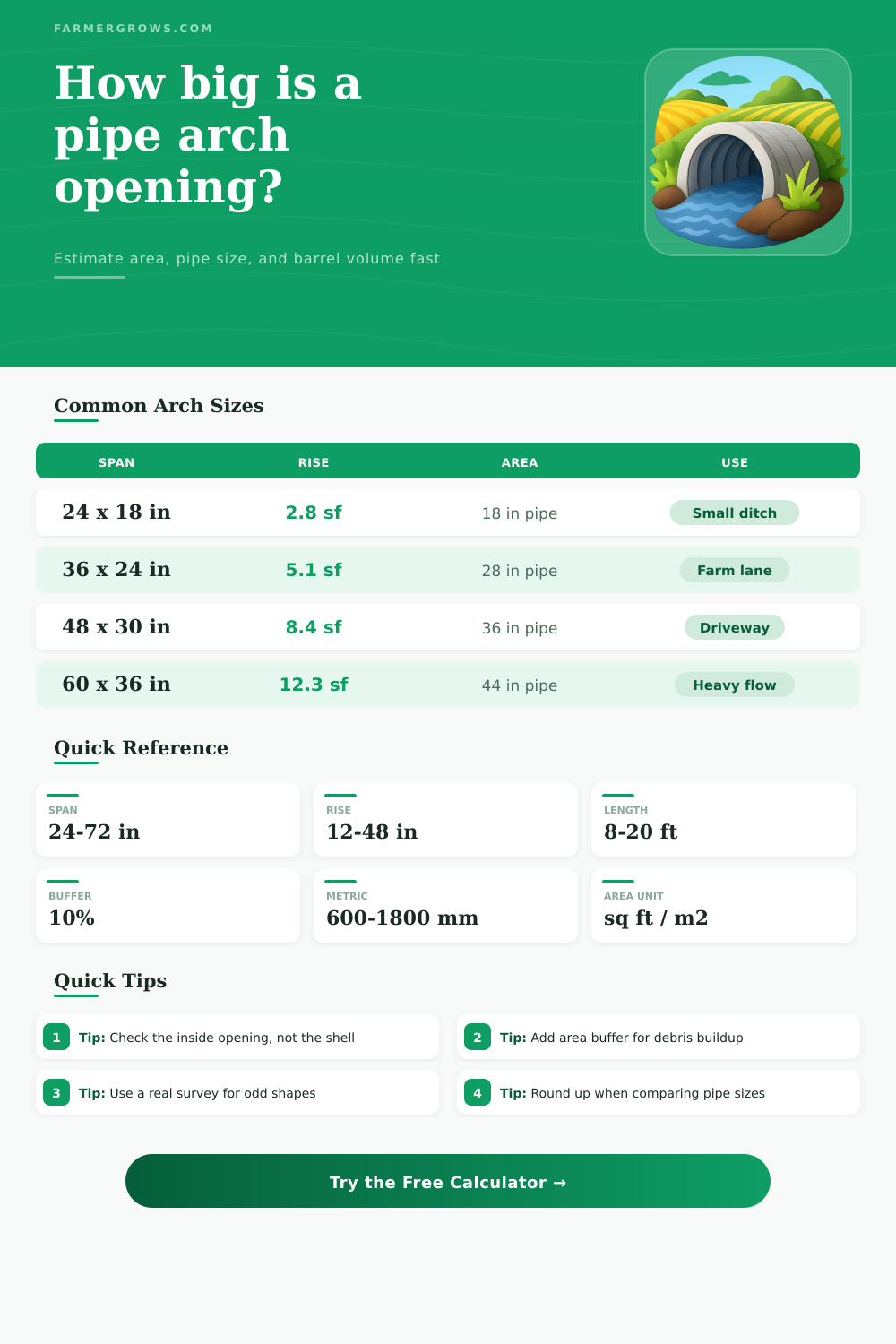
Estimate opening area, compare common culvert profiles, and check an equivalent round pipe before you set the crossing.
This planner uses a practical opening-area check and a simple equivalent-circle comparison for farm lanes, ditch crossings, and small road culverts.
Imperial uses feet, inches, and cfs. Metric uses meters, millimeters, and m3/s.
Size Summary
Runoff, recommended culvert size, capacity, velocity, and cover check from the current inputs.
Calculation breakdown
| Diameter | Area | Full flow @1% | Typical use |
|---|---|---|---|
| 12 in | 0.79 sq ft | 1.8 cfs | Driveway edge |
| 18 in | 1.77 sq ft | 5.8 cfs | Farm lane ditch |
| 24 in | 3.14 sq ft | 13.8 cfs | Pasture swale |
| 36 in | 7.07 sq ft | 37.0 cfs | Road crossing |
Values above are quick planning guides. The calculator below still recomputes the full Manning result from your own inputs.
| Surface | C | Storm response | Typical use |
|---|---|---|---|
| Roof | 0.90 | Fast | Outlets |
| Gravel | 0.40 | Moderate | Drive lanes |
| Pasture | 0.25 | Slower | Grass catchment |
| Pavement | 0.95 | Very fast | Aprons |
If the catchment mixes roof, gravel, and soil, choose the coefficient that best reflects the peak runoff path into the culvert.
A pipe arch culvert is a structure that allow water to pass under a road, driveway, or farm lane. Pipe arch culvert is useful because the shape of a pipe arch culvert allow for more water to pass through the bottom of the culvert, and because the shape of a pipe arch culvert allows for more space within the culvert when there isnt many soil covering the top of the culvert. Many people chooses pipe arch culverts over other types of culverts because pipe arch culverts can handle sediment better than round pipe, and because they take up less space than box culverts.
To determine the size of the pipe arch culvert that is need for a specific road or lane, it is first necessary to understand the watershed that drain into the culvert. The watershed is the area of land that drain into the culvert. The shape of the watershed will determine the amount of water that will flow into the culvert during rainstorm.
How to Size and Install a Pipe Arch Culvert
If the installer does not account for the shape of the watershed when installing culverts, the culvert may end up being too small to handle the amount of water that will fall into it during periods of rainfall. In addition to understanding the watershed, it is also necessary to calculate the runoff coefficient for the land area that is to be culverted. The runoff coefficient is a number that represent the amount of rain that runs off of the land rather than falls onto the land and become absorbed by the land.
Land features like pavement will have high runoff coefficient, while pastures will have lower runoff coefficients. If you dont calculate the runoff coefficient correct for the culvert calculations, the culvert will end up being incorrectly sized. The runoff coefficient must also be combined with the storm intensity in the area to determine how much water will flow into the culvert.
Another factor that will impact the size of the culvert is the material of the culvert. The material of the culvert will impact how fast the water drain through the culvert. For instance, if the culvert is made of smooth concrete, the water will move quick through the culvert.
However, if the material of the culvert has corrugations in it, like corrugated metal or HDPE material, the water will move more slow through the culvert. Ensuring that there is enough cover depth over the culvert is also important; without enough cover depth over the culvert, the weight of heavy vehicle may buckle the culvert. The cover depth also must meet the minimum cover depth that is required for the culvert material.
The entrance into the culvert will also have an impact upon the amount of water that enter the culvert. Culverts that feature a beveled headwall will allow more water to enter the culvert than those that feature only projecting end walls. In addition to the entrance of the culvert, it is also important to ensure that a safety buffer establish for the entrance of the culvert.
Leaves and silt may enter the culvert and create a blockage at the entrance; if this should happen, the culvert will not be able to handle the amount of water that was calculate for the culvert. When using a calculation tool to determine the size of the culvert, the tool will provide information regarding the design flow in cubic feet per second, the capacity margin, the velocity of the water in the culvert, and the status of the culvert cover depth. You should check the velocity to ensure that it is not too high; velocities higher than 10 feet per second will erode the culvert over time.
Additionally, the capacity of the culvert should also be checked to ensure that it has enough headroom for heavy rainstorms. Many people make mistake when they install pipe arch culverts. One of the most common is incorrectly measuring the culvert; its the inside of the culvert that determines the amount of water that will flow through it.
Another mistake is not include inlet bevels to the culvert; these inlet bevels will allow for more water to enter the culvert. Finally, another common mistake with installing culverts is to install the culvert directly onto mud instead of installing it onto a bed of compacted gravel; installing the culvert on a bed of gravel will ensure that the water does not erode the culvert over time. If these mistake are avoided when installing the culvert, it will function properly for a long period of time.