🚚 Culvert Slope Calculator
Check grade, fall, and invert elevation for roadside crossings, farm lanes, and drainage runs in imperial or metric units.
Light runoff
Common fall
Quick drainage
Short runs only
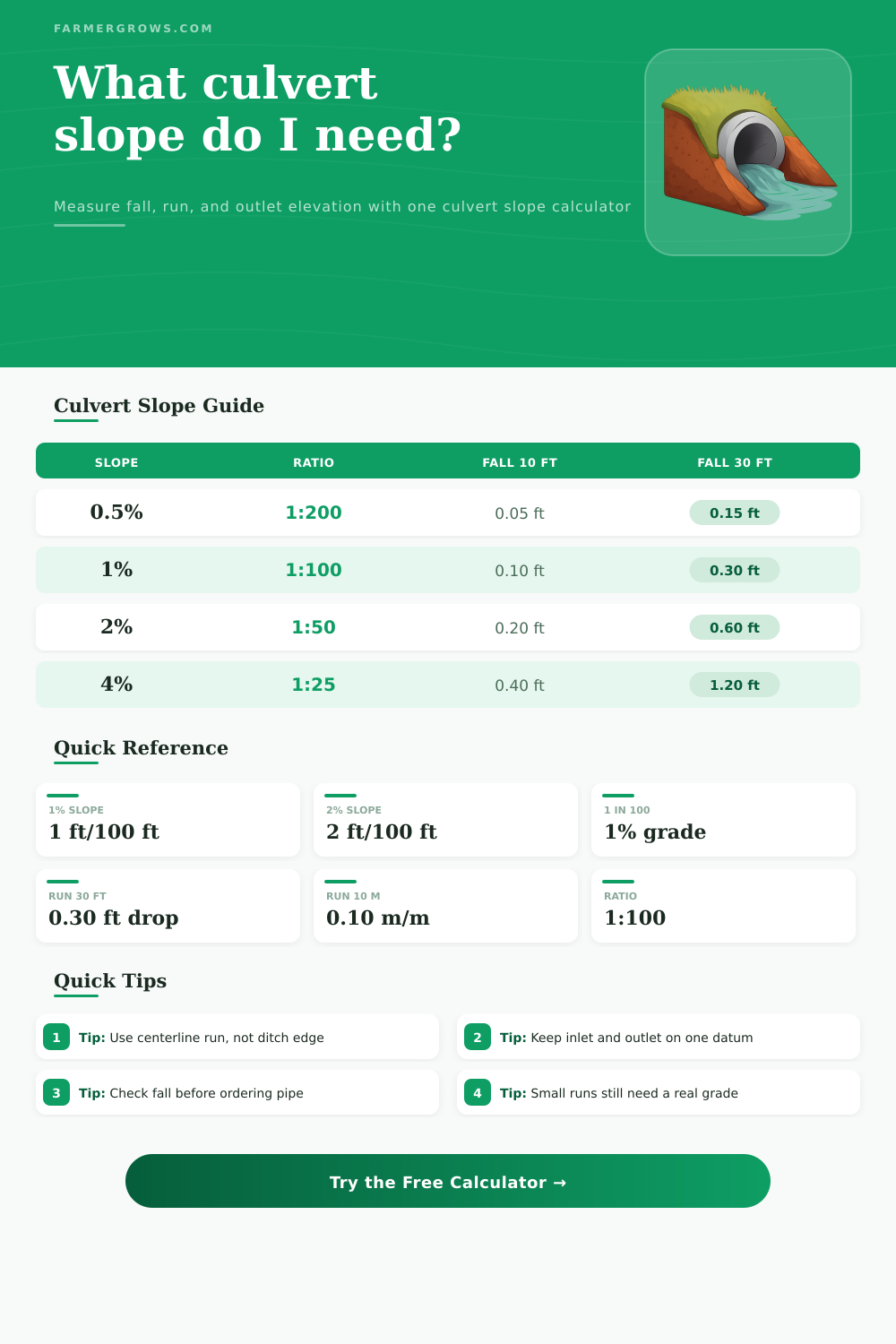
| Grade | Ratio | Fall / 30 ft | Fall / 100 ft |
|---|---|---|---|
| 0.5% | 1:200 | 0.15 ft | 0.50 ft |
| 1.0% | 1:100 | 0.30 ft | 1.00 ft |
| 2.0% | 1:50 | 0.60 ft | 2.00 ft |
| 4.0% | 1:25 | 1.20 ft | 4.00 ft |
| Run | 1% drop | 2% drop | Metric note |
|---|---|---|---|
| 20 ft | 0.20 ft | 0.40 ft | 6.1 m run |
| 30 ft | 0.30 ft | 0.60 ft | 9.1 m run |
| 50 ft | 0.50 ft | 1.00 ft | 15.2 m run |
| 100 ft | 1.00 ft | 2.00 ft | 30.5 m run |
When installing a culvert, determining the correct slope is essential. The slope of the culvert is the vertical drop over a specific distance. If the culvert have a slope that is too flat, the water will pool within the culvert, leading to the collection of silt and debris within the culvert.
If the culvert has a slope that is too steep, the water move too quickly through the culvert, potentially leading to erosion of the bottom of the culvert. In order to avoid these detrimental outcome, calculating the slope before installing the culvert is necessary. The slope of the culvert can be expressed as a ratio or a percentage.
How to Choose and Measure the Right Culvert Slope
A ratio of 1:100 indicates that the culvert drops one unit of vertical distance for every 100 units of horizontal distance. This same slope can also be expressed as a percentage, where 1:100 is equal to a one percent slope. The vertical drop of a culvert and the horizontal run of the culvert indicate the velocity of the water moving through the culvert.
The higher the slope of the culvert, the higher the velocity of the water that will move through the culvert. Conversely, the lower the slope of the culvert, the lower the velocity of the water that will move through the culvert. In order to calculate the slope of a culvert, one must first determine the length of the culvert.
The length of the culvert is the distance along the centerline of the culvert from the inlet to the outlet of the culvert. The distance should not be measured along the edges of the ditch in which the culvert will be installed or along the ground itself. Instead, you can measure the distance along the invert path of the culvert using a string line or laser.
Additionally, you must establish a common elevation benchmark for the culvert site to ensure that the elevation of the inlet invert and the outlet invert can be accurately measure. The inlet invert of a culvert is the elevation of the culvert at the start of the pipe. Similarly, the outlet invert of a culvert is the elevation of the culvert at the end of the culvert pipe.
The difference between the inlet invert elevation and the outlet invert elevation is the total drop of the culvert. The total drop divided by the run length of the culvert will reveal the slope of the culvert. In general, different types of sites require different slopes of culverts.
A standard slope for culverts is one percent. One percent of slope will allow the water to move through the culvert at a steady rate and will not contribute to erosion of the site itself. Roadside ditches may require a two percent slope.
However, a two percent slope will contribute to an increased velocity of the moving water. In other instances, a half-percent slope may be required. However, a half-percent slope poses the risk of stagnation of the water within the culvert if silt and debris enter the culvert.
The slope of the culvert should also be balanced to the soils at the site. Culverts installed in sandy soils may have steeper slopes than those installed in clay soils, as the sandy soil will not experience erosion at steeper slopes. Many people make mistakes when calculating the slope of a culvert.
For example, individuals may incorrectly measure the length of the culvert from face to face. Measuring along the culverts invert path will provide the correct length of the culvert. Additionally, individuals may use different benchmarks for the inlet and outlet of the culvert.
Using different benchmarks will create an inaccurate measurement of the culverts total drop. Moreover, you should ensure the culvert has a straight alignment. Installing a culvert with a curved alignment will change the relationship between the length of the culvert and its horizontal run.
The material of the culvert will also impact the slope of the culvert. For instance, corrugated metal culverts will allow for the movement of water at a slower rate than smooth PVC pipes. An additional consideration is that headwalls or grates can be used to protect the inlet of the culvert from debris.
Finally, local regulations may exist regarding the maximum slope of a culvert installed on public roads. High velocities of water moving through a culvert can damage the road at velocities of five feet per second or higher. In order to install a culvert that effectively manages water at a site without causing erosion or the buildup of silt within that culvert, the slope of the culvert should be balanced.
To balance the slope, you should measure the length of the culvert along its centerline, measure the elevation of the culvert from a common benchmark at both the inlet and outlet of the culvert, and choose the slope of the culvert according to the volume of water that will pass through the culvert and the soil type at the installation site. By following these steps, the culvert will effectively move the water at the site and will not experience erosion of that culvert or the silt that collects within that culvert.