⚙️ Screw Conveyor Flight Calculator
Calculate flight dimensions, capacity, shaft torque & volume throughput for screw conveyor design
| Screw Dia (in) | Pitch (in) | Typical RPM | Capacity (ft³/hr) | Capacity (m³/hr) |
|---|---|---|---|---|
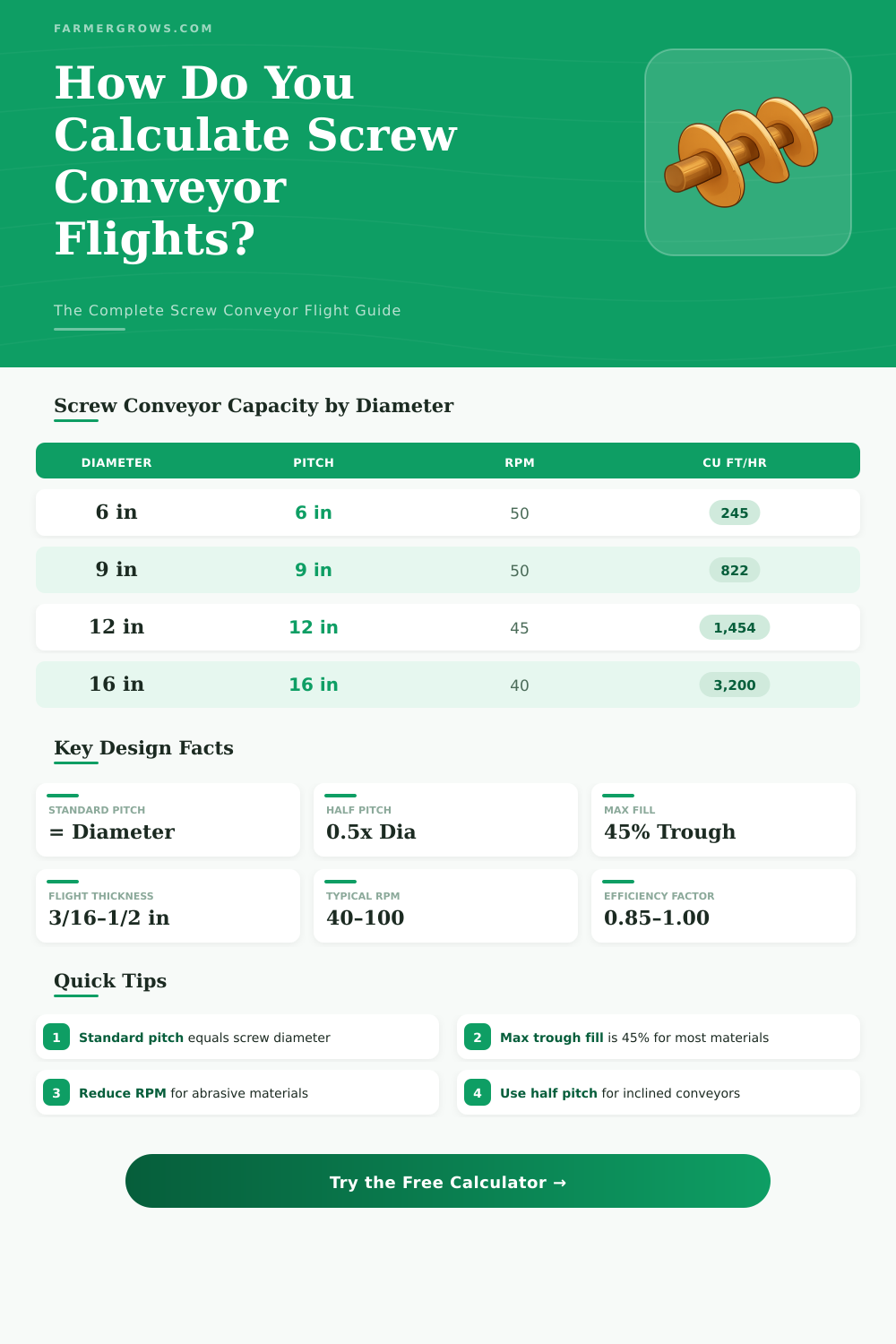
| 6 | 6 | 50 | 245 | 6.9 |
| 9 | 9 | 50 | 822 | 23.3 |
| 10 | 10 | 50 | 1,122 | 31.8 |
| 12 | 12 | 45 | 1,454 | 41.2 |
| 14 | 14 | 40 | 2,046 | 57.9 |
| 16 | 16 | 40 | 3,200 | 90.6 |
| 18 | 18 | 35 | 3,600 | 101.9 |
| 20 | 20 | 30 | 4,100 | 116.1 |
| Outer Dia (in) | Shaft Dia (in) | Flight Width (in) | Flight Area (in²) | Flights per Ft |
|---|---|---|---|---|
| 6 | 3 | 1.5 | 21.2 | 2.0 |
| 9 | 4.5 | 2.25 | 47.7 | 1.33 |
| 12 | 6 | 3.0 | 84.8 | 1.0 |
| 14 | 7 | 3.5 | 115.5 | 0.86 |
| 16 | 8 | 4.0 | 150.8 | 0.75 |
| 18 | 9 | 4.5 | 190.9 | 0.67 |
| Pitch Type | Pitch Ratio | Best For | Efficiency Factor |
|---|---|---|---|
| Half Pitch | 0.5x Dia | Inclined / sticky materials | 0.85 |
| Standard Pitch | 1.0x Dia | Most horizontal applications | 1.00 |
| Long Pitch | 1.5x Dia | Free-flowing, high speed | 1.15 |
| Short Pitch | 0.67x Dia | Steep inclines (>20°) | 0.78 |
A screw conveyor is a machine that are used to move bulk material from one location to another. Screw conveyors use a central shaft with a spiraling flight weld to the shaft. The spiraling flight moves the bulk material forward through a trough of the conveyor system.
The dimensions and design of the spiraling flight is critical to the proper function of the screw conveyor system. If the dimensions of the spiraling flight is incorrect, the conveyor system may experience various problems, such as the build-up of bulk material along the conveyor, the motors may strain to push the materials forward, or the throughput of the system may decrease. The diameter of the spiraling flight is one of the critical measurement for the bulk material conveyor system.
How to Design and Maintain a Screw Conveyor
If the diameter of the spiraling flight is too small, the capacity of the conveyor system will suffer. However, if the diameter of the spiraling flight is too large, the drive system of the conveyor will become overloaded. The size of the central shaft of the system is also important.
The central shaft is typically half an outer diameter of the spiraling flight. The density of the materials to be conveyed will impact the dimensions of the system, as well. For instance, materials like grain will have less density than materials like sand.
Therefore, the trough will fill with grain to a deeper level than sand. The pitch of the spiraling flight determine the distance that the bulk material will be advanced during one complete turn of the central shaft. For horizontal conveyor systems, the pitch of the spiraling flight must be matched to the diameter of the spiraling flight; the efficiency of the system will be highest if the two measurements is equal (approximately 100 percent of the diameter).
Should the conveyor system be inclined at an angle greater than 15 degrees from the horizontal, the pitch of the spiraling flight must be set to 50 percent of the diameter of the flight to prevent the materials from rolling backward on the conveyor. Short pitches allow the system to maintain better grip on the materials at angles; however, they also reduce the capacity of the system. Long pitches will increase the speed of the conveyor system if the materials are dry granules; however, using long pitches can cause the bulk materials to surge within the system.
The speed of a screw conveyor system is measured in revolutions per minute (RPM). The best range of RPMs for most bulk material conveyors is between 40 and 100 RPMs. RPMs that are too high may cause the conveyor system to begin grinding against the bulk materials.
High RPMs are used when conveying powdered bulk materials. Low RPMs are used when conveying rocky bulk material. Additionally, the amount that the trough will be filled with bulk materials impacts the RPMs that the conveyor system should use; for example, the conveyor system should be filled to a level of 15 percent with light bulk materials, such as sawdust, but filled to 60 percent with dense bulk materials.
When you calculate the capacity of a screw conveyor, you have to factor in the capacity factor, which is the measure of the slip of the material and the capacity of the packing. The formula to calculate the capacity is the cross-section of the trough times the pitch and the speed of the conveyor, but you have to factor that number in for the fill level and the efficiency of the screw conveyor. For example, a 12-inch screw conveyor can move 1,454 cubic feet of material per hour at 45 RPM.
Furthermore, you can calculate the weight by determining the density of the product because cement is heavier than grain. This calculation will tell you how many tons of material will pass in an hour, how much torque the motor shaft has to exert to turn the screw conveyor at the necessary RPM, and the size of the steel flights. The material that will be transported determines the design of the screw conveyor.
For instance, if the material is sticky like fertilizers you may need to use a half pitch screw conveyor for the horizontal screw conveyor. For materials like coal that are very abrasive the flights may have to be increased in thickness to half an inch in order to handle that rate of 40 RPM. For materials like plastic pellets the pitch has to be long in order to prevent bridging of the plastic and the fill level has to be 30 percent to avoid bridging of the plastic.
For inclines that are greater than 20 degrees a two-thirds pitch screw conveyor will prevent the material from rolling backward on the conveyance system. Common mistakes should be avoided when designing a screw conveyor. For example oversizing the diameter of the spiraling flight to provide safety for the screw conveyor will exponentially increase the amount of power draw for the screw conveyor.
Any undersizing of the central shaft of the screw conveyor can result in the shaft snapping under the load of the transported material. Always check the horsepower tables to ensure the selected motor for the screw conveyor has the appropriate horsepower to move the material at the desired RPM. Finally be careful about unit conversions within the calculation as using the wrong unit conversions can result in the incorrect pitch measurements for the screw conveyor.
Maintenance will be necessary to keep the screw conveyor functioning proper. For instance if the screw conveyor is transporting abrasive materials like sand the flights will become polished. Polished flights will reduce the capacity of the screw conveyor.
The screw conveyor should be greased every week and the alignment of the screw conveyor should be checked every month. Furthermore many professionals will specify 20 percent of the calculated capacity as a reserve to account for future wear and tear on the screw conveyor. By properly maintaining the screw conveyor it will move the material in a steady stream.