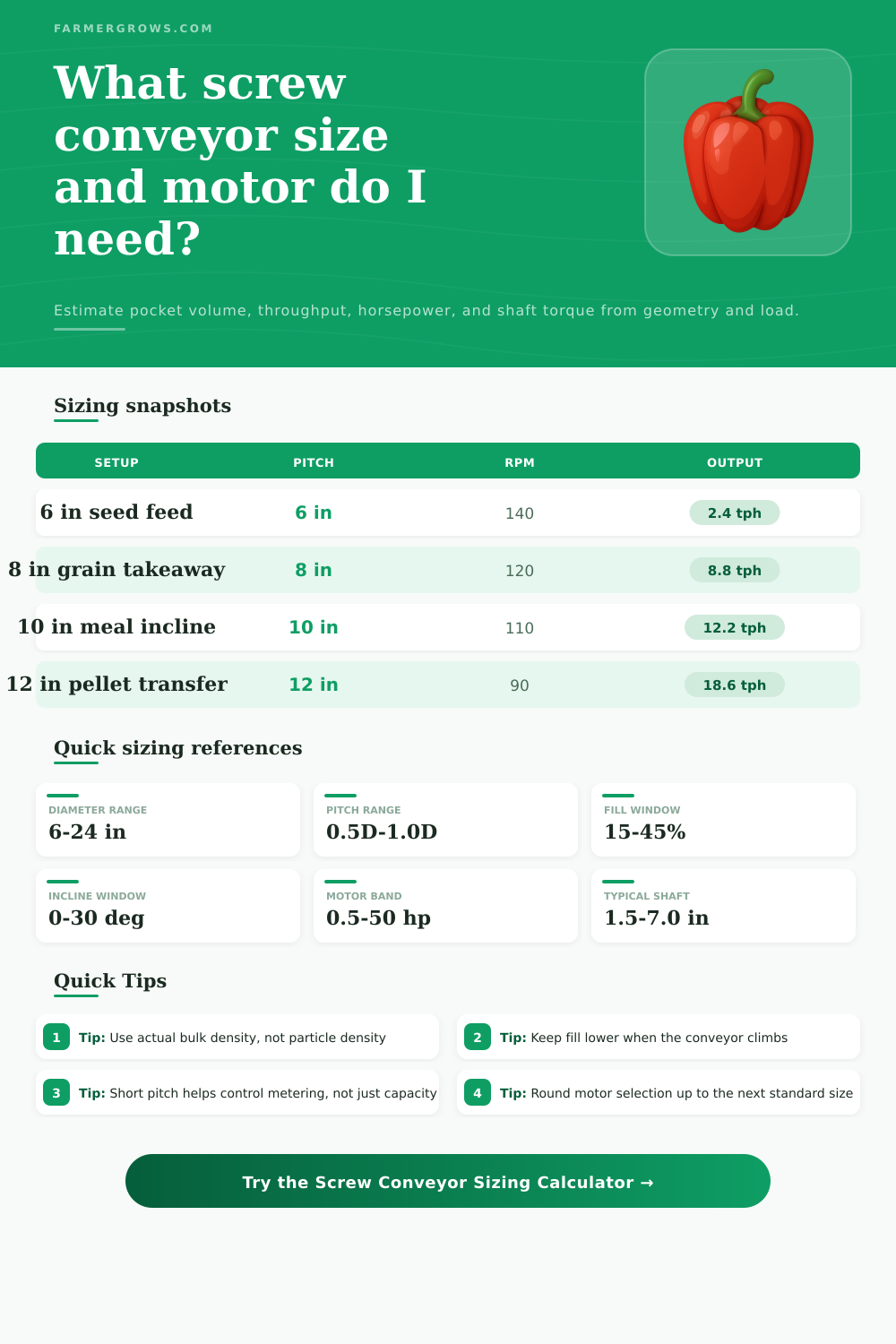
Screw Conveyor Sizing Calculator
Estimate pocket volume, throughput, drive horsepower, shaft torque, and a practical motor recommendation from screw diameter, pitch, speed, fill, density, length, and incline.
Pick a real screw conveyor job first. Each preset sets diameter, pitch, speed, length, incline, fill, shaft, and margin for a common sizing scenario.
This calculator is tuned for farm and bulk screw conveyors, so it prioritizes throughput, density, lift, torque, and motor margin instead of cost or purchase guidance.
Live sizing output
Estimated volume, mass flow, running horsepower, and motor size from the settings above.
| Screw diameter | Typical shaft | Annulus area | Notes |
|---|---|---|---|
| 6 in | 1.5 in | 26.7 in² | Light agricultural and seed handling |
| 8 in | 2.5 in | 45.4 in² | Common grain and feed transfer size |
| 10 in | 3.0 in | 71.5 in² | Useful for moderate throughput runs |
| 12 in | 3.5 in | 103.5 in² | Often used for blend and pellet movement |
| 14 in | 4.0 in | 141.4 in² | Moves denser loads with better stiffness |
| 16 in | 4.5 in | 185.2 in² | Longer runs and larger reclaim systems |
| 18 in | 5.5 in | 230.7 in² | Heavy duty transfer and reclaim use |
| 24 in | 7.0 in | 414.0 in² | High volume conveyors and live bottoms |
| Material | lb/ft³ | kg/m³ | Sizing note |
|---|---|---|---|
| Whole corn | 45 | 721 | Good baseline for feed bin transfer |
| Soybean meal | 37 | 593 | Lighter meal, moderate packing |
| Pelleted feed | 38 | 609 | Usually steady flow with low bridging |
| Urea granules | 65 | 1,041 | Dense fertilizer product, watch motor load |
| Dry sand | 100 | 1,602 | High mass rate and higher drive demand |
| Wood chips | 22 | 353 | Fibrous product, lower fill and more drag |
| Wheat flour | 35 | 561 | Fine, dusty, and prone to packing |
| Angle | Factor | Effect | Use note |
|---|---|---|---|
| 0 deg | 1.00 | No derate | Reference case for horizontal sizing |
| 5 deg | 0.96 | Slight loss | Small rise, usually easy to manage |
| 10 deg | 0.90 | Noticeable loss | Check fill and motor margin carefully |
| 15 deg | 0.82 | Material starts to slide back more | Shorter pitch often helps control |
| 20 deg | 0.74 | Strong derate | Use conservative loading and slower speed |
| 25 deg | 0.65 | Major derate | Confirm the material will still convey cleanly |
| 30 deg | 0.55 | Severe derate | Specialized layouts may be needed beyond this point |
A screw conveyor are a machine that is used to move bulk materials. To ensure the screw conveyor operate without failing, it is necessary to size the machine correctly. Several factor impact the sizing of the screw conveyor.
For instance, the size of the motor impact the performance of the screw conveyor. Should the motor be too small, the motor will stall. In contrast, should the motor be too large, it will waste energy to move the material.
Factors That Affect Screw Conveyor Size and Performance
The geometry of the screw conveyor impact the amount of bulk material that can be moved. The diameter of the screw conveyor will impact the scale of the movement of the screw conveyor. However, the pitch of the screw conveyor will impact the volume of bulk material that the screw conveyor can move.
For instance, if a screw conveyor have a full pitch, it will allow for bulk material to smoothly move horizontal along the screw conveyor. A screw conveyor that has a short pitch will have bulk material travel a shorter distance than a screw conveyor that features a full pitch. Short pitches are mainly used for conveying bulk material that must be metered in small amount.
Additionally, the style of the flight can impact the movement of sticky or fibrous bulk material. Another factor that will impact the performance of the screw conveyor is the amount of bulk material that is load into the trough. This amount is referred to as the trough loading.
The trough loading should be between 25 and 50 percent of the trough is filled with bulk material. Should the trough be filled higher than this with bulk material, and if that screw conveyor is on an incline, the bulk material will cascade down the screw conveyor, preventing it from moving forward. Another factor that will impact the capacity of the screw conveyor is the speed and the angle.
The speed at which the screw conveyor will move will impact the amount of bulk material that is moved. However, the speed will not be too high for the screw conveyor to avoid unnecessary vibrations. Additionally, the angle of the incline will also impact the capacity of the screw conveyor.
For example, a small incline like seven degrees will have a minimal impact on the capacity of the screw conveyor. However, a steep incline like twenty-five degrees will have a significant impact on the capacity of the screw conveyor. Bulk density is another factor that will impact the capacity of the screw conveyor.
Bulk density is the weight of the bulk material per unit of volume. For instance, corn has a lower bulk density than sand. This means that corn will require less energy to move than sand.
Another factor to consider is the bulk material’s settling in the trough. Bulk material that compact will require more torque to move than bulk material that settles in the trough in a less compacted manner. To size the screw conveyor correctly, calculating the amount of horsepower that is required will occur.
To calculate the horsepower, the drag that the bulk material will create will be calculated. The bulk material will create the drag as it rubs against the trough. Additionally, another calculation will be the horsepower to lift the bulk material up the incline.
Divide the two calculations by the efficiency of the drive system for the screw conveyor. Finally, add a service margin to the total amount of horsepower that will be calculated. Adding a service margin will allow the motor to handle cold starts for the screw conveyor and any unexpected load on the screw conveyor.
Round the total up to the next standard size for the motor. Another factor that will impact the performance of the screw conveyor is the diameter of the shaft. If the diameter is too small for the bulk material to be conveyed, the shaft may twist under the increased torque that is created.
Additionally, if the diameter of the shaft is too large, the screw conveyor will be unnecessarily heavy for the bulk material to be conveyed. One common mistake that may be made when sizing the screw conveyor is to increase the trough loading to 45 percent to increase the capacity of the screw conveyor. However, increasing the trough loading will increase the amount of bulk material that is moving, but it will also increase the draw on the motor.
Another mistake is to size the screw conveyor for horizontal use but then tilt the screw conveyor. This will reduce the output of the screw conveyor. Always build in a margin of 10 to 20 percent into your calculations.
Motors require a certain amount of power to operate correctly. If not provided for the motor, they will fail. Additionally, to ensure that youre calculations are accurate regarding the bulk density of the bulk material that will be conveyed, perform the test using a scale and bucket.
By ensuring that the bulk conveyor’s components match the density of the bulk material that will be conveyed, the screw conveyor will operate correctly. You should of used a scale and bucket to be sure. Its importent to recieve accurate data for teh calculation.
The screw conveyors performance depends on it. The size of the motor should of been checked first. Many people makes mistakes with the trough loadin.
This is a common problem. Youll see it alot.