Pole Barn Post Size Calculator
Estimate post size, embedment depth, and perimeter count for a pole barn layout with quick presets, compare-friendly references, and clean planning numbers.
| Index | Use Case | Post | Notes |
|---|---|---|---|
| 1.00-1.05 | Small utility | 6x6 PT | Light span |
| 1.06-1.25 | Compact barn | 6x8 PT | Short wall |
| 1.26-1.55 | Standard barn | 8x8 PT | General fit |
| 1.56-1.95 | Tall/heavy | 8x10 PT | More reserve |
| Eave | Snow | Embed | Soil |
|---|---|---|---|
| 10 ft | 30 psf | 42 in | Firm |
| 12 ft | 40 psf | 48 in | Average |
| 14 ft | 50 psf | 54 in | Soft |
| 16 ft | 60 psf | 60 in | Wet |
| Layout | Size | Spacing | Posts |
|---|---|---|---|
| Utility shed | 20x24 | 8 ft | 14 |
| Hobby barn | 24x36 | 8 ft | 18 |
| Equipment | 30x40 | 8 ft | 20 |
| High snow | 40x60 | 6 ft | 36 |
| Spacing | 20x30 | 30x40 | 40x60 |
|---|---|---|---|
| 6 ft | 18 | 22 | 28 |
| 8 ft | 14 | 18 | 24 |
| 10 ft | 12 | 14 | 20 |
| 12 ft | 10 | 12 | 18 |
Check the local snow map first. A building near a load boundary should use the higher number so the post recommendation stays conservative.
Match the depth to the soil. Soft or wet ground can need a larger post and a deeper set, even when the span looks moderate on paper.
When building a pole barn, choosing the correct size for the posts are essential because the posts determine the stability of the barn. The posts will bear the weight of the roof and the walls of the barn, and they must be able to withstand both the weight of the snow on the roof as well as an force of the wind. Choosing the wrong size for the posts could result in the barn leaning or even collapse under the weight, or choosing posts that is too large will cost you more money than you would normaly spend on constructing the barn.
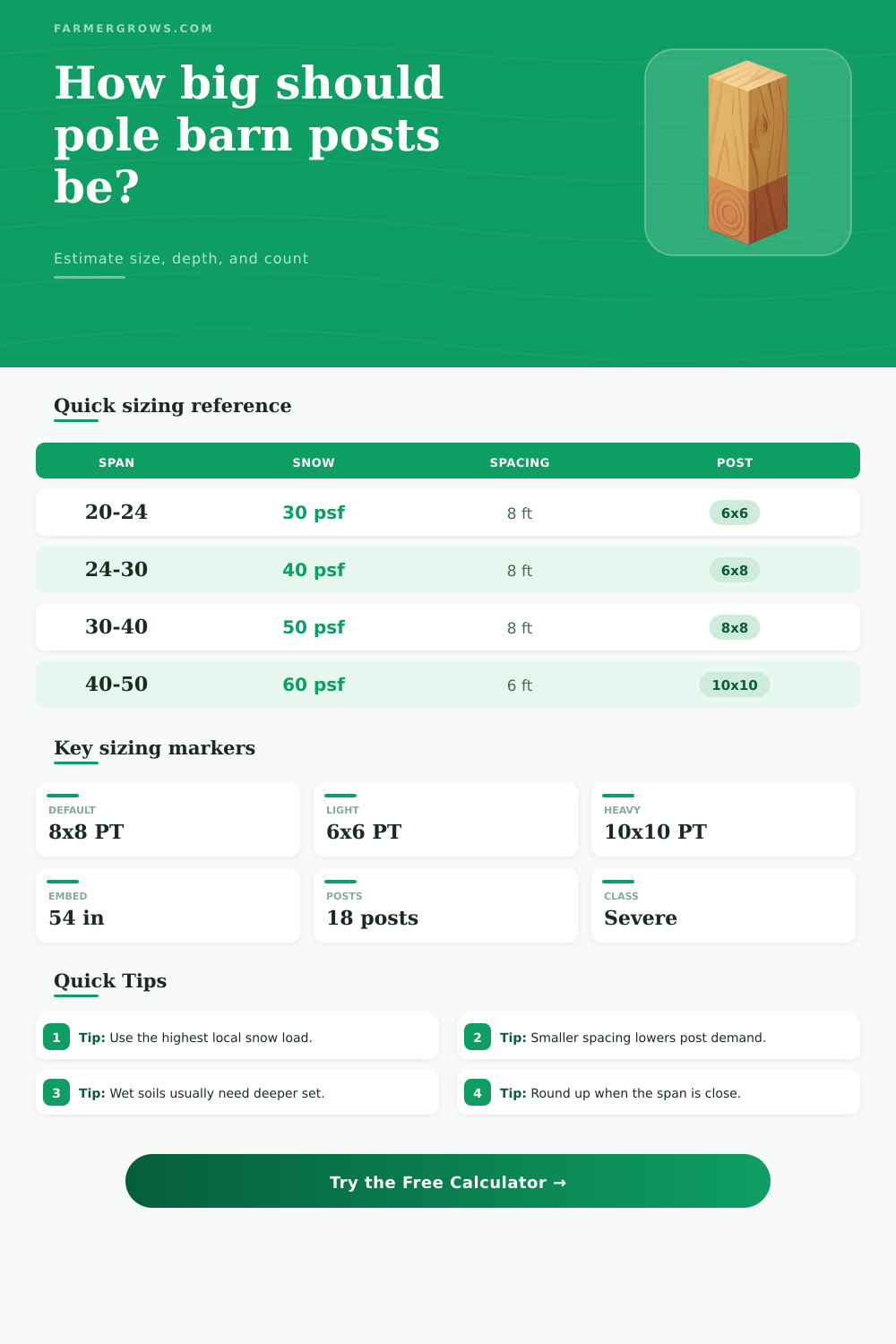
The span of the barn will play a significant role in determining the size of the posts that is required for the barn. A barn with a 20-foot span may only require certain size of timbers to build the barn, but a barn with a 40-foot span will require larger posts to bear the additional weight. The taller the eaves of the barn, the more the force of the wind will impact the posts.
How to Choose the Right Posts for a Pole Barn
The snow load that falls on the barn will play a significant role in determining the size of the posts. In some instance, the snow load may not be even across the roof. Using conservative numbers for the snow load will ensure that the posts can handle the weight of the snow.
The location of the barn relative to the wind will affect the posts. In open fields, the posts will need to be larger than in valleys. The type of soil in which the builder will build the barn will also have an impact on the size of the posts.
In soils with clay, the posts will have a firm grip in the soil, but in wet soil, the posts will need to be buried deeper or the posts will be more thicker to prevent shifting in the ground. The spacing between the posts will play a critical role in determining the load on each of the posts. If the spacing between the posts is 12 feet, each of the posts will have to bear a significant amount of load.
However, if you space the posts 6 or 8 feet apart, the number of posts will increase, but the load on each of the posts will decrease. To find the total number of posts, divide the length and the width of the barn by the distance between the posts. This figure represent the number of posts for one side of the barn; double the number to get the total number of posts for the barn.
Another critical measurement to consider is the embedment depth of the posts. Many building codes require that the posts are buried at least 4 feet deep to allow for proper anchoring of the posts in the ground. The type of posts to use for the barn should be pressure treated to ensure that they will not rot due to contact with the wet ground.
For posts, 6×6 sizes are more common; however, using 8×8 posts will offer more support for the barn. A common mistake when building pole barns is using the wrong size for the posts. One of the most common mistakes is underestimating the snow load that the barn will receive.
In this case, the snow load should be rounded up to the highest number in the snow load table, especially if the barn is near the boundary between two snow load zones. Another common mistake is not considering the soil in which the barn will be built. If the soil is wet, the depth at which the posts are embedded into the ground will need to be increased.
Finally, the spacing measurements between the posts need to be rounded to a conservative number to allow the posts to be smaller in size. The dimensions of the barn, the snow load, the wind exposure, and the soil in which the barn will be built all impact the size of the posts for the barn. If the barn is wider, the posts will have to be larger to distribute the load.
If the spacing between the posts is smaller, the size of each individual post will be smaller. The placement of the windows and doors will impact the placement of the posts; the posts will need to be close placed to the doors and windows. Finally, the building codes and soil in the building area will vary from state to state and locality to locality within the nation.
To finalize the design of the barn, it is essential to consult with a local engineer or local building code for the specific area in which the barn will be built.