Pole Barn Calculator
Estimate footprint area, roof surface, post count, and concrete volume from a simple barn layout. Switch units, test presets, and compare shell options fast.
Pick a real-world barn shape to seed the calculator. Each preset sets length, width, wall height, pitch, spacing, holes, slab, and material so you can compare layouts in seconds.
Advanced layout controls
These refine the roof, posts, concrete, and cladding counts. Defaults stay practical for common pole barn builds.
Calculation Results
These values update from the selected barn size, roof pitch, spacing, and material system.
| Panel system | Wall weight | Roof weight | Notes |
|---|---|---|---|
| 29 ga steel | 0.80 lb/sq ft | 0.80 lb/sq ft | Lightest common shell |
| 26 ga steel | 1.10 lb/sq ft | 1.10 lb/sq ft | Heavier, stiffer panel |
| Board and batten | 2.30 lb/sq ft | 2.30 lb/sq ft | Thicker wood cladding |
| Insulated steel | 1.45 lb/sq ft | 1.45 lb/sq ft | Panel and foam core |
| Post spacing | 24 x 24 | 30 x 40 | 40 x 60 |
|---|---|---|---|
| 6 ft O.C. | 20 posts | 24 posts | 28 posts |
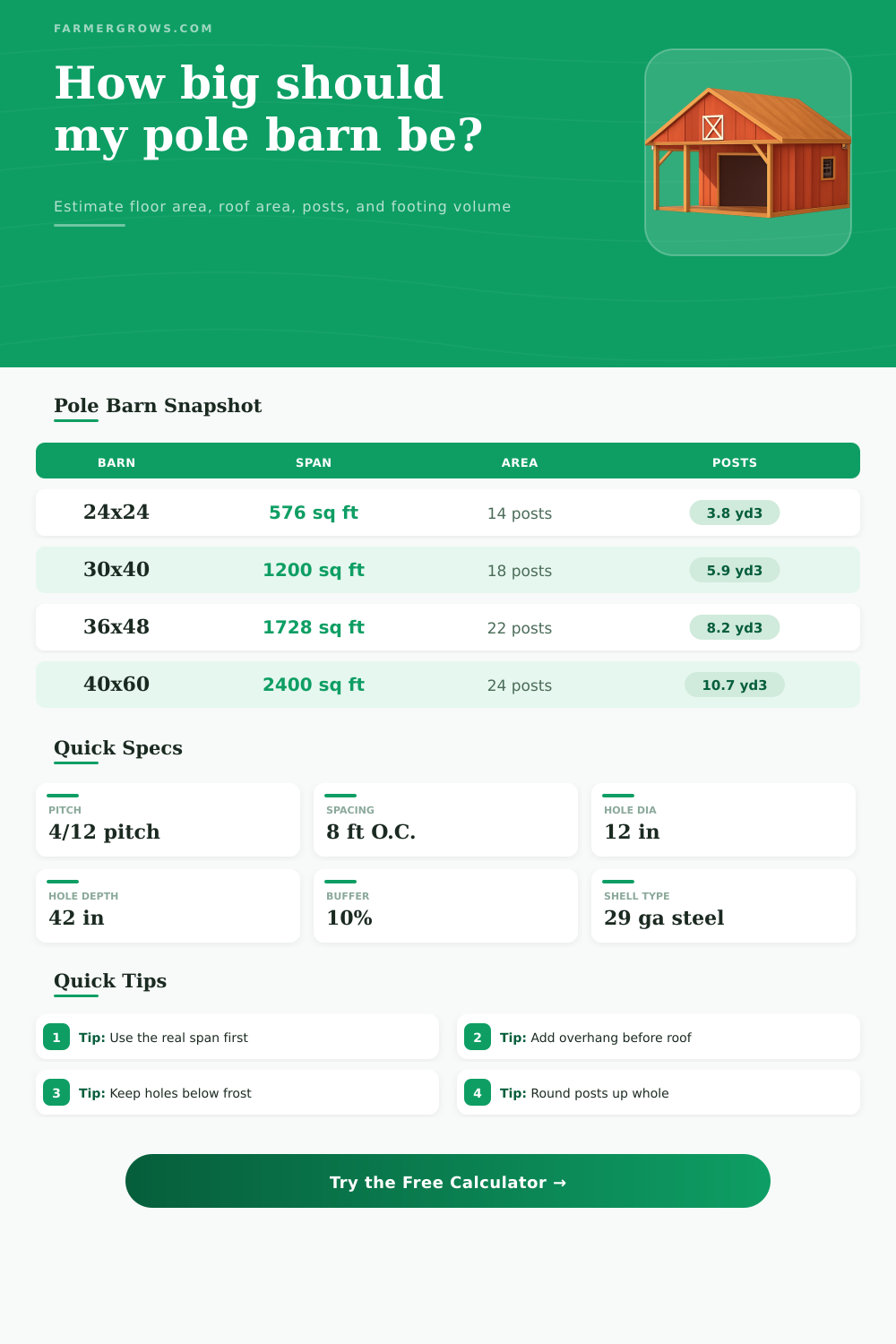
| 8 ft O.C. | 12 posts | 18 posts | 24 posts |
| 10 ft O.C. | 12 posts | 14 posts | 20 posts |
| 12 ft O.C. | 8 posts | 12 posts | 16 posts |
| Roof pitch | Rise / 12 | Slope factor | Use case |
|---|---|---|---|
| 3/12 | 3 in | 1.03 | Low slope shed |
| 4/12 | 4 in | 1.06 | Most barns |
| 5/12 | 5 in | 1.08 | Higher drainage |
| 6/12 | 6 in | 1.12 | Steeper shell |
| Hole size | Depth | Concrete / post | Use case |
|---|---|---|---|
| 12 in | 42 in | 0.20 yd3 | Light barn post |
| 12 in | 48 in | 0.23 yd3 | Deeper embed |
| 14 in | 48 in | 0.32 yd3 | Heavier shell |
| 16 in | 54 in | 0.47 yd3 | Large spans |
Building a pole barn involve measuring and performing calculations to ensure that the pole barn will be able to support weights and conditions that it will encounter. A pole barn is a type of barn that use treated posts that are anchored into the ground to help support the structure of the pole barn. To build a pole barn, the dimension of the pole barn must be carefully considered to ensure that the pole barn will be able to support snow loads and the weight of the equipment that will be within the barn.
If the span of the pole barn are constructed with the wrong materials or if the footings for the pole barn are insufficient, then the trusses of the pole barn may sag, and the footings of the pole barn may crack due to the ground heaving from the frost in the ground. The size of the pole barn determine how much space is within the barn for different uses. Its length and width create the footprint of the pole barn.
How to Plan and Build a Pole Barn
For instance, a pole barn with dimension of 30 feet by 40 feet may be sufficient for the parking of a few vehicle. A pole barn that is 40 feet by 60 feet, however, provides more space for livestock to roam within the structure. Because the perimeter of the pole barn of dimensions of 40 feet by 60 feet is larger than the pole barn of dimensions of 30 feet by 40 feet, the larger pole barn will require more post to support its structure.
You will place the posts every eight feet along the perimeter of the barn, and corners will always include a post. Small pole barns may require only twelve posts, while large pole barns may require up to twenty-four post. The distance between the posts will relate to the strength of the trusses within the pole barn.
The roof also need to have specific measurements to facilitate proper drainage of rain and snow from the barn. The pitch of the roof is the ratio of the rise of the roof to it’s run. A four-inch over twelve-inch rise is a common roof pitch for pole barns.
Steeper pitches will shed water good but will require more roofing material. The overhangs of the barns eaves will also increase the width of the barn. The height of the walls will determine the headroom for machinery within the pole barn.
The taller the barn walls are, the more headroom for machinery will be available within the pole barn. However, taller walls will use more siding for the barns walls. Lastly, concrete is necessary for the construction of the pole barns poles.
You can pour a slab of concrete under the pole barn floor to even out the ground for the barn. For the floor of the pole barn, a four-inch thick slab of concrete is often pour under the floor. Additionally, the posts will be placed into holes in the ground, and you will pour concrete into these hole to secure the poles of the pole barn.
A standard post hole is 12 inches in diameter and 42 inches in depth. Each post hole will take approximately one-fifth of a cubic yard of concrete to fill. Post holes must be dug deeper if the frost line is deep in your area.
In addition, if the pole barn will be supporting heavy shells, the pole barns posts must be wider. The materials used for the shell of the pole barn determine the weight and durability of the pole barn. If using light 29-gauge steel for the shell, the pole barn will be lighter in weight.
Use the heavier 26-gauge steel or the board and batten option if the pole barn will be exposed to more weather and need to be used in year-round environments. The weight of the shell of the pole barn affect the design of the trusses for the roof of the pole barn. As with many project, there are some mistakes that is made when planning a pole barn.
One of the most common is ignoring the depth of the frost line in your area. Another mistake is failing to account for overhangs of the barn, which will make the roof too small for the overhang and cause leaks. Always order materials with a 10 percent buffer to account for any error in cutting the siding for the barn.
Lastly, always subtract the area of doors and windows from the total area of siding for the pole barn. The site for the pole barn will affect the construction of the pole barn. For instance, the type of soil on the plot will determine the size of the posts for the pole barn.
Lastly, the site must allow for drainage that will drain away from the pole barn on its concrete slab to prevent rotting the sill of the barn. Another site consideration is the wind in the area, which will determine the spacing of the girts on the pole barn at 4-foot intervals. The structural component of a pole barn must be constructed in a specific order.
You will install the trusses at 12-foot intervals along the pole barn. Purlins will be installed on top of the trusses every two feet. Lastly, girts will be installed beneath the purlins.
These structural components will hold the panels and the metal roof of the pole barn flat. If constructed with the dimension, roof pitch, spacing of the poles, and required buffer for the building materials, a pole barn will last for many years.