Hydraulic Cylinder Cycle Time Calculator
Estimate extend time, retract time, full cycle time, and oil demand from bore, rod, stroke, flow, and dwell.
📦 Presets
🔧 Inputs
📈 Results
🧱 Cycle Spec Grid
📊 Reference Tables
| Bore | Area | Gal/In | 12 in stroke |
|---|---|---|---|
| 2 in | 3.14 sq in | 0.014 | 0.17 gal |
| 2.5 in | 4.91 sq in | 0.021 | 0.26 gal |
| 3 in | 7.07 sq in | 0.031 | 0.39 gal |
| 4 in | 12.57 sq in | 0.054 | 0.65 gal |
| Flow | Extend | Retract | Full |
|---|---|---|---|
| 4 gpm | 6.1 sec | 4.6 sec | 11.2 sec |
| 6 gpm | 4.1 sec | 3.1 sec | 7.7 sec |
| 8 gpm | 3.1 sec | 2.3 sec | 5.9 sec |
| 12 gpm | 2.0 sec | 1.5 sec | 4.0 sec |
| Job | Size | Flow | Cycle |
|---|---|---|---|
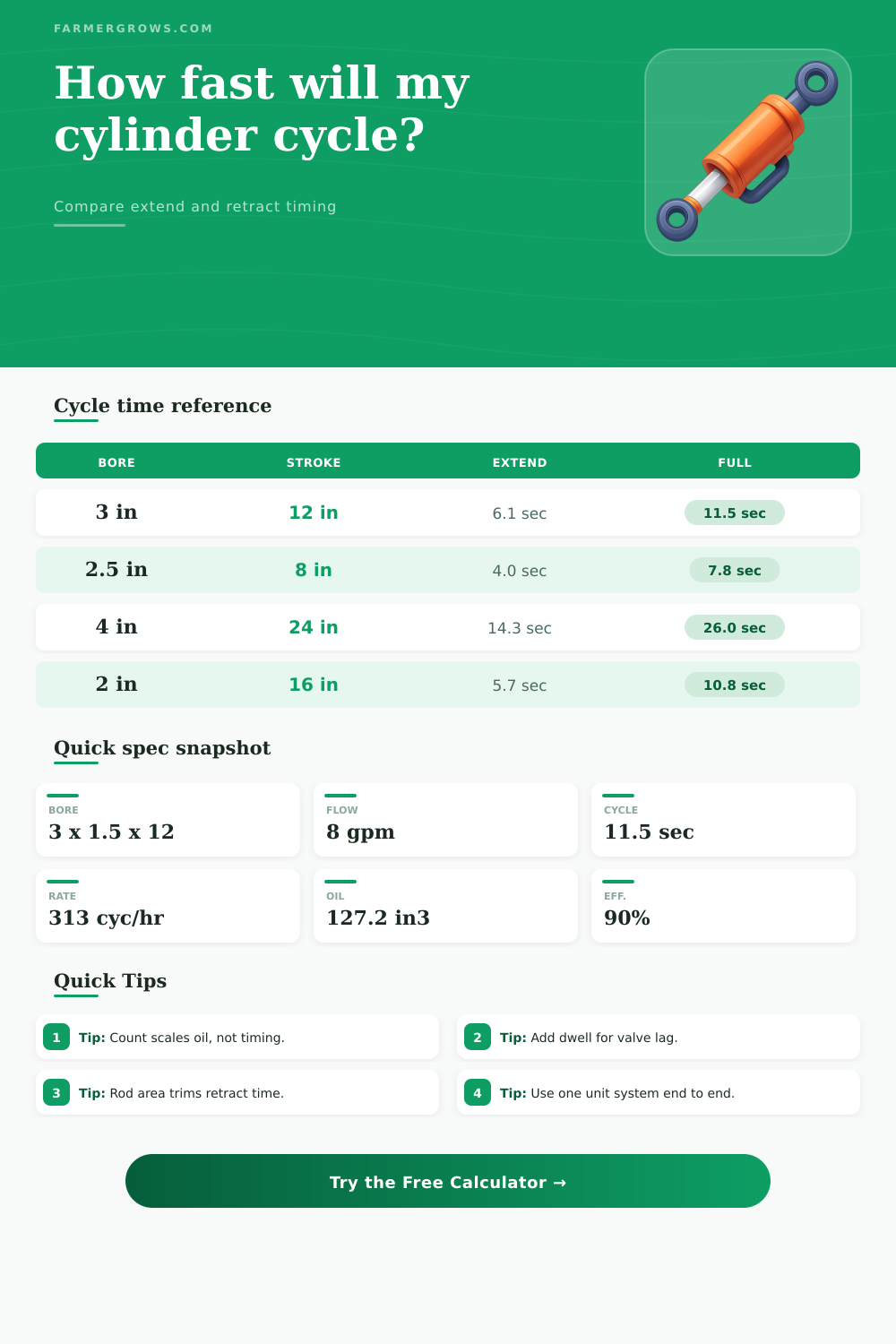
| Loader Curl | 3 x 1.5 x 12 | 8 gpm | 11.5 sec |
| 3-Point Lift | 2.5 x 1.25 x 8 | 4.5 gpm | 8.5 sec |
| Dump Hoist | 4 x 2 x 24 | 10 gpm | 17.8 sec |
| Log Splitter | 4.5 x 2.25 x 24 | 16 gpm | 10.7 sec |
| Measure | Imperial | Metric | Exact factor |
|---|---|---|---|
| Length | 1 in | 25.4 mm | x 25.4 |
| Flow | 1 gpm | 3.785 L/min | x 3.7854 |
| Volume | 1 gal | 3.785 L | x 3.7854 |
| Volume | 1 in3 | 16.387 cc | x 16.3871 |
💡 Practical Tips
Hydraulic cycle time is a measurement of the length of time it takes for a hydraulic cylinder to perform a complete cycle. A cycle of a hydraulic cylinder include the extension phase, the retraction phase, and a dwell period for the cylinder. If the cycle time of a machine that utilize hydraulic cylinders is too long, the machine will not be able to perform at it’s expected rate of speed.
Slow cycle times result from a mismatch between the flow rate of the hydraulic pump and the volume of oil that the hydraulic cylinders require to perform their work. The speed at which a hydraulic cylinder can perform its work is determined by the speed at which oil can be pumped into the chambers of the cylinder. The system pumps oil into the cap side of the cylinder during the extension phase.
Hydraulic Cycle Time and What Affects It
The volume of the cap side of the cylinder is calculate as the bore area times the stroke length of the cylinder. The system pumps oil into the annulus of the cylinder during the retraction phase. The annulus of the cylinder is the area of the cylinder that exists between the bore and the rod.
Because the annulus of the cylinder is smaller than the cap side of the cylinder, the retraction phase will always occur at a faster rate than the extension phase. A dwell period is the length of time that the hydraulic cylinder pause during its cycle. A dwell period can occur when the control valves must be shifted or when the loads on the hydraulic cylinder must settle.
Another factor that affect a hydraulic cycle time is the efficiency of the hydraulic system. Hydraulic systems are never 100% efficient and typically lose between 10% and 20% of the flow rate of the system due to friction and heat in the hoses. If the efficiency of a system is high, the hydraulic cylinder will move quick.
Conversely, if the efficiency of the hydraulic system is low, the cycle time will increase. The number of cylinders that are include within the hydraulic system will impact the cycle time. If a system utilize multiple cylinders, the system will require a greater volume of oil to perform each cycle.
If the system utilize cylinders that are in parallel, the cylinders will all move at the same speed but will require more oil from the hydraulic pump to achieve that rate of movement. In determining the cycle time of a hydraulic system, it is necessary to consider the bore size and the rod size of the cylinder. The larger the bore size of the cylinder, the more oil is required to extend the cylinder.
Thus, the larger the bore size, the slower the extension phase of the cycle. The larger the rod size of the cylinder, the larger the annulus of the cylinder. The size of the annulus impacts the speed at which the piston can retract from it’s extended position.
All calculations of cycle time should use a single unit system. For instance, if the bore size of the cylinder is measured in inches (imperial system), the flow rate should also be measured in imperial unit. Using another unit system will result in error in the calculation of cycle time.
Some components of the hydraulic system will have tradeoffs to others. For instance, using a larger bore in the cylinder allows for more force to be applied to the load, but at the cost of slower cycles. If the cycles are to be faster, the operator will have to increase the flow rate of the hydraulic pump.
However, increasing the flow rate will heat the oil within the cylinder and place more strain on the engine (or the prime mover). Using a thinner rod allows for the piston within the cylinder to move at a faster rate during the retraction phase. However, using a thin rod create a weaker component of the cylinder that is under compression.
A calculator can be used to determine the length of time that each phase of a cycle will take, as well as the total cycle time. The calculator will ask for the diameter of the bore of the cylinder, the diameter of the rod, the length of the stroke, the flow rate of the pump, the number of cylinders, the efficiency of the system, and the dwell time. Based off these variables, the calculator will provide the extension time, the retraction time, the total cycle time, and the total volume of oil that the cylinders use during each cycle.
Additionally, reference table are available to indicate how cycle time will change with a change in the flow rate. For instance, a table may indicate that if the flow rate is doubled, the cycle time will be cut in half. It is important to test a hydraulic system while the machine is under a load.
If hydraulic cycle times are test while the machine is idling, the cycle times may not accurately reflect the cycle times while the machine is in use. For instance, backpressure may slow the cycles. If the pump makes a whine noise while in operation, it may be undersized to handle the flow rate required by the cylinders.
If the oil within the system becomes too hot during operation, there may be a loss of efficiency of the system or the dwell time may be too long due to sticking valve. Finally, the cycle time must be continuously monitored to ensure that the machine remain productive.