🌾 Pasture Seed Per Acre Calculator
Estimate seed needed from paddock size, blend rate, germination, purity, depth, and buffer, then see bags and bulk volume at a glance.
Pasture Seed Results
Ready to calculate a pasture seeding plan.
Pasture Seed Rate Guide
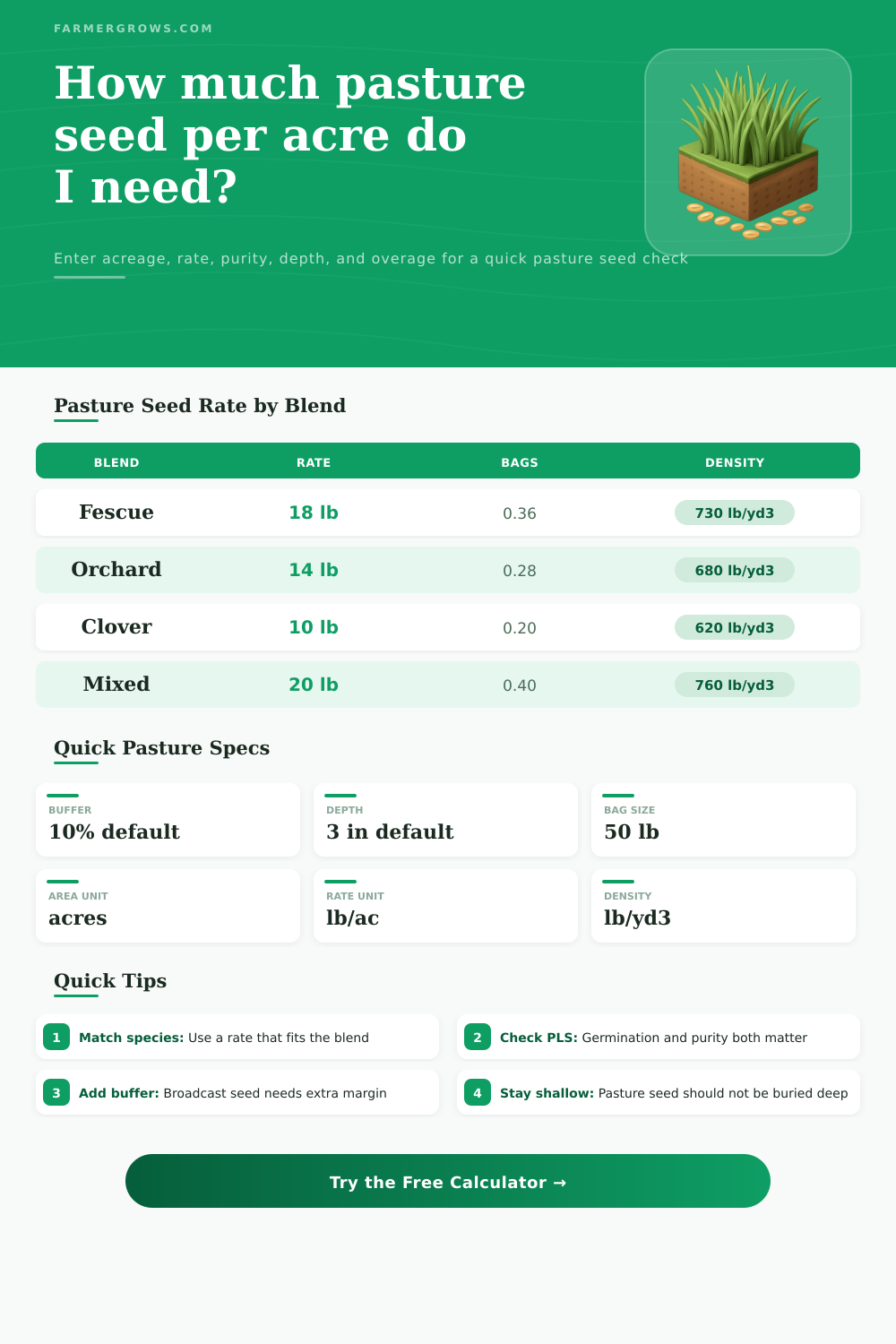
These example rates are useful starting points for common pasture blends. Always adjust for tag data, planting conditions, and local goals.
| Blend | Rate | 50-lb Bags | Density |
|---|---|---|---|
| Tall fescue | 18 lb/ac | 0.36 | 730 lb/yd³ |
| Orchardgrass | 14 lb/ac | 0.28 | 680 lb/yd³ |
| Perennial ryegrass | 22 lb/ac | 0.44 | 710 lb/yd³ |
| White clover mix | 8 lb/ac | 0.16 | 620 lb/yd³ |
Seeding Depth Guide
Pasture seed is usually placed shallow. Deeper settings can reduce emergence and increase the seed cushion needed for a reliable stand.
| Depth | Factor | Best For | Note |
|---|---|---|---|
| 1 in | 1.00 | Firm bed | Shallow |
| 2 in | 1.04 | Normal drill | Safe |
| 3 in | 1.08 | Loose cover | Common |
| 6 in | 1.20 | Heavy cover | Use care |
Bags vs Bulk Conversion
The calculator uses 50-lb bags as the primary reference and also shows the 25-lb bag equivalent for smaller jobs.
| Bag | Weight | Area @18 | Area @22 |
|---|---|---|---|
| Small | 25 lb | 1.39 ac | 1.14 ac |
| Standard | 50 lb | 2.78 ac | 2.27 ac |
| Bulk tote | 500 lb | 27.8 ac | 22.7 ac |
| Mini tote | 1000 lb | 55.6 ac | 45.5 ac |
Common Paddock Sizes
These examples show quick acreage planning for common pasture jobs and help check whether the calculated seed count looks sensible.
| Project | Area | Seed @18 | Bags |
|---|---|---|---|
| Small paddock | 1 acre | 18 lb | 0.36 |
| Horse run | 3 acres | 54 lb | 1.08 |
| Hay block | 8 acres | 144 lb | 2.88 |
| Full pasture | 20 acres | 360 lb | 7.20 |
To successfully plant seed in your pasture, you must calculate the correct amount of seed to be used in your area. If you dont put enough seed in your pasture, the weed will grow in those areas. However, if you use too much seed, you will waste the moneys that you will have to spend on purchasing the nessecary amount of seed.
To determine the amount of seed that you should plant in your acre, you will have to determine the size of your land and the requirements of the different types of seeds. The first step in determining how much seed to plant in your pasture is to determine the size of the area that you would like to seed. If your land is in the shape of a rectangle, measuring it is easy.
How Much Seed Do You Need for Your Pasture
However, pastures can have irregular shapes, such as triangles or circles, caused by fence lines. Calculating the area of your land will provide the square footage of the area that you would like to seed. From this measurement, you can calculate how many acre of land you posses.
This will allow you to calculate how many pounds of seed you will need to plant in your pasture. Not all types of seed require the same amount of seeding in your pasture. For example, tall fescue require approximately 18 pounds of seed per acre.
This type of grass grows more faster than other types of grass, such as white clover, which requires half of the amount of seed because it will spread once it is established in the ground. Therefore, knowing the type of seed that you will use will determine how many pound of seed you should use in your pasture. Additionally, you should also consider the quality of the seeds by looking at the tag that is included in the bag of seed.
This will tell you the germination rate of the seed and the purity of the seed. The germination rate will allow you to determine the percentage of the seed that will actualy grow, while the purity of the seed will tell you how much of the bag is the actual seed. To calculate the amount of pure live seed that will grow, you will have to multiply the germination percentage by the purity percentage.
This number will help you calculate the amount of seed that you need to plant in your pasture. You can also add 10% to this number to account for the amount of seed that birds may eat or the wind may blow away before it can be planted in your pasture. However, the depth that you choose to plant your seeds will also play a significant role in how many pounds of seed you will need to use in your pasture.
Most seed require a depth of one to two inches for the best growth. If you plant the seeds too deep into the ground, they may not be able to grow. You may also have to change the amount of seed based on the type of seed spreader that you will use to plant the seeds.
If you use a broadcast spreader, you will have to add more seed because the spreader will not ensure that each seed of your seed bag makes contact with the soil. However, if you use a drill to plant the seeds, you will have to use less seed because the drill will ensure that the seeds are planted close to the soil. You will also have to consider the type of soil that you will be planting the seeds in your pasture.
Clay soil retains the moisture in the soil that is necessary for the seeds to germinate and grow. However, sandy soil will dry out of the standing water that is necessary for the seeds to grow. Therefore, sandy soil may require a heavier seeding rate.
The type of livestock that will use the pasture also has an impact on the type of seed that should be planted in the pasture. For example, cattle will eat the tall fescue that is planted in the pasture, but horses may prefer orchardgrass or timothy grasses because they are more soft to eat. Additionally, if you would like to plant clover into the pasture, the clover will add nitrogen to the soil.
However, planting too much clover may cause bloat for the livestock that live in the pasture. Therefore, you must choose the correct type of seed based on the animals that will live in the pasture. Before you begin to plant the seeds in your pasture, you should perform a soil test on your land.
The soil test will tell you the ph level of your soil. Grass grows best in soil with a ph level between 6.0 and 7.0. If your soil has a ph level that is too acidic, you will have to add lime to your soil to even the ph level.
The soil may also require additional phosphorus to help the roots of the grass grow or additional potassium to allow the grass to be drought resistant. The soil should contain the nutrients necessary to help the grass seeds grow. If the soil does not contain these nutrients, the grass will not grow well.
Finally, once you have calculated the amount of seed that you will need for your pasture, you must also calibrate your spreader for even distribution of the seed. To calibrate your spreader, simply walk your test acre to ensure that your spreader is releasing the appropriate amount of seed. Once you have measured your land, purchased the correct amount and quality of seed, and calibrated your seed spreader, you can begin to prepare and plant the seeds in your pasture.
You should of checked the soil first.