Pasture Cover Calculator
Estimate area, depth, volume, and bag counts for paddocks, runs, and pasture refresh work.
📌Quick Presets
⚒Calculator Inputs
Pasture cover results
Full breakdown
🌱Material Weight Grid
📑Reference Tables
| Depth | Cu ft per yd | Sq ft per yd | Sq m per yd |
|---|---|---|---|
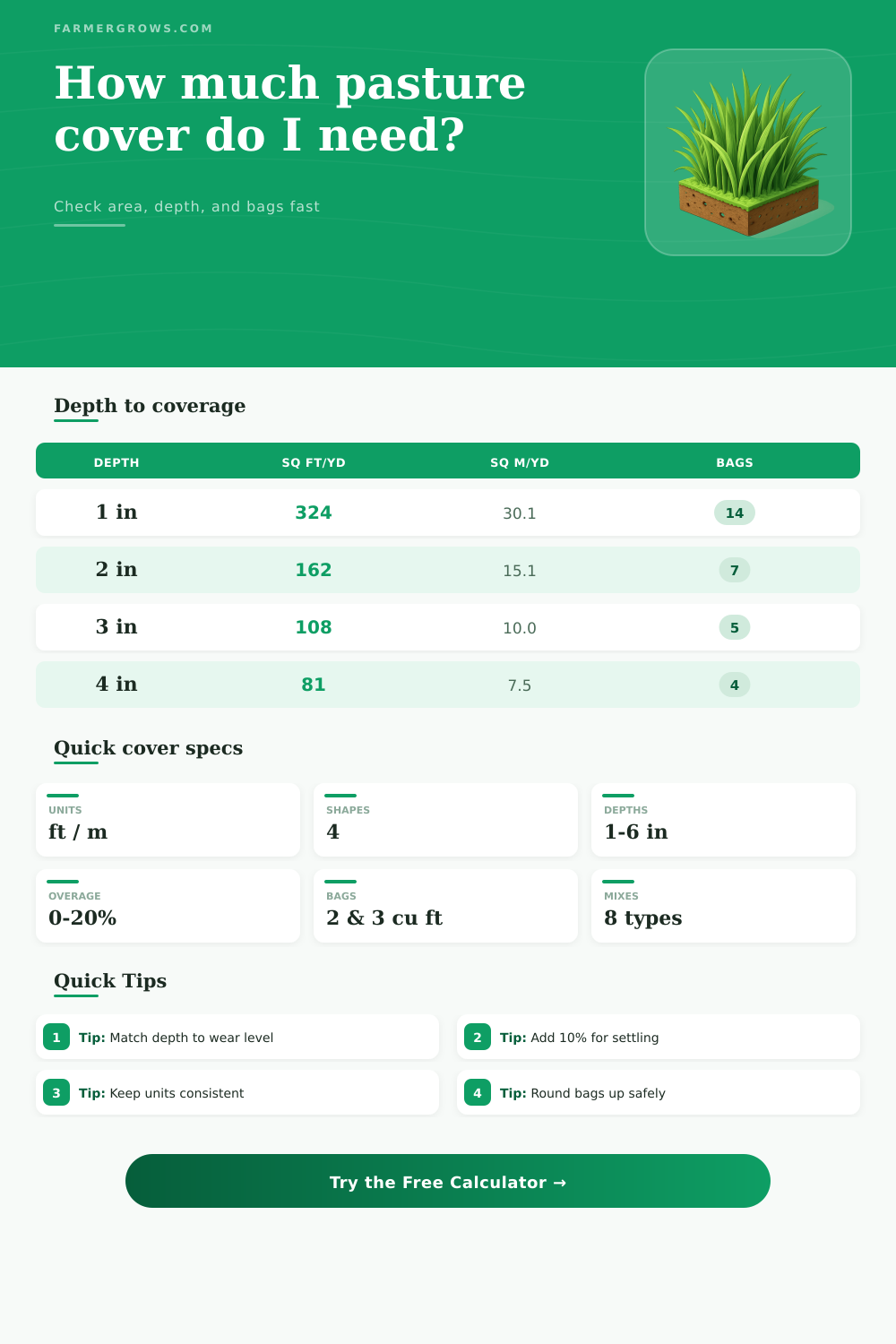
| 1 in | 27 | 324 | 30.1 |
| 2 in | 54 | 162 | 15.1 |
| 3 in | 81 | 108 | 10.0 |
| 4 in | 108 | 81 | 7.5 |
| 6 in | 162 | 54 | 5.0 |
| Bag type | Volume | Bags per yd | 3 in cover |
|---|---|---|---|
| 2 cu ft bag | 2 cu ft | 13.5 | 24 sq ft |
| 3 cu ft bag | 3 cu ft | 9.0 | 36 sq ft |
| Bulk yard | 27 cu ft | 1.0 | 324 sq ft |
| Half yard | 13.5 cu ft | 2.0 | 162 sq ft |
| Pasture project | Typical area | 3 in yards | 2 cu ft bags |
|---|---|---|---|
| Small paddock | 40 x 60 ft | 2.2 | 30 |
| Horse run | 20 x 20 ft | 0.7 | 10 |
| Round pen | 50 ft dia | 1.8 | 24 |
| Pasture strip | 30 x 18 m | 21.4 | 290 |
| Material | Low lb/yd | High lb/yd | Best use |
|---|---|---|---|
| Screened topsoil | 2200 | 2600 | Leveling |
| Pasture compost blend | 1100 | 1500 | Feed and cover |
| Loam | 2000 | 2300 | Finish work |
| Sand dressing mix | 2600 | 3000 | Drainage |
Measure the widest usable area, then subtract gates, water trough pads, and hard exclusions before calculating cover.
For uneven paddocks, use the custom area mode and add a small buffer so you do not run short mid-spread.
Pasture cover is a material that you apply to a field in order to improve the condition of the ground within that field. Pasture cover can be used to fill in bare spots within a pasture, as well as to help mitigate the mud that can form in the low area within a pasture. When you apply pasture cover to a pasture, the pasture cover will help to both rebuild the firmness of the ground within the pasture, as well as help to nourish the soil within that pasture.
Overall, because pasture cover can improve the soil and the ground within a pasture, pasture cover will help to create healthier grazing condition for the livestock that live on that farm. The depth of the pasture cover that you apply to a field must be chosen according to the amount of damage that has been done to the ground within that pasture. For example, one inch of pasture cover may be applied to smooth the crack in the ground, but three inches of pasture cover may be needed to build the structure in areas where the livestock has chewed the ground.
How to Choose and Use Pasture Cover
An even deeper layer of pasture cover may be needed for a heavy renovation of the pasture. The depth of the pasture cover that is applied must be chosen according to the amount of damage that the livestock does to the ground. The type of material that is used for the pasture cover must be chosen based off the needs of the pasture.
For instance, sand mixes is used for areas that experience high traffic from the grazing animals. Compost blend are used in pastures that need an addition of nutrients to encourage the regrowth of the grass. Loam is a heavy type of pasture cover, whereas mulch is a lighter type of pasture cover.
Because the lighter type of cover will settle into the ground more quick than heavy pasture cover, it is recommended to add a buffer of between ten and twenty percent extra material when applying lighter pasture covers. Before buying pasture cover for a farm, it is necesary to measure the area of the pasture. The area can be measured with a tape measure to determine the number of square foot of the field that needs to be covered with pasture cover.
Any areas that are to be excluded from the pasture cover should be subtracted from the total area to be covered. For triangular area, the area is calculated by one half of the base of the triangle multiplied by the height of the triangle. Because fields are often of varying height, it is best to use an average depth for the pasture cover calculations.
Additionally, some extra pasture cover should of be purchased in case the calculated amount is not enough for the pasture. Pasture cover can be bought in bags or in bulk quantity. Small areas that require fixing can take two cubic foot bag of pasture cover, which are among the easiest to load into a truck.
Bulk quantities is best for larger areas, as they are cheaper per unit of area, but require a loader to spread the pasture cover. Based on the depth and area of the pasture that will be treated, it is possible to determine how many bag of pasture cover will be needed to cover the area. One yard of pasture cover at a depth of three inches will cover one hundred eight square feet.
This information can be used as a reference to calculate the amount of pasture cover that will be needed for a field. Such a calculation will help avoid any mistake when buying the pasture cover material. Common mistake when buying pasture cover include underestimating the area of the field by estimating it by sight rather than using the measurements described above.
Additionally, people sometimes under-estimate the depth of the pasture cover that will be needed. If the depth is underestimated, the pasture cover will be too thin to cover the field. A third common mistake is using the wrong type of pasture cover in areas of the field that require a different type of material.
Finally, when applying pasture cover, it is necesary to spread the pasture cover even over the field, rake it into the ground, and roll the pasture cover to ensure that the pasture cover makes contact with the ground. Healthy pasture covers provide a variety of benefit to the farm. For instance, pasture cover can increase the amount of forage that is available for the farms livestock.
Additionally, pasture cover prevents erosion of the soil that is used to grow the grass that the farms livestock eats. Furthermore, pasture cover helps to prevent health issue in the livestock, such as issues with their hooves that can be caused by walking on soggy ground. Additionally, the root of the grass will grow through the pasture cover, strengthening the grass.
By properly measuring the field, as well as by choosing the proper type of pasture cover, pasture cover will provide a lasting foundation for the land and the livestock that graze upon it.