Spring Bean Seed Rate Calculator
Estimate seed mass, seed count, and planting density for spring beans from plot size, spacing, germination, and seed weight.
| Bean class | Row spacing | In-row gap | Typical rate |
|---|---|---|---|
| Early drill | 15-18 in | 4-5 in | 140-170 kg/ha |
| On-time row | 18-24 in | 5-7 in | 150-190 kg/ha |
| Wide row | 24-30 in | 6-8 in | 130-175 kg/ha |
| Broadcast | Wide | Dense | 180-230 kg/ha |
| TSW | Seeds/kg | Seeds/lb | Bean note |
|---|---|---|---|
| 250 g | 4,000 | 1,814 | Small bean |
| 350 g | 2,857 | 1,296 | Medium |
| 450 g | 2,222 | 1,008 | Large bean |
| 550 g | 1,818 | 825 | Heavy lot |
| Row spacing | In-row gap | Plants/m2 | Seeds/ha |
|---|---|---|---|
| 15 in | 4 in | 167 | 666,667 |
| 18 in | 5 in | 120 | 480,000 |
| 24 in | 6 in | 83.3 | 333,333 |
| 30 in | 8 in | 50.0 | 200,000 |
| Field | Germination | Buffer | Note |
|---|---|---|---|
| Firm moist | 94-97% | 0-5% | Best start |
| Normal seedbed | 92-95% | 5-10% | Common |
| Dry topsoil | 88-92% | 10-15% | Add seed |
| Crusted/no-till | 84-90% | 15-20% | Watch loss |
Determining the correct seed rates is a necessary process for growing beans. By determining the correct seed rate, a person will ensure that the beans stand arent too thin or too thick. If a person plants too little seed, there will be gap between the plants that will allow weeds to grow in those gaps.
If a person plants too much seed, they will waste money on the excess amounts of seed that will not grow enough beans to make more higher yield. Bean plants require even coverage when growing the beans, so the person must consider these factors when determining the correct seed rate for there field. The density of the plants is another factor that a person must consider when determining the correct seed rate.
How Many Bean Seeds to Plant
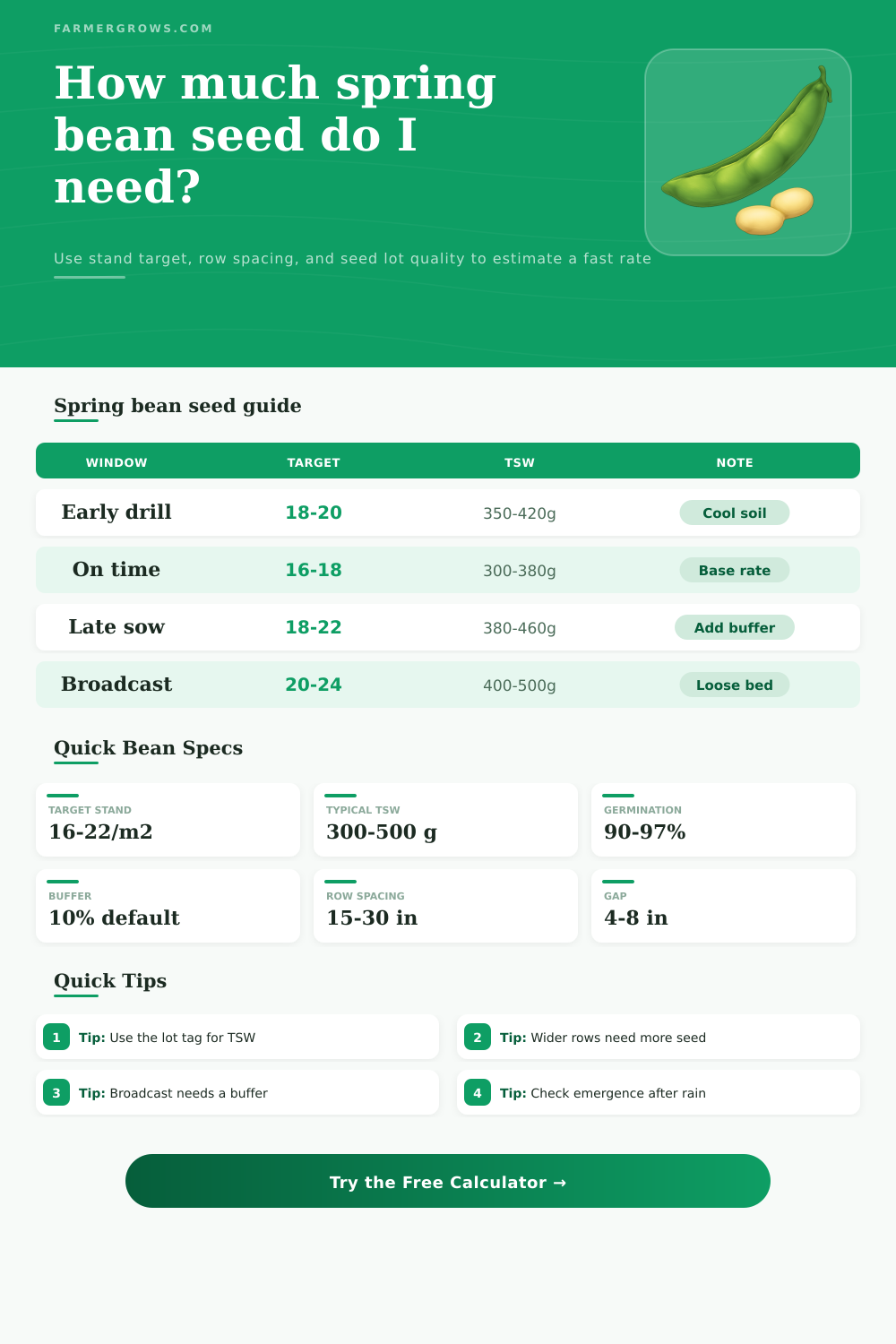
The goal is to have 16 to 22 plants per square meter. Too many plants will compete with each other for water and light, and there will be bare patches where the plants has too thin stand. Too few plants will also create the same problem in that there will be bare patches in the soil where the beans is grown.
A person must consider the different distances between the rows and the distance between each plant when determining the correct density of beans that a person will plant into the field. A person must also account for the difference between the amount of seed that is sown into the ground and the number of plants that will grow out of those planted seeds. The germination rate of the seeds will determine the number of plants that will emerge from the ground.
However, other factors such as birds, slugs, and crusty soil can prevent seeds from germinating and growing into plants. A person has to sow an additional 10% of seed to account for these variables to ensure that there are enough plants to form an even stand of beans. Another important measurement of the beans is the thousand seed weight or the TSW.
The thousand seed weight is the weight of one thousand seeds of the bean variety that a person is to be planted. The thousand seed weight will determine the number of seeds that are of a specific mass of seed. For instance, a small navy bean will have a lower thousand seed weight then a large kidney bean.
Therefore, a kilo of navy beans will contain more individual seeds than a kilo of kidney beans. If a person ignores this measurement, they will calculate the incorrect amount of seed that is needed for the field. A person must also consider soil condition and the time of year when planting the beans.
When drilling seeds into cool ground at the start of the season, 18 to 20 plants per square meter will be required to account for the slow rate at which the seeds will emerge from the ground in the cool conditions. If the sun warms the soil, 16 to 18 plants per square meter will grow sufficient into the soil. However, if the beans are planted later into the season, 22 plants per square meter will be required because the late planting of the beans will reduce the vigor of the plants.
The way in which a person plants the seeds will also change the amount of seed that the field will require. If a person chooses to broadcast the seeds, they will require 20 to 24 plants per square meter. This is because broadcasting the seeds into the ground will require more seed than drilling the seeds into the soil.
The rows created in the field will also impact the amount of seed that will be required to cover the field with sufficient plants. The length and width of the field, the distance between the rows, and the thousand seed weight will impact the total weight of the beans that a person will require to sow into the field. A person should also monitor the field in which the beans will be grown.
A person should go into the field and scout the area where the bean plants have emerged from the ground after sowing the seeds 7 days after sowing the seeds. At this stage, the person can determine if the plants are too crowded or too sparse. If there are too many plants, the person can thin out the plants.
However, if there are too few plants emerging from the ground, the person will have to overseed the field to ensure that there are enough plants to produce the desired stand of beans. By calculating the correct seed rate, a person insulate themselves against the negative effects of different environmental variable. Additionally, by calculating the correct amount of seed to sow into the ground, a person can control and maintain their stand of beans throughout the growing season.