🌾 Grain Drill Calibration Calculator
Calculate your exact seeding rate in lbs/acre — enter drill specs, catch weight & strip length
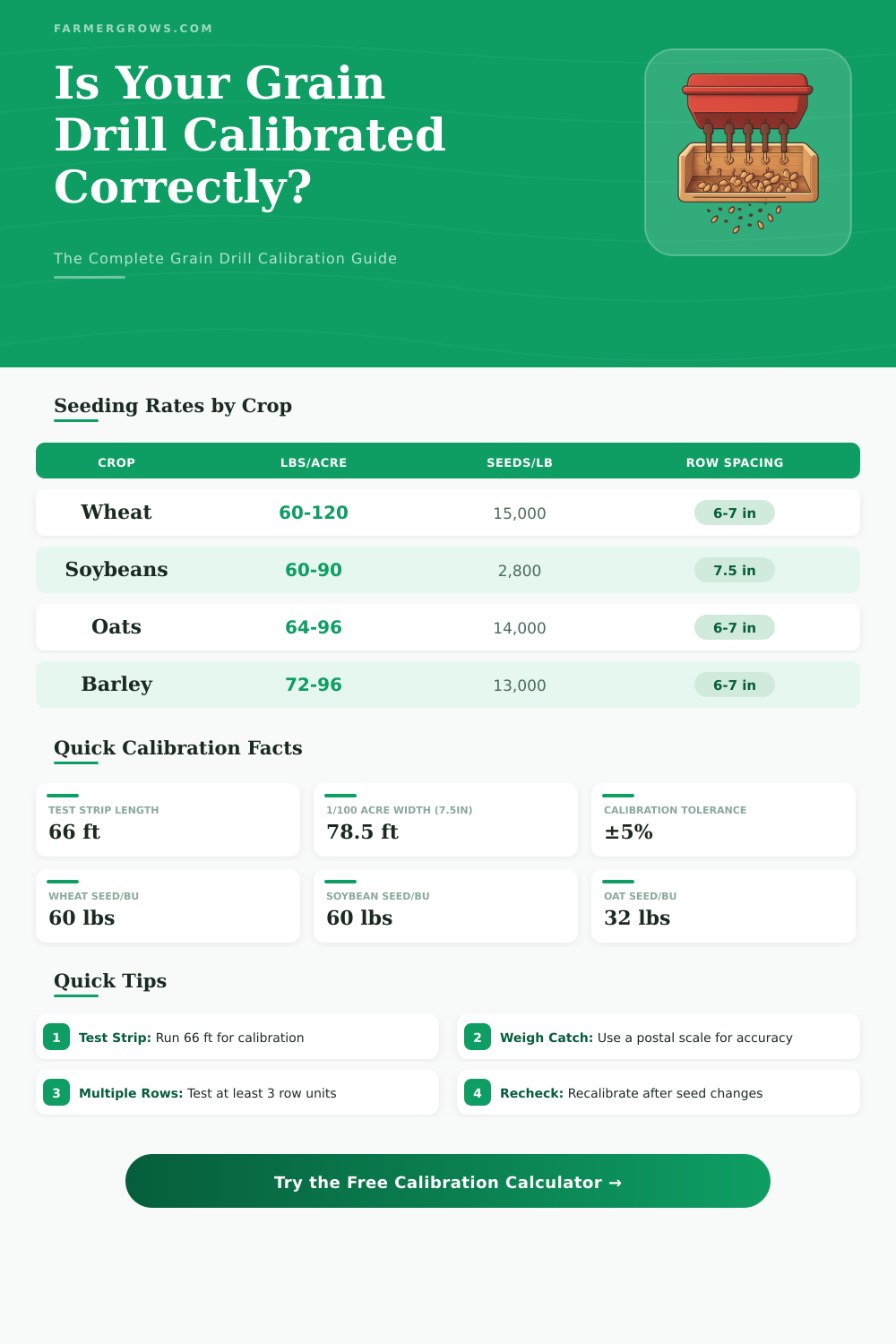
| Row Spacing (in) | Strip Length (ft) | Strip Area (sq ft) | Fraction of Acre | Multiply Catch by |
|---|---|---|---|---|
| 6 in | 66 ft | 33 sq ft | 1/1,320 | 1,320 |
| 7.5 in | 66 ft | 41.25 sq ft | 1/1,056 | 1,056 |
| 7.5 in | 100 ft | 62.5 sq ft | 1/696.96 | 697 |
| 10 in | 66 ft | 55 sq ft | 1/792 | 792 |
| 12 in | 66 ft | 66 sq ft | 1/660 | 660 |
| 15 in | 66 ft | 82.5 sq ft | 1/528 | 528 |
| 19.5 in | 66 ft | 107.25 sq ft | 1/406 | 406 |
| 30 in | 66 ft | 165 sq ft | 1/264 | 264 |
| Crop | Seeds per Pound | 1,000 Seed Wt (g) | Typical Seeding Rate |
|---|---|---|---|
| Winter Wheat | ~15,000 | 28–45 g | 60–120 lbs/ac |
| Spring Wheat | ~15,000 | 28–40 g | 60–90 lbs/ac |
| Soybeans | ~2,800 | 140–220 g | 60–90 lbs/ac |
| Oats | ~14,000 | 30–40 g | 64–96 lbs/ac |
| Barley | ~13,500 | 33–45 g | 72–96 lbs/ac |
| Canola | ~150,000 | 3–6 g | 3–7 lbs/ac |
| Ryegrass | ~220,000 | 2–2.5 g | 10–30 lbs/ac |
| Alfalfa | ~220,000 | 2 g | 10–20 lbs/ac |
| Grain Sorghum | ~15,000 | 28–35 g | 4–8 lbs/ac |
| Corn | ~1,300 | 280–380 g | Seeds counted/ac |
| Crop | Seeding Rate (lbs/ac) | Seeds/Acre (approx.) | Target Plants/Sq Ft |
|---|---|---|---|
| Winter Wheat | 90 lbs/ac | 1,350,000 | 25–35 |
| Soybeans | 70 lbs/ac | 196,000 | 4–6 |
| Oats | 80 lbs/ac | 1,120,000 | 25–35 |
| Barley | 85 lbs/ac | 1,147,500 | 25–35 |
| Canola | 5 lbs/ac | 750,000 | 15–20 |
| Alfalfa | 15 lbs/ac | 3,300,000 | 50–75 |
| Scenario | Row Spacing | Target Rate | Catch Weight (per row) |
|---|---|---|---|
| Winter Wheat — 66 ft strip, 6 rows | 7.5 in | 120 lbs/ac | ~0.114 lbs |
| Soybeans — 66 ft strip, 6 rows | 7.5 in | 70 lbs/ac | ~0.066 lbs |
| Canola — 66 ft strip, 6 rows | 7.5 in | 5 lbs/ac | ~0.0047 lbs |
| Oats — 66 ft strip, 8 rows | 6 in | 80 lbs/ac | ~0.061 lbs |
| Alfalfa — 66 ft strip, 8 rows | 6 in | 15 lbs/ac | ~0.011 lbs |
Every farmer should calibrate his grain drill each spring. Like this he ensures that the right seed rate will be used. If too many seeds per acre, the costs will grow, while too few seeds cause weak stands and weed competition.
Getting it right matters here
How to Calibrate a Grain Drill
For calibrate drill, you require some tools. These include a bin to catch seeds, tape measure for estimate the circumference of the drive wheel and the spacing between disks, flags for mark the spots of start and finish for calibration on field, flat surface or bottle jack for stationary testing and scale with accuracy of 0.1 grams.
The working width you count by multiplying the spacing between seed openers by the number of openers on the drill. Typical area for calibration is 2000 square feet, so 200 feet long and 10 feet wide. For find the part of acre, divide 2000 by 43560, that gives around 0.046 acres.
Later count the number of revolutons of the drive wheel during travel that distance.
For find the revolutions, measure the circumference of the drive wheel in feet and divide 150 by that value. It is this simple!
Using wire flags, field paint or some visible mark, measure and point the calibration distance on typical soil for crops. Engage the drive mechanism of the drill, drive in the wanted pace, start correctly at the first mark and go until the finish. The testing ensures seed collection for 1/100 of acre, so the weight you multiply by 100 for have the dose in pounds for acre.
At many drills, after reach the desired dose, you close the jam nut for set the adjusting rod. The chart on drill is only a guide. The dose that it shows for a particular position commonly is too low.
For instance, if it points 100 pounds for acre, really it could be only 70 pounds according to the seed. Good records help to avoid mistakes over time. Old drills commonly lack charts, or the seed is not listed here.
A seeder meter removes the need of wild attempts.
After calibration, you should control the dose through some acres. Modern grain drills have an acre meter. Note the amount of seed and divide the used amount by the planted acres.
Like this you find the real dose. One farmer calibrated his drill for rye last autumn and planned to repeat for oats this spring, attentively considering varieties, fertility and plant populations for better grain quality and output.