🌾 Combine Acres Per Hour Calculator
Calculate your combine's field capacity based on header width, ground speed, and field efficiency
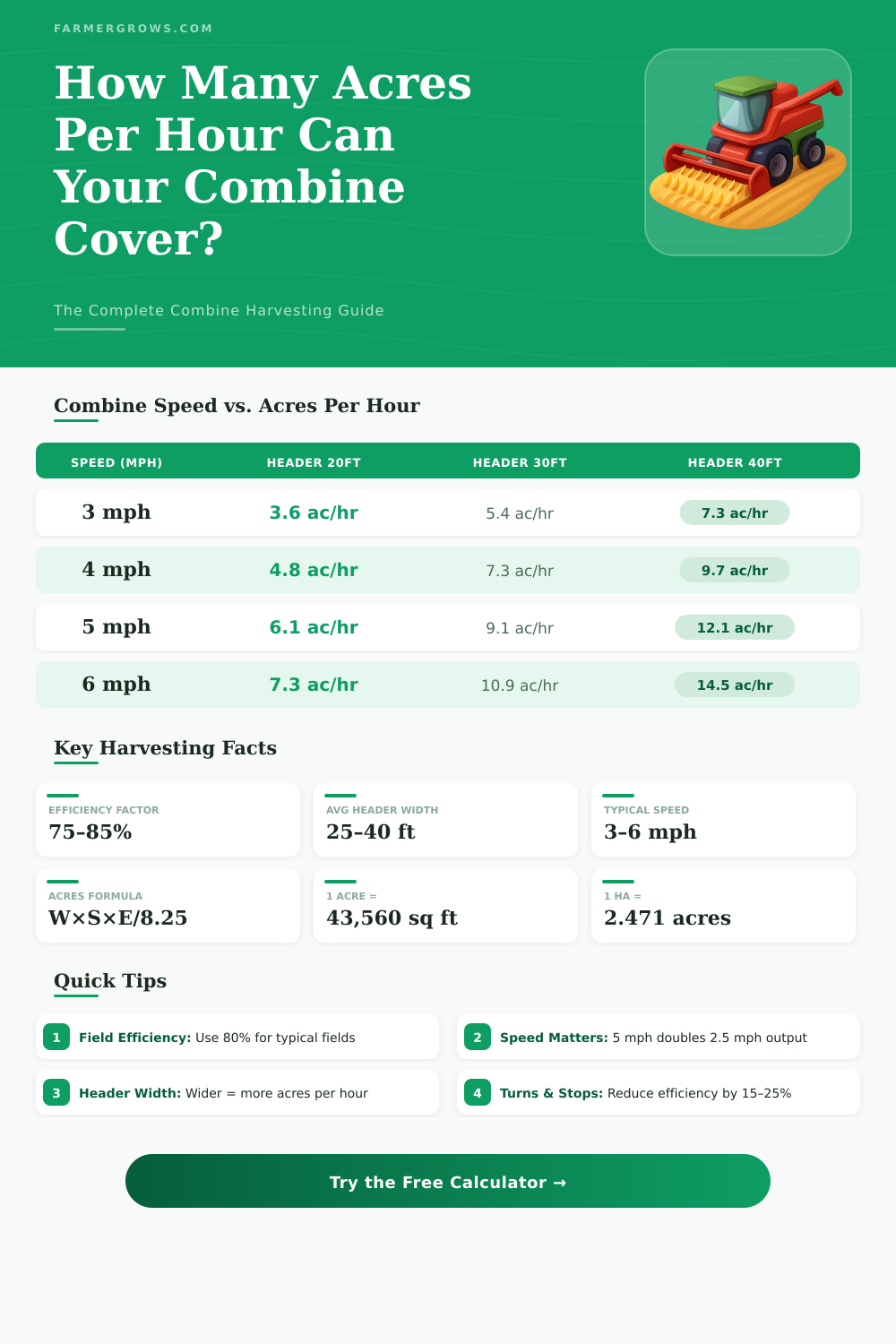
| Header Width | 3 mph / 4.8 km/h | 4 mph / 6.4 km/h | 5 mph / 8 km/h | 6 mph / 9.7 km/h |
|---|---|---|---|---|
| 20 ft / 6.1 m | 2.9 ac/hr | 3.9 ac/hr | 4.8 ac/hr | 5.8 ac/hr |
| 25 ft / 7.6 m | 3.6 ac/hr | 4.8 ac/hr | 6.1 ac/hr | 7.3 ac/hr |
| 30 ft / 9.1 m | 4.4 ac/hr | 5.8 ac/hr | 7.3 ac/hr | 8.7 ac/hr |
| 35 ft / 10.7 m | 5.1 ac/hr | 6.8 ac/hr | 8.5 ac/hr | 10.2 ac/hr |
| 40 ft / 12.2 m | 5.8 ac/hr | 7.8 ac/hr | 9.7 ac/hr | 11.6 ac/hr |
| 45 ft / 13.7 m | 6.5 ac/hr | 8.7 ac/hr | 10.9 ac/hr | 13.1 ac/hr |
ℹ Values calculated at 80% field efficiency. Actual capacity varies with terrain, crop density, and moisture.
| Condition | Efficiency | Acres Lost/hr (30ft@5mph) | Cause |
|---|---|---|---|
| GPS Auto-Steer, large flat fields | 88–92% | 0.6–0.9 ac | Unloading, service stops |
| Large, flat, regular fields | 83–88% | 0.9–1.5 ac | Turns, minor delays |
| Typical production fields | 77–83% | 1.5–2.0 ac | Turns, obstacles, unloading |
| Irregular or hilly terrain | 70–77% | 2.0–2.7 ac | Speed variation, turns |
| Very rough or small fields | 60–70% | 2.7–3.7 ac | Frequent stops, obstacles |
| Field Size | 6 ac/hr (1 combine) | 9 ac/hr (1 combine) | 9 ac/hr (2 combines) | 12 ac/hr (1 combine) |
|---|---|---|---|---|
| 200 acres / 81 ha | 3.3 days | 2.2 days | 1.1 days | 1.7 days |
| 500 acres / 202 ha | 8.3 days | 5.6 days | 2.8 days | 4.2 days |
| 1,000 acres / 405 ha | 16.7 days | 11.1 days | 5.6 days | 8.3 days |
| 2,000 acres / 809 ha | 33.3 days | 22.2 days | 11.1 days | 16.7 days |
| 5,000 acres / 2024 ha | 83.3 days | 55.6 days | 27.8 days | 41.7 days |
ℹ Based on 10 productive hours per day. Adjust proportionally for your available daily hours.
Combine productivity rate is a key idea in farming. It looks at how much output a combine harvester can produce compared to the inputs needed to run it The combine harvester has greatly reduced the time and work needed for harvest, so farmers can cover more land in less time. This grew the yields and sank the costs.
In farming you commonly count productivity by total factor productivity, or TFP. This estimates the output of agricultural products from the combination of land, work, capital and materials used in farm production. It seizes the increase that does not explain changes in the amount of work and capital.
How combine harvesters and technology make farms more productive
So, if a farm uses more machines and less hand labor per unit, the output each hour should rise. Even so multifactor productivity will not necessarily grow, because the total input rises as the produceitnon.
GPS-guided navigation systems help to exactly plan harvest routes and avoid overlap. This sinks the fuel use and time, while you cover more area. Yield monitoring sensors give data in real time about the state of crops, so farmers can adapt their methods for best results.
Simple analytics gather useful info about field outputs and soil quality.
John Deere‘s Combine Advisor has features like HarvestSmart, which automatically rules the feedrate by means of AI algorithms, to optimize the activities and output. It operates by means of precise separation of unwanted material from the grains.
Human-robot collaboration systems let workers lead sets of robots, which strengthens productivity by 40 %. AI-driven predictive maintenance use sensor data and neural nets to service machines, like this lowering failures by 25 %. The possibility to receive data in real time and immediately correct makes modern combines ideal for farmers, who base on data decisions.
Combines probably will move to specialty fields. Basically, if you have a combine, the return on investment is so low that you must use it almost constantly for profit. So one farmer buys it and harvests all local fields.
Technologies for remote monitoring help to optimize the use of resources and increase outputs. They maximize productivity and sustainability by letting you do more with less. In country-level agricultural productivity growth is measured by exports versus imports of agricultural products, and a government that keeps high exports supports a stronger economic growthrate.