🚜 Tractor Tire Ballast Calculator
Calculate ballast fluid volume, weight, and fill level for any tractor tire size
lbs per gallon
lbs per gallon
lbs per gallon
lbs per gallon
lbs per gallon
lbs per gallon
Fill Level
US Gallon
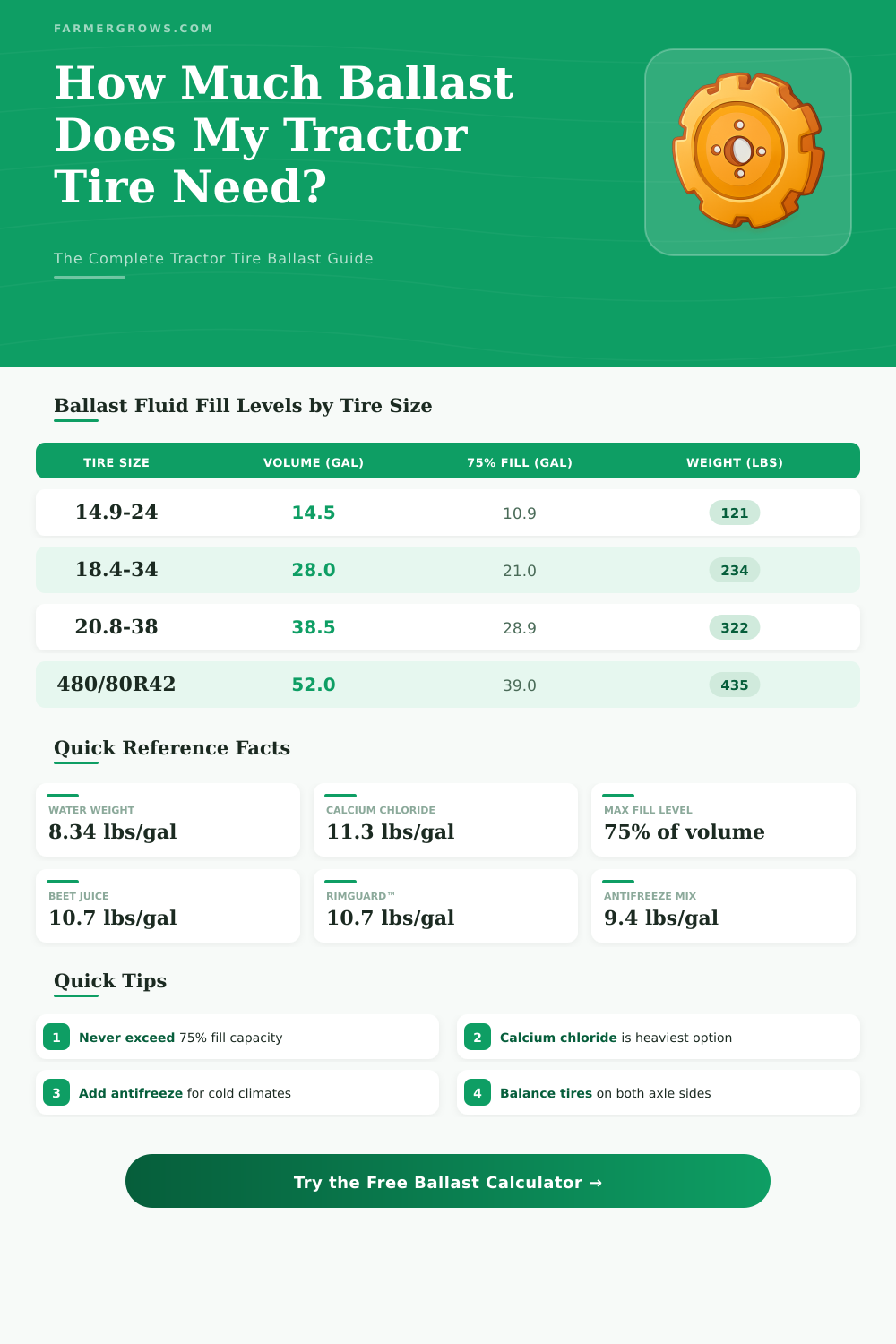
| Tire Size | Total Volume (gal) | 75% Fill (gal) | 75% Fill (L) | Weight w/ Water (lbs) | Weight w/ CaCl2 (lbs) |
|---|---|---|---|---|---|
| 11.2-28 | 7.8 | 5.9 | 22.3 | 49 | 67 |
| 13.6-28 | 11.2 | 8.4 | 31.8 | 70 | 95 |
| 14.9-24 | 14.5 | 10.9 | 41.3 | 91 | 123 |
| 16.9-30 | 21.0 | 15.8 | 59.8 | 132 | 179 |
| 18.4-34 | 28.0 | 21.0 | 79.5 | 175 | 237 |
| 20.8-38 | 38.5 | 28.9 | 109.4 | 241 | 326 |
| 320/85R28 | 22.0 | 16.5 | 62.5 | 138 | 187 |
| 380/85R34 | 33.0 | 24.8 | 93.8 | 207 | 280 |
| 480/80R42 | 52.0 | 39.0 | 147.6 | 325 | 441 |
| 710/70R42 | 85.0 | 63.8 | 241.4 | 532 | 721 |
| Fill Level | % of Volume Used | Example: 28 gal tire (gal) | Water Weight (lbs) | CaCl2 Weight (lbs) | Notes |
|---|---|---|---|---|---|
| 50% | Half full | 14.0 | 117 | 158 | Light ballast |
| 60% | Moderate | 16.8 | 140 | 190 | Common light use |
| 70% | High | 19.6 | 163 | 221 | Good balance |
| 75% | Recommended | 21.0 | 175 | 237 | Industry standard |
| 80% | Near max | 22.4 | 187 | 253 | Use with caution |
| 90% | Absolute max | 25.2 | 210 | 285 | Risk of rim damage |
| US Gallons | Liters | Water (lbs) | CaCl2 (lbs) | RimGuard (lbs) | Water (kg) |
|---|---|---|---|---|---|
| 5 | 18.9 | 42 | 57 | 54 | 19 |
| 10 | 37.9 | 83 | 113 | 107 | 38 |
| 15 | 56.8 | 125 | 170 | 161 | 57 |
| 20 | 75.7 | 167 | 226 | 214 | 76 |
| 25 | 94.6 | 209 | 283 | 268 | 95 |
| 30 | 113.6 | 250 | 339 | 321 | 114 |
| 40 | 151.4 | 334 | 452 | 428 | 151 |
| 50 | 189.3 | 417 | 565 | 535 | 189 |
Tractor tire ballast is one of the oldest and cheapest ways to improve the stability and traction of tractors. You add liquid in tractor tires as ballast when you started to use air tires. It helps better grip, lower the center of gravity of the tractor and balance heavy equipment.
That lower center of gravity really is useful for work on sloping ground.
How to Fill Tractor Tires with Liquid Ballast
The right amount of wheel and tire ballast matters because it fully uses the power of the tractor. If ballast too little, limits the weight of equipment and wagons that you can pull. That causes too much slipping of tires.
At low ballast happens too much slipping. Around 5 to 15 percent slipping are normal with 8 percent as ideal. Too much slipping grows fuel use, shortens work time and quickly wears tires.
Tire ballast use mainly for mowing or pulling up hills while frame ballast as a ballast box or weight helps to reduce tractor wear and backward tipping of equipment or front loaders. Back ballast is useful during work with front loader because it moves weight away from the front tires.
There are several liquid ballast options. Water is the easiest to add in tires. Calcium chloride commonly used, but it can rust rims.
A drum of 55 gallons of calcium chloride costs several hundred dollars. Methanol does not corrode rims as solution of calcium chloride. Some use window washer fluid for a windshield as ballast.
Rim Guard is natural liquid ballast from by-product of sugar beet processing. It maximizes pull, helps lifting and reduces risk of tipping. Bio-Ballast no thickens in cold and stays without slush until -30 degrees Fahrenheit.
Fill tires by means of liquid usually done with tube tires instead of tubeless, because here the liquid does not touch directly the rims. Inner tube protects against corrosion until leak happens. Tires should not one fill completely.
Ninety percent are the maximum.
While filling the valve stem stand in the 12-hour position. For gravity filling, keeps you the bucket with ballast above the tire and connect by means of hose. Pumping are much more quickly than gravity draining.
Weight in tires well helps for front loaders and all-around traction. Good management of ballast and tire pressure maximizes pull, lessens compaction and extends the life of tractor drivetrain.